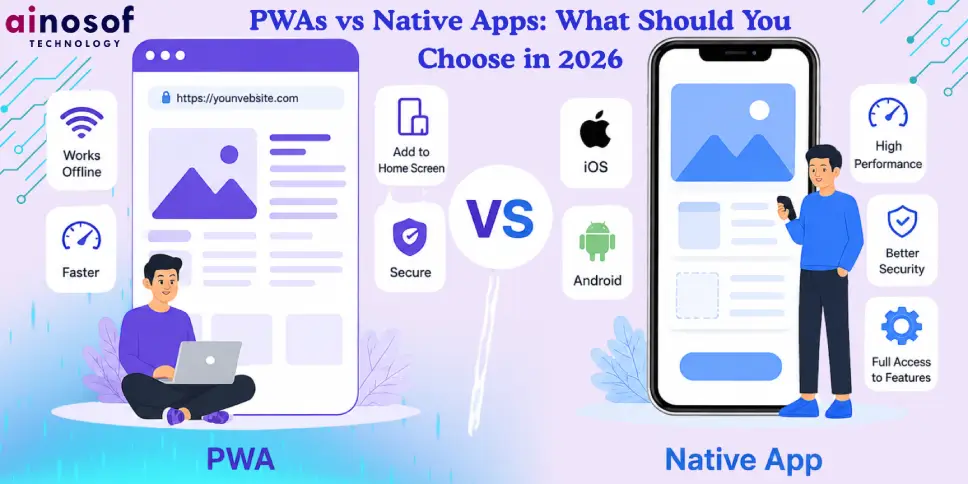

Workflow Automation Software: How It Saves Time for Growing Businesses
 Iram
Iram


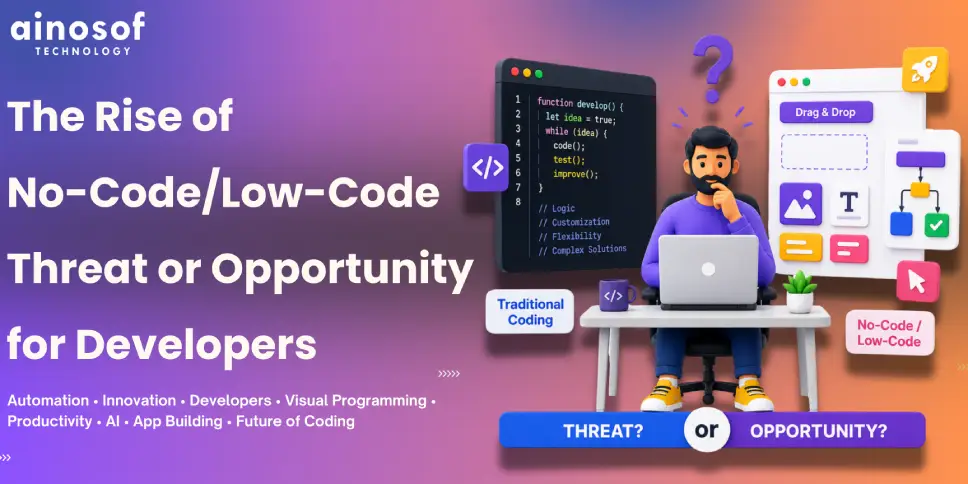
walk through the gleaming office parks of Gurgaon's Cyber City or down the busy industrial stretches of Bhiwadi's economic zones, and you'll find a quiet revolution unfolding on laptops across industries. Marketers are spinning up customer portals. Operations managers are automating procurement workflows. HR teams are designing onboarding apps — all without writing a single line of code. The no-code and low-code movement has arrived in India's enterprise corridor, and it's asking a pointed question of every developer: are you obsolete, or are you more essential than ever?
The answer, as with most transformative shifts in technology, is far more nuanced than the headlines suggest. No-code and low-code platforms are genuinely disrupting how software gets made. But the disruption is not the kind that eliminates developers — it's the kind that redefines what great development looks like.
No-code platforms like Bubble, Webflow, and Glide allow non-technical users — business analysts, designers, entrepreneurs — to build functional applications using drag-and-drop interfaces and visual logic builders. Low-code platforms like OutSystems, Mendix, and Microsoft Power Platform go a step further, offering customizable components that developers can extend with code when necessary.
For businesses in Gurgaon's financial and BPO sectors, these tools offer a compelling proposition: faster time-to-market, reduced dependency on stretched engineering teams, and the ability for domain experts to directly encode their knowledge into software. A supply chain analyst in Bhiwadi's manufacturing hub doesn't need to wait three months for IT to build her inventory dashboard — she can build it herself in an afternoon.
It would be dishonest to pretend no-code platforms don't threaten certain types of work. The simple CRUD application, the basic CMS-driven website, the straightforward internal tool — these categories of work are absolutely being absorbed by platforms that let non-developers produce them in days rather than weeks. If your entire development practice consists of building templated solutions for clients who don't need much customisation, the pressure is genuine.
The software companies of Gurgaon's DLF Cyber Hub and the tech-enabled manufacturers of Bhiwadi's industrial estates are already experimenting. Recruitment patterns show rising demand for "citizen developer" training programmes. Platform literacy is becoming a baseline expectation in non-technical roles.
But here's what those dramatic headlines miss: the complexity ceiling of no-code platforms is real and it hits fast. The moment a business requirement involves custom integrations, performance at scale, complex security logic, multi-tenant architectures, machine learning pipelines, or genuine UX sophistication — no-code tools either fail outright or produce unmaintainable spaghetti that a developer eventually has to untangle at great cost.
The smarter frame for any developer in 2025 is not "will platforms take my job?" but rather "how do I position myself above the platform ceiling?" Low-code democratises the bottom of the software stack. It has, paradoxically, made the top of that stack more valuable.

Consider the typical Gurgaon enterprise: a mid-size fintech or SaaS company with 200–1000 employees, competing for talent in one of India's most expensive hiring markets. These companies have every incentive to deploy no-code tools widely — they reduce dependency on scarce developer talent and accelerate internal operations. But they also have complex regulatory requirements (RBI compliance, data localisation), demanding performance SLAs, and custom integrations with banking infrastructure that no off-the-shelf platform handles.
The result is a hybrid model: citizen developers handle operational workflows on Power Apps or Zoho Creator; senior engineers focus on the core product, API layer, and security posture. Developers aren't eliminated — they're elevated. Their time is liberated from routine internal tooling and redirected to problems that actually require their skills.
Bhiwadi, Rajasthan's rapidly growing industrial hub bordering Haryana, presents a different dynamic. Manufacturing and industrial companies here are adopting low-code primarily for operational visibility — inventory systems, production tracking dashboards, vendor management portals. Many of these companies don't have large in-house tech teams; they rely on small IT departments or external vendors.
For developers serving this market, no-code tools are an opportunity to deliver more value faster. A developer who can configure and customize a low-code platform for a Bhiwadi manufacturing client — delivering a solution in two weeks instead of three months — is more competitive, not less. The developer who refuses to engage with these tools because they're "not real coding" is the one at risk.
The strategic response is not to ignore the shift or to pretend it's less significant than it is. The smart response is deliberate repositioning along three axes:
1. Develop platform fluency alongside engineering depth
Know how to use Bubble, Webflow, Power Platform, or Retool at a practitioner level. Understand their limitations deeply. This makes you a more useful advisor to the organisations deploying them, and it makes you the person who can step in when those platforms hit their ceiling.
2. Move up the complexity ladder
Invest in areas that platforms cannot address: distributed systems, security engineering, performance optimisation, developer tooling, AI/ML integration, and complex data architecture. The further you move from "standard application features," the safer your position.
3. Embrace the "developer as multiplier" model
Some of the highest-value developer work in the next decade will be enabling non-developers to work safely and effectively. Building internal platforms, designing component libraries for citizen developers, creating guardrails and governance systems — this is sophisticated engineering that requires both technical depth and organisational empathy.
No-code and low-code are not the end of software development as a profession. They are a redistribution of software creation — broadening participation while simultaneously raising the floor of what "professional development" means. In the context of India's tech economy, where cities like Gurgaon compete globally for engineering talent and industrial centres like Bhiwadi are digitising rapidly, this redistribution creates more opportunities than it forecloses.
The developers who will struggle are those who compete primarily on the ability to produce routine applications faster than a capable non-developer — because that race is largely lost. The developers who will thrive are those who go deeper, get broader, and position themselves not as implementers of requirements but as architects of digital capability.
At Ainosof, we work with businesses across the Gurgaon–Bhiwadi industrial corridor to navigate exactly this kind of strategic technology transition. The question for every development team is not whether to engage with the no-code wave — it's how to ride it intelligently.
The tools have changed. The need for the people who truly understand technology? More urgent than ever.
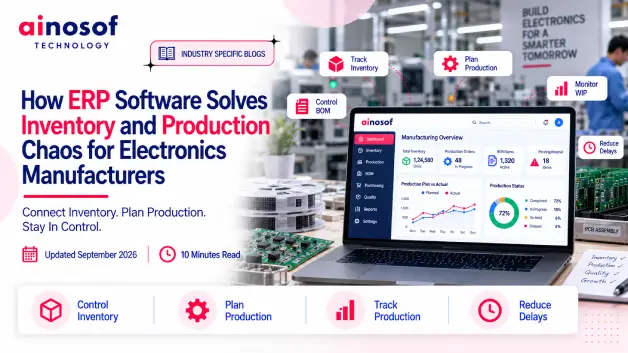 How ERP Software Solves Inventory and Production Chaos for Electronics Manufacturers
22 Sep, 2026
How ERP Software Solves Inventory and Production Chaos for Electronics Manufacturers
22 Sep, 2026
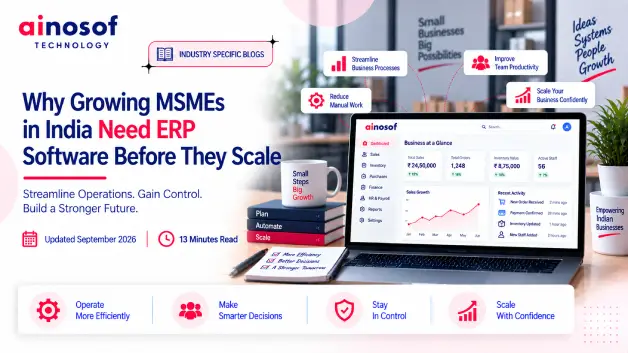 Why Growing MSMEs in India Need ERP Software Before They Scale
21 Sep, 2026
Why Growing MSMEs in India Need ERP Software Before They Scale
21 Sep, 2026
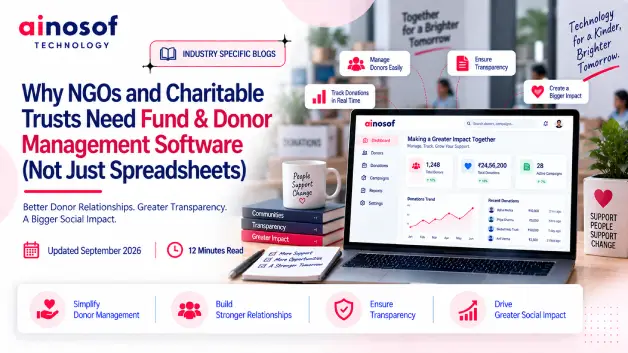 Why NGOs and Charitable Trusts Need Fund & Donor Management Software (Not Just Spreadsheets)
19 Sep, 2026
Why NGOs and Charitable Trusts Need Fund & Donor Management Software (Not Just Spreadsheets)
19 Sep, 2026
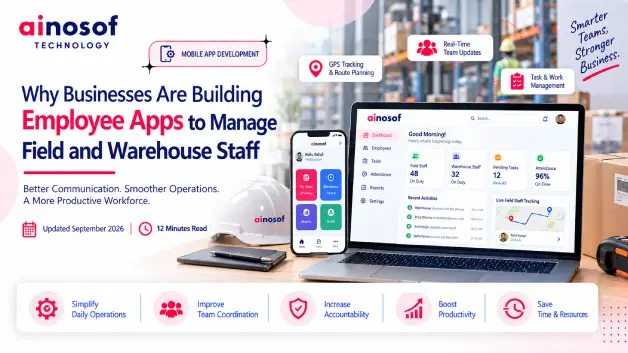 Why Businesses Are Building Employee Apps to Manage Field and Warehouse Staff
18 Sep, 2026
Why Businesses Are Building Employee Apps to Manage Field and Warehouse Staff
18 Sep, 2026
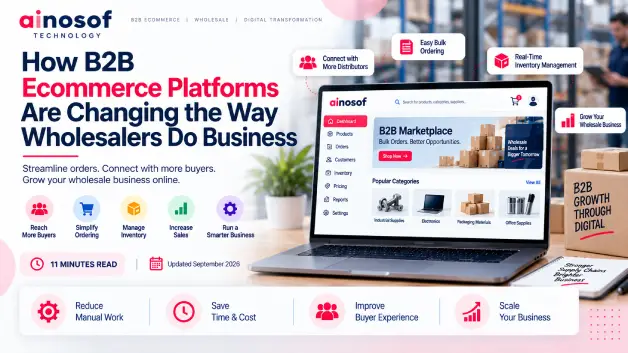 How B2B Ecommerce Platforms Are Changing the Way Wholesalers Do Business
17 Sep, 2026
How B2B Ecommerce Platforms Are Changing the Way Wholesalers Do Business
17 Sep, 2026
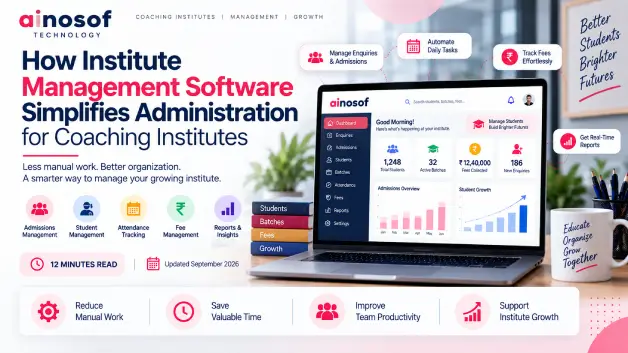 How Institute Management Software Simplifies Administration for Coaching Institutes
16 Sep, 2026
How Institute Management Software Simplifies Administration for Coaching Institutes
16 Sep, 2026
Comment with an expert and get our answer.
Comment with an expert and get our answer.
Explore more insights related to this topic and discover useful perspectives, ideas and strategies from our latest articles.