

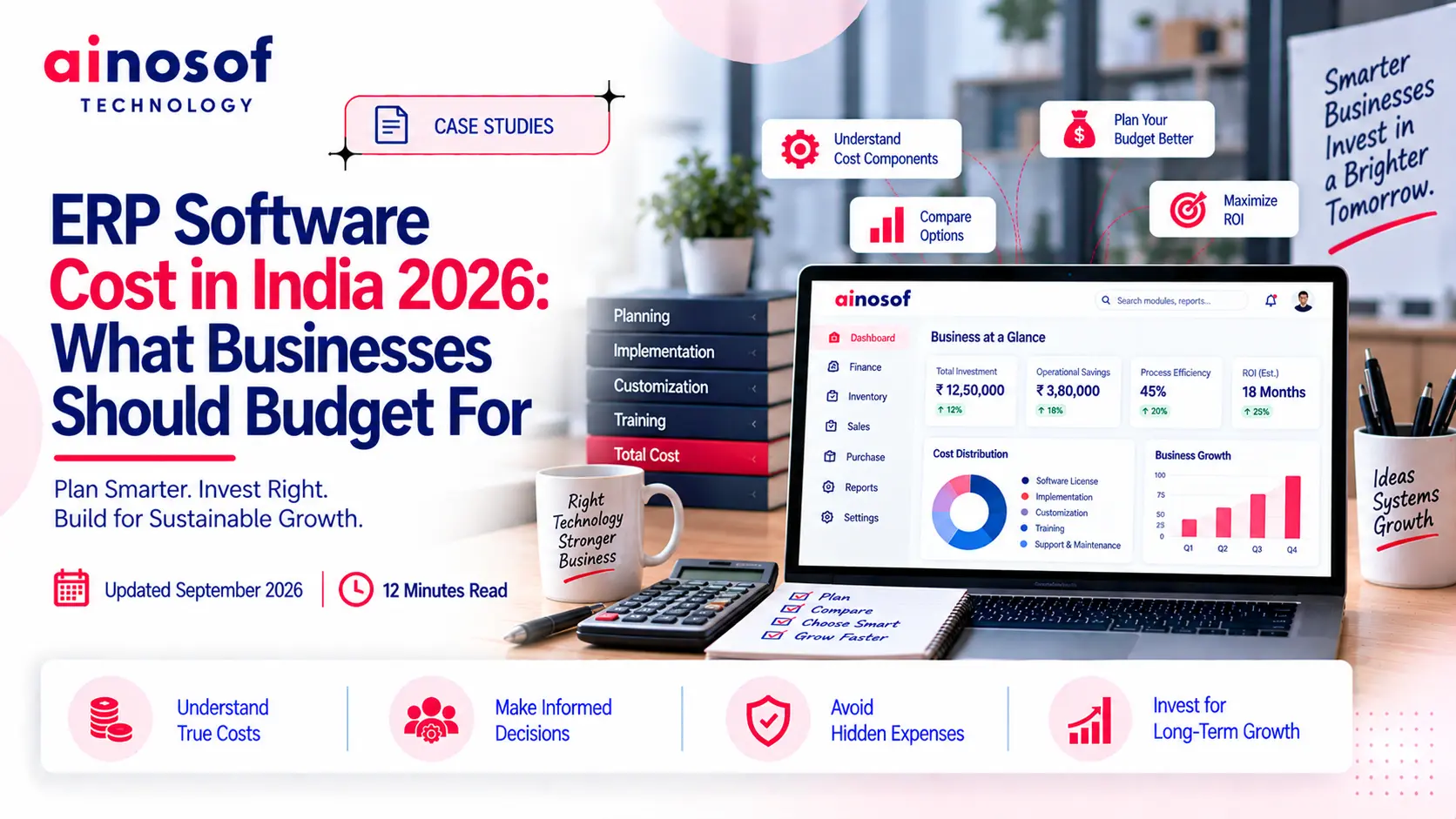
ERP Software Cost in India 2026: What Businesses Should Budget For

Introduction
For many businesses, the ERP decision begins with a simple question: “How much will it cost?” The difficulty starts when different vendors provide very different quotations for what appears to be a similar ERP solution.
One quotation may cover only the software. Another may include implementation, customization, training, migration, integrations, and support. A lower initial price can therefore look attractive while leaving important costs outside the quotation. At the same time, a business may spend more than necessary by paying for modules or customizations it does not actually need.
This makes ERP budgeting more than a software purchasing exercise. The right budget needs to reflect the business's users, departments, processes, customization requirements, integrations, implementation needs, and expected growth. It should also account for the difference between the first-year ERP investment and the costs that continue afterward.
Understanding these factors becomes particularly important when comparing ERP software cost in India in 2026, evaluating ERP implementation cost in India, or looking for an affordable ERP software price that still fits the way the business operates.
In this article, we will look at how ERP pricing models work, what contributes to the total ERP investment, how business requirements affect cost, how to calculate a realistic ERP budget, how to compare vendor quotations, and what businesses should verify before choosing an ERP vendor.
Why ERP Pricing Becomes Difficult to Compare
When businesses start comparing ERP solutions, the first thing they often look at is the quoted price. The problem is that ERP pricing does not always represent the same scope from one vendor to another. One quotation may cover only the core software, while another may include implementation, customization, training, migration, or support.
That is why two ERP quotations can look similar at first but lead to very different total investments.
Why can two ERP quotations have very different total costs?
Two ERP quotations can have different total costs because the businesses behind those quotations may have very different requirements.
For example, one company may need a basic ERP for finance, inventory, and sales with a small number of users. Another may need manufacturing, purchasing, inventory, production planning, multiple departments, custom workflows, third-party integrations, and access for many employees.
Even if both companies ask for “ERP software,” the implementation effort is not the same.
The difference can come from:
- Number of users
- Required ERP modules
- Number of departments
- Number of business locations
- Customization requirements
- Data migration
- Third-party integrations
- Reporting requirements
- Training and implementation support
- Ongoing maintenance
For example, a distributor operating from one location may need a relatively straightforward ERP setup. A manufacturer with multiple warehouses, production units, customized approval processes, and existing software integrations may require considerably more implementation work.
This is why comparing only the final quotation amount can be misleading. Businesses need to compare what each quotation actually includes before deciding whether one ERP solution is more affordable.
Why is the advertised software price not the complete ERP investment?
An advertised ERP price usually represents only one part of the investment.
The actual project may also involve implementation, customization, data migration, integrations, training, hosting, support, and maintenance. Some of these costs may be included in the initial quotation, while others may be charged separately.
Consider a business that sees an ERP package advertised at a particular price. After discussing its requirements, the business discovers that its existing customer data needs migration, its accounting system needs integration, and several internal approval processes require customization.
The software price has not necessarily changed. The scope of the ERP project has changed.
This distinction is important when evaluating ERP software cost in India 2026. A business should ask what it is actually paying for rather than treating the advertised software price as the final project cost.
A transparent ERP budget should therefore look at the complete business requirement, not just the headline software price.
How Is ERP Software Priced in India?
ERP systems can be priced in different ways, and the pricing model itself can influence how a business manages its technology budget. Understanding the model helps businesses compare quotations on a more consistent basis.
The right question is not simply, “Which ERP costs less?” It is also, “How will this ERP charge us as our usage and requirements change?”
How do subscription, per-user, module-based and one-time licensing models differ?
Different ERP vendors can use different commercial models.
A subscription model generally involves recurring payments, often monthly or annually. This can make the initial investment easier to plan, but the business needs to consider the long-term recurring cost.
A per-user model bases pricing partly on the number of people using the ERP. A growing business should therefore understand how additional users will affect future costs.
A module-based model charges according to the functionality selected. A company may begin with finance and inventory and later add modules for manufacturing, CRM, HR, or other operations.
A one-time licensing model may involve a larger initial software investment instead of a recurring subscription for the core license. However, implementation, support, upgrades, hosting, and customization can still create additional costs.
For example, a business with 20 users and four required modules may have a very different cost structure from a business with 100 users and eight modules, even if both use the same ERP platform.
Businesses should therefore understand the pricing model, included modules, user limits, recurring charges, and future expansion costs before comparing ERP prices.
When does customized ERP development use a different pricing approach?
Standard ERP software works well when a business can operate largely within the system's existing workflows.
The situation changes when the business has processes that require significant changes to the standard system.
For example, a manufacturing company may need a specific production workflow, customized approval levels, industry-specific reports, unique inventory rules, or integrations with existing systems. In such cases, the cost may depend more on the scope of customization and development effort than on a standard package price.
With customized ERP development, vendors may evaluate:
- Business requirements
- Number and complexity of workflows
- Custom modules
- Integrations
- User roles and permissions
- Reports and dashboards
- Data migration
- Testing and deployment
- Future support requirements
This approach can make the initial quotation look different from a standard ERP package, but it also allows the system to be designed around the business's actual processes.
For businesses considering affordable ERP software price, the important point is to compare the solution's business fit and total cost, rather than assuming the lowest initial quotation represents the lowest overall investment.
What Actually Makes Up the Total ERP Investment?
Once the pricing model is understood, the next step is to look beyond the software itself. The total ERP investment is usually made up of several connected cost components.
This matters because a business may approve an ERP budget based on the software quotation and later discover additional expenses during implementation.
Which costs should businesses include when preparing an ERP budget?
A realistic ERP budget should consider the complete project rather than only the software license or subscription.
Depending on the ERP and business requirements, the budget may include:
- ERP software or subscription
- Implementation and configuration
- Custom development
- Data migration
- Third-party integrations
- User training
- Hosting or infrastructure
- Technical support
- Maintenance
- Future upgrades
For example, a business moving from spreadsheets and separate applications to an ERP system may need to clean and migrate years of customer, supplier, inventory, and financial data. That work should be considered when preparing the project budget.
A useful approach is to separate the expected investment into software costs, implementation costs, and ongoing operational costs.
This gives management a clearer picture of what the ERP project will require financially.
Which additional costs can appear during ERP implementation?
ERP implementation is where the difference between an initial quotation and the final project investment can sometimes become visible.
Additional costs may arise when the business discovers that existing processes need changes or when requirements were not fully documented at the beginning.
Common areas include:
- Additional customization
- Complex data migration
- New system integrations
- Additional user accounts
- New modules
- Advanced reports
- Additional training
- Changes to workflows
- Additional implementation support
For example, a business may initially request inventory management but later require barcode integration, automated purchase approvals, custom stock reports, and integration with its accounting system.
These requirements can increase the implementation effort.
This is why businesses should document their requirements clearly before approving an ERP project and ask vendors to specify what is included and what is outside the agreed scope.
Why should businesses separate first-year costs from ongoing ERP costs?
The first year of an ERP project can look very different from the years that follow.
The first-year ERP investment may include implementation, configuration, data migration, customization, training, and initial setup. These are often project-related costs.
Ongoing costs may include:
- Subscription or license renewal
- Hosting
- Technical support
- Maintenance
- Additional users
- New modules
- Future customizations
- Upgrades
For example, a business may have a significant implementation expense during the first year but a lower recurring operating cost afterward. Another business using a subscription-based ERP may have a smaller initial investment but a continuing annual payment.
Looking only at the first-year quotation can therefore hide the longer-term financial commitment.
A better ERP budget considers both initial investment and total ongoing cost, so management can evaluate affordability beyond the launch of the system.
How Business Requirements Change ERP Cost
ERP pricing becomes much easier to understand when it is connected to the actual business requirements.
There is no single ERP budget that applies equally to every company. The number of users, departments, locations, workflows, integrations, and level of customization can all change the amount of work required.
How do users, modules, departments and locations affect ERP cost?
The size and structure of a business can directly affect ERP requirements.
A company with a small team and a few basic processes may require fewer users and modules. A larger organization may need multiple departments, different user roles, several locations, and more extensive reporting.
For example, a business may need:
- Finance for the accounts team
- Inventory for warehouse staff
- Sales for the sales team
- Purchasing for procurement
- Production for manufacturing
- CRM for customer management
Each additional area can introduce more configuration, users, workflows, permissions, reporting requirements, or integrations.
Multiple locations can add another layer of complexity because the ERP may need to manage branch-wise operations, inventory, users, transactions, and reporting.
Therefore, businesses should not estimate ERP software cost in India 2026 simply by looking at company size. The more useful approach is to assess the actual processes and level of operational complexity.
When do customization, integrations and data migration increase implementation cost?
Customization becomes a cost factor when the standard ERP workflow does not adequately match the way a business operates.
Integrations can also increase implementation effort when the ERP needs to exchange information with accounting software, payment systems, e-commerce platforms, CRM systems, machines, APIs, or other business applications.
Data migration can become another major consideration when the business already has years of information stored across spreadsheets, legacy software, or separate databases.
For example, a growing manufacturer may want its ERP to connect purchasing, inventory, production, accounting, and existing sales software. It may also need historical customer, supplier, stock, and transaction data migrated into the new system.
Each requirement adds work that needs to be understood before finalizing the ERP implementation cost in India.
The more accurately a business defines these requirements before requesting quotations, the easier it becomes to build a realistic ERP budget and avoid unexpected costs later.
How Can a Business Calculate Its ERP Budget?
Once a business understands what affects ERP pricing, the next challenge is turning those factors into a realistic budget. Instead of starting with an arbitrary amount, management should build the budget around the actual ERP requirements, implementation effort, and expected ongoing expenses.
A practical ERP budget should answer three questions: What will we pay for the system? What will it take to implement it? And what will it cost us to operate it over time?
How can businesses estimate software, implementation and customization costs?
The easiest way to estimate an ERP budget is to divide the project into major cost areas rather than treating ERP as one single expense.
Start with the software cost. This may depend on the pricing model, number of users, selected modules, or subscription period.
Then estimate implementation costs, including configuration, deployment, data migration, testing, training, and initial support.
Finally, identify whether the business needs customization. If the standard ERP does not match important business workflows, additional development may be required.
For example, a manufacturing company may need inventory, purchasing, production, finance, and sales modules. If it also needs a customized production approval workflow and integration with existing accounting software, those requirements should be considered before the ERP budget is finalized.
A useful budget structure is:
Software + Implementation + Customization + Migration + Integration + Training = Initial ERP Investment
The exact amount will vary from one business to another, but this approach gives management a much clearer starting point than simply asking for the cheapest ERP package.
How should businesses calculate first-year and recurring ERP expenses?
Businesses should separate the first-year ERP investment from the costs that will continue after implementation.
First-year expenses may include:
- ERP software or subscription
- Implementation
- Customization
- Data migration
- Integrations
- Training
- Initial support
- Hosting or infrastructure
Recurring expenses may include:
- Annual subscription or license renewal
- Hosting
- Maintenance
- Technical support
- Additional users
- New modules
- Future customizations
- Upgrades
For example, a subscription-based ERP may require a lower initial software investment but create a recurring annual expense. A customized ERP project may require greater development investment at the beginning but have a different ongoing cost structure.
This distinction helps businesses evaluate ERP software cost in India 2026 from a longer-term perspective instead of judging affordability only by the initial quotation.
The important question is not simply “What will ERP cost us to start?” but also “What will it cost us to operate and expand?”
What should businesses include in their ERP budget before requesting quotations?
Before approaching ERP vendors, businesses should prepare a basic requirement document.
It should identify:
- Number of users
- Required ERP modules
- Departments involved
- Business locations
- Existing software
- Required integrations
- Custom workflows
- Data migration requirements
- Reporting requirements
- Training expectations
- Support requirements
- Expected future growth
This makes vendor discussions more productive because every vendor is responding to a clearer business requirement.
For example, instead of asking an ERP company for “ERP software for our business,” a company could specify that it has three locations, 50 users, manufacturing and inventory operations, existing accounting software, and a requirement for customized approval workflows.
That level of information makes it easier to understand the expected ERP implementation cost in India and compare proposals on the same basis.
A well-defined requirement is often the foundation of a more reliable ERP budget.
How Should Businesses Compare ERP Quotations?
Receiving multiple ERP quotations does not automatically make the purchasing decision easier. The quotations need to be compared based on scope, inclusions, implementation effort, recurring costs, and business requirements.
A lower quotation may not represent a lower total investment if important services or requirements are excluded.
What should be included in an ERP vendor quotation?
A clear ERP quotation should explain what the business is actually paying for.
Depending on the project, the quotation should clearly identify:
- Software or licensing cost
- Number of users included
- Modules included
- Implementation scope
- Configuration
- Customization
- Data migration
- Integrations
- Training
- Hosting
- Support and maintenance
- Upgrade terms
- Recurring charges
- Payment terms
- Additional or out-of-scope costs
For example, if one vendor includes data migration and training while another charges for them separately, comparing only the headline software price will not provide a fair comparison.
Businesses should also ask vendors to clearly identify included and excluded services.
This creates greater pricing transparency and reduces the possibility of unexpected costs during implementation.
How can businesses compare affordable ERP software prices beyond the lowest quotation?
An affordable ERP software price should not be judged only by the smallest number on a quotation.
Businesses should compare what they receive for that investment.
A useful comparison should consider:
Price + Functionality + Implementation Scope + Business Fit + Scalability + Ongoing Cost
For example, Vendor A may offer a lower initial price but require substantial paid customization for essential workflows. Vendor B may have a higher initial quotation but already support more of the business's required processes.
Neither price should be considered in isolation.
The same principle applies to customized ERP development. A solution that fits the company's processes may require a different initial investment but could reduce the need for repeated workarounds or disconnected systems later.
The objective should therefore be to identify the most transparent and suitable total investment for the business requirement, rather than simply selecting the lowest quotation.
What Should Businesses Check Before Choosing an ERP Vendor?
Price comparison is only one part of the final decision. An ERP system becomes part of the business's daily operations, so the vendor's pricing structure, implementation approach, and ability to support future growth also matter.
Before finalizing an ERP vendor, businesses should look beyond the quotation and examine whether the commercial arrangement can support the project over the long term.
Is the pricing structure clear and scalable?
The vendor should clearly explain how the ERP price changes when the business grows.
For example, businesses should understand what happens when they:
- Add new users
- Add another department
- Open another location
- Add a new ERP module
- Request additional reports
- Require a new integration
- Need additional customization
A pricing structure that is clear at the beginning makes future budgeting easier.
For a growing business, scalability should therefore be considered alongside the initial ERP price.
The goal is to avoid a situation where the ERP appears affordable at the beginning but becomes difficult to budget as usage expands.
Does the implementation scope match the actual business requirements?
An ERP quotation is useful only when its implementation scope matches what the business actually needs.
Management should check whether the proposed implementation covers the required modules, workflows, data migration, integrations, user roles, reports, testing, and training.
For example, if a company needs production, inventory, purchasing, and accounting to work together, but the quotation only covers basic inventory and accounting configuration, the initial price may not represent the actual project.
This is where a clear requirement document becomes valuable.
A business should be able to connect every major requirement with a corresponding part of the ERP proposal.
Can the ERP grow with the business without creating unexpected costs?
ERP is usually a long-term business system, so the budget should not be evaluated only against today's requirements.
A growing business may add users, products, locations, departments, integrations, or new processes over time.
Before choosing a vendor, businesses should understand:
- How additional users are priced
- How new modules are added
- How customization is handled
- What support costs apply
- How upgrades are managed
- Whether integrations can be expanded
- What happens when business processes change
For example, a business starting with one location may later expand to multiple branches. If the ERP can accommodate that growth through a clear and predictable pricing and implementation model, future planning becomes easier.
The right ERP budgeting approach therefore looks beyond today's quotation and considers how the total investment may change as the business grows.
Continue Your Business Development Journey
ERP is only one part of building a more connected and efficient business operation. Once a business understands its ERP requirements and budget, the next step is to examine how ERP development, business process automation, inventory management, production management, and CRM can work together.
Explore the relevant Ainosof Technology resources to understand how different business systems can support operational growth and better information flow.
The objective should always be to build technology around genuine business requirements rather than adding software simply because it is available.
Conclusion
ERP budgeting becomes easier when businesses stop looking at ERP as a single software price and start looking at the total investment required to implement, operate, and grow the system.
The final cost can be influenced by users, modules, departments, locations, customization, integrations, migration, implementation, training, support, and the selected pricing model. That is why two businesses can receive very different ERP quotations while both are looking for an ERP solution.
A practical approach is to define requirements first, separate software and implementation costs, calculate first-year and recurring expenses, and compare vendor quotations based on the complete scope rather than the lowest headline price.
For businesses evaluating ERP software cost in India 2026, the most useful question is not simply, “Which ERP is cheapest?”
It is:
“Which ERP investment gives our business the right capabilities, predictable costs, and enough flexibility to support where we are going next?”
Frequently Asked Questions
What is the average ERP software cost in India in 2026?
There is no single ERP price that applies to every business. ERP software cost in India 2026 depends on factors such as users, modules, implementation requirements, customization, integrations, data migration, and the pricing model.
A small business with limited users and standard processes may have very different requirements from a manufacturer with multiple departments and customized workflows.
The better approach is to estimate ERP cost based on your actual business requirements rather than relying only on an advertised starting price.
What factors affect ERP software cost in India?
The main factors include the number of users, ERP modules, departments, locations, customization, integrations, data migration, implementation, training, hosting, and ongoing support.
For example, an ERP covering finance and inventory for one location may require less implementation effort than an ERP connecting finance, purchasing, inventory, production, sales, and multiple branches.
Understanding these cost drivers helps businesses prepare a more realistic ERP budget.
What is included in ERP implementation cost in India?
ERP implementation cost in India can include configuration, workflow setup, data migration, testing, deployment, training, and implementation support.
The exact scope depends on the ERP system and business requirements. Custom workflows, complex integrations, or large amounts of existing data may require additional work.
Businesses should therefore ask vendors to clearly document what is included and excluded from implementation.
Which ERP pricing model is suitable for a growing business?
There is no single pricing model suitable for every growing business. Businesses may consider subscription, per-user, module-based, one-time licensing, or customized ERP development, depending on their requirements.
A growing company should pay particular attention to how costs change when it adds users, modules, departments, locations, or integrations.
The important consideration is whether the pricing structure remains understandable and manageable as the business expands.
Is customized ERP software more expensive than standard ERP?
Customized ERP can require a higher initial investment because development is based on the business's specific workflows and requirements.
However, the cost depends on the scope of customization, not simply on whether the ERP is customized.
For example, a business requiring a few workflow changes may have a different development requirement from a company needing custom modules, multiple integrations, specialized reports, and complex approval processes.
Businesses should compare the cost against the level of business fit and the long-term requirements of the organization.
How can businesses find affordable ERP software without compromising important requirements?
Businesses should first identify their essential processes and ERP requirements instead of choosing a system only because its initial price is low.
Compare the software, implementation scope, customization, integrations, training, support, recurring costs, and scalability.
An ERP with a slightly higher initial quotation may provide better value if it covers important business requirements without requiring extensive additional work later.
The goal should be a transparent and sustainable ERP investment, not simply the lowest starting price.
What should I check before accepting an ERP quotation?
Before accepting an ERP quotation, check:
- Software or subscription cost
- Users and modules included
- Implementation scope
- Customization costs
- Data migration
- Integrations
- Training
- Hosting
- Support and maintenance
- Recurring charges
- Upgrade terms
- Additional or out-of-scope costs
Most importantly, confirm that the quotation matches the actual business requirements discussed with the vendor.
A clear quotation makes it easier to understand the expected total investment and reduces the possibility of unexpected costs during implementation.
Can Ainosof Technology develop ERP software according to a business's budget and requirements?
Yes. Ainosof Technology can approach ERP development around the specific requirements of a business, including its workflows, modules, user requirements, integrations, and customization needs.
For businesses considering customized ERP, the important starting point is to understand the processes that need to be managed and the outcomes the system should deliver.
This requirement-based approach helps businesses evaluate what should be developed, what can remain standard, and where customization is genuinely necessary.

-
 What is LLM SEO and Why Is It Becoming Important for Business Visibility in 2026?
24 Sep, 2026
What is LLM SEO and Why Is It Becoming Important for Business Visibility in 2026?
24 Sep, 2026
-
 Why Colleges and Universities Need ERP Software to Manage Admissions, Fees and Operations
23 Sep, 2026
Why Colleges and Universities Need ERP Software to Manage Admissions, Fees and Operations
23 Sep, 2026
-
 How ERP Software Solves Inventory and Production Chaos for Electronics Manufacturers
22 Sep, 2026
How ERP Software Solves Inventory and Production Chaos for Electronics Manufacturers
22 Sep, 2026
-
 Why Growing MSMEs in India Need ERP Software Before They Scale
21 Sep, 2026
Why Growing MSMEs in India Need ERP Software Before They Scale
21 Sep, 2026
-
 Why NGOs and Charitable Trusts Need Fund & Donor Management Software (Not Just Spreadsheets)
19 Sep, 2026
Why NGOs and Charitable Trusts Need Fund & Donor Management Software (Not Just Spreadsheets)
19 Sep, 2026
-
 Why Businesses Are Building Employee Apps to Manage Field and Warehouse Staff
18 Sep, 2026
Why Businesses Are Building Employee Apps to Manage Field and Warehouse Staff
18 Sep, 2026
Still have some doubts?
Comment with an expert and get our answer.