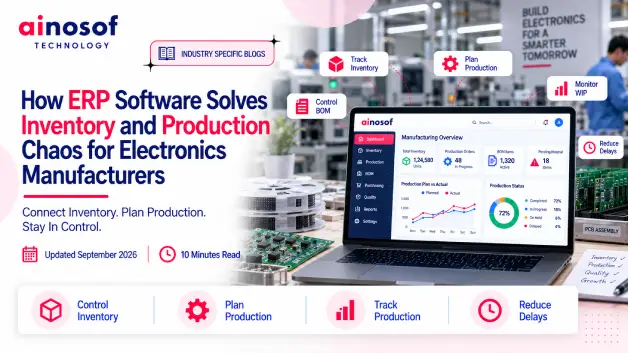
How ERP Software Solves Inventory and Production Chaos for Electronics Manufacturers
 Iram
Iram


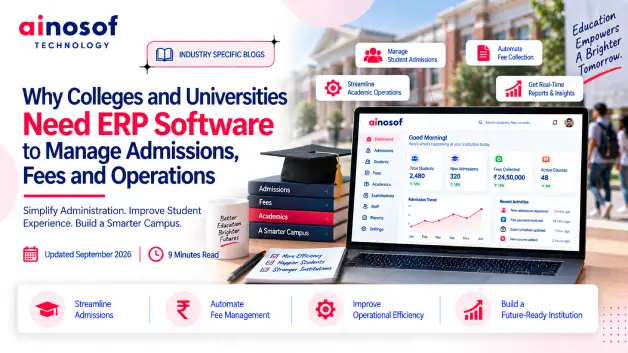
For a college or university, administrative complexity grows quietly. More students mean more applications, more admissions records, more fee transactions, more departments, and more information moving between academic and administrative teams.
The problem usually appears when these processes are managed separately. An admission update may need to be entered again into a student record. The finance team may maintain separate fee information. Departments may have their own records, while management waits for reports to understand what is happening across the institution.
As student volumes and institutional operations grow, these small gaps can create larger problems—duplicate data, delayed updates, manual follow-ups, fee-tracking issues, and limited visibility into the student lifecycle.
This is why ERP software for colleges and universities deserves to be considered as an operational decision, not simply another software purchase. The real question is whether admissions, student records, fees, academics, departments, and reporting can work from connected information.
In this article, we will examine where disconnected college operations create problems, how an ERP system can connect the student lifecycle, how a college ERP system in India can support growing institutions, and what colleges and universities should evaluate before choosing university management software.
As a college or university grows, administration becomes more difficult when important information is spread across separate systems, spreadsheets, and departmental records. Admissions may use one system, finance another, while academic departments maintain their own student information.
The problem is not simply having multiple tools. The bigger issue is that these tools may not share the same information in real time. This can make simple administrative tasks slower and create uncertainty about which record is current.
Student information changes throughout the academic journey. A student moves from applicant to admitted student, then becomes part of a course, department, fee structure, attendance record, and examination process.
When each stage is managed separately, the same information may need to be entered and updated multiple times.
For example, a student's admission details may be available to the admissions team but not immediately visible to the finance or academic department. Someone then has to transfer the information manually or request it from another team.
This creates unnecessary follow-ups and increases the possibility of duplicate or inconsistent student data.
With ERP software for colleges and universities, relevant student information can be connected across different institutional processes, reducing the need to repeatedly search for or recreate the same information.
When departments work from connected student information, administrative work becomes easier to coordinate and less dependent on manual follow-ups.
Manual processes may work when student numbers are small and operations are simple. The difficulty begins when the institution has thousands of students, multiple courses, several departments, and large volumes of daily transactions.
A simple request such as checking a student's admission status, fee dues, or academic information can require coordination between multiple teams.
For example, if the finance team has one student record and the academic department has another, resolving a fee or enrollment issue may require checking both records before anyone can give a reliable answer.
As the institution grows, these small tasks consume more staff time and make administrative processes harder to control.
Manual administration becomes a business problem when routine coordination starts taking time away from higher-value institutional work.
Admission is not an isolated activity. The information collected during application and enrollment becomes part of the student's ongoing institutional record.
A connected college ERP system India institutions can use should therefore treat admission as the beginning of a wider student lifecycle rather than a separate administrative transaction.
An ERP can connect the information collected during application with the student's admission and subsequent institutional records.
Instead of creating a completely new record after admission, relevant information can flow into the student's profile and become available to authorized departments.
For example, an applicant submits personal details, course information, and required documents. Once admission is confirmed, the relevant information can become part of the student's institutional record instead of being entered again from the beginning.
This creates continuity between application, admission, and student management.
The value is simple: information captured once can support multiple stages of the student's journey.
Repeated data entry often happens because departments need the same student information for different purposes.
Admissions may collect the information, finance may need it for fee records, and academic teams may need it for course and student management.
A connected ERP can allow authorized departments to access the relevant information from a shared student record rather than recreating it separately.
For example, when a student's admission is confirmed, the system can make the required information available for the next administrative processes without requiring staff to manually copy the same details into multiple records.
This can reduce duplicate data entry, save administrative time, and lower the risk of simple data-entry mistakes.
A well-connected student record turns admission from a one-time transaction into a reliable starting point for the entire student lifecycle.
Fee management becomes increasingly difficult when institutions have different courses, fee structures, payment schedules, scholarships, concessions, and outstanding balances.
The challenge is not only collecting fees. Management also needs accurate information about what has been billed, what has been paid, what remains outstanding, and which student record the transaction belongs to.
An integrated ERP can connect student records and financial information, giving both administrators and management a clearer view of the institution's fee position.
Different programs or student categories may have different fee structures. Managing these manually can make tracking difficult, particularly when payment schedules and concessions vary.
ERP can connect the applicable fee structure with the student's institutional record and maintain information about payments and outstanding amounts.
For example, if a student has paid one installment but another remains due, the relevant financial status can be maintained against the student's record rather than being tracked separately in another spreadsheet.
This helps finance teams identify pending fees, payment history, and outstanding dues more systematically.
Better fee control starts with keeping student and financial information connected.
Students generally need straightforward answers: What is my total fee? What have I paid? What is still due? When is the next payment required?
Administrators need similar information at a broader level across courses, departments, and student groups.
A connected ERP can make the relevant information available to authorized users without requiring staff to manually collect it from different records.
For example, instead of checking separate payment sheets and student records, an administrator can access the student's current financial status from the system.
This improves fee transparency while reducing unnecessary communication between students and administrative teams.
When financial information is current and connected to the student record, fee management becomes easier for both the institution and the student.
Admissions and fees are only part of institutional administration. Once students enter a program, information must move across academic departments, attendance, examinations, and other administrative processes.
This is where university management software can help create a shared operational view instead of leaving every department to maintain separate information.
Different departments may need different information about the same student, but they should not have to maintain completely separate versions of that student's core record.
A connected ERP can provide authorized departments with access to the information relevant to their responsibilities.
For example, the academic department may need course and enrollment information, while the finance team needs fee details. Both can work from the same underlying student record without unnecessarily duplicating it.
This improves coordination while keeping departmental responsibilities separate.
The goal is not to make every department see everything; it is to ensure that each department works from reliable, connected information.
Academic activities generate information that is useful beyond the classroom.
Course enrollment affects academic records. Attendance may affect student monitoring. Examination information becomes part of the student's academic history. Administrative teams may need parts of this information for reporting and student support.
When these processes are disconnected, staff may have to move information manually between systems.
An ERP can connect relevant academic and administrative workflows so that information moves through the institution more systematically.
For example, a student's course enrollment can be linked to the appropriate academic records, attendance information, and examination processes without creating separate disconnected records for every activity.
Connected academic and administrative workflows give institutions a more complete view of the student's progress and institutional activity.
Management cannot make timely decisions if important information remains scattered across departments.
An integrated ERP can bring key operational information together so that college and university management can see what is happening across admissions, students, fees, academics, and departments without waiting for multiple teams to manually compile information.
Management often needs a high-level view rather than individual records.
They may want to know how many students have been admitted, which courses are receiving applications, how much fee has been collected, what remains outstanding, and how different departments are performing operationally.
With ERP software for colleges and universities, these areas can be connected within one system.
For example, management can review admission numbers alongside student records and fee information instead of requesting separate reports from admissions, finance, and academic teams.
This creates a more connected view of institutional operations.
Management visibility improves when important information is available from one connected operational system instead of multiple departmental reports.
A report is useful only when it helps management understand what is happening and decide what needs attention.
If information is collected manually from different departments, reports can take time to prepare and may become outdated before they are reviewed.
Connected ERP data can make reporting more timely and consistent.
For example, management may identify a gap between admissions and fee collection, compare student numbers across departments, or review operational information without waiting for every department to prepare a separate report.
This changes reporting from a routine administrative task into a source of institutional decision-making.
The real value of connected reporting is not producing more reports; it is helping management see problems earlier and make better-informed decisions.
Choosing an ERP for a college or university is not simply about comparing software features. The more important question is whether the system can support the institution's actual way of working today and continue to support it as the institution grows.
A suitable ERP software for colleges and universities should connect the processes that staff already depend on while providing enough flexibility for different courses, departments, campuses, and administrative requirements.
Higher-education institutions rarely operate around one simple workflow. A college may have multiple courses and departments, while a university may manage several faculties, campuses, programs, and student groups.
The ERP should be able to organize these different structures without forcing every department to work in exactly the same way.
For example, one department may have a different fee structure or academic workflow from another. The system should be able to manage these differences while keeping institution-wide information connected.
This is particularly important when evaluating a college ERP system in India, where institutions can have varied courses, departments, academic structures, and operational requirements.
The right ERP should provide centralized control without removing the flexibility individual departments need.
This is one of the most important questions an institution should ask before choosing an ERP.
An ERP may have separate modules for admissions, fees, academics, and administration, but those modules become far more useful when they can work with the same underlying student information.
For example, when a student is admitted, the relevant information should be available for fee management and academic administration without requiring staff to create the same record again.
Before selecting a system, institutions should examine how information moves between these processes rather than simply checking whether each module exists.
The value of ERP comes from connecting institutional processes, not from collecting separate modules in one software package.
An ERP that works for a small institution may become difficult to manage when student numbers, courses, departments, campuses, and transactions increase.
The system should therefore be evaluated against future requirements, not only today's workload.
For example, an institution may begin with one campus and a limited number of programs but later add departments, courses, or additional campuses. The ERP should be able to accommodate that growth without forcing the institution to rebuild its entire operational system.
Scalability should also include the ability to handle increasing student records, fee transactions, academic information, and administrative activity.
A good ERP should solve today's operational problems while giving the institution room to grow.
Managing a growing educational institution requires more than individual digital tools. The larger opportunity is to connect the processes that depend on the same student and institutional information.
Institutions evaluating digital transformation can explore ERP Software Development, Custom ERP Software Development, and education-focused management solutions to identify which workflows should be connected first.
The objective should be practical: reduce repetitive administration, improve information flow, and give management better visibility without forcing the institution into an unsuitable workflow.
For colleges and universities, operational complexity grows with every new student, course, department, campus, and administrative process. When these activities remain disconnected, staff spend more time transferring information, checking records, and preparing reports instead of managing the institution.
ERP software for colleges and universities can bring admissions, student records, fees, academics, departments, and reporting into a connected operational environment. The result is not simply more automation. It is better access to the information needed to manage the institution.
The right system should be evaluated around the institution's actual workflows, its current operational challenges, and its plans for future growth.
For a college or university considering ERP, the most important question is therefore not “What features does the software have?” but “Can this system connect the information our institution depends on every day?”
ERP can connect applications, admissions, and student records so that information captured during admission can continue through the student's institutional lifecycle. This can reduce repeated data entry and help departments work from more consistent information.
ERP can connect student records with fee structures, payments, and outstanding dues, making it easier for finance teams to track financial information and provide students with clearer payment details.
Yes. A suitable ERP can connect relevant information across academics, finance, admissions, and administration, allowing authorized teams to work from shared institutional data instead of maintaining disconnected records.
Yes, provided the ERP is designed to support multi-department and multi-campus structures. Institutions should verify this using their actual courses, departments, campuses, and workflows before implementation.
Colleges should evaluate workflow flexibility, admissions, student records, fee management, academic processes, reporting, integration, scalability, and multi-department support. The system should match the institution's current requirements and future growth plans.
Yes. Ainosof Technology can develop customized ERP solutions around an institution's specific admissions, student management, fee, academic, administrative, and reporting workflows.
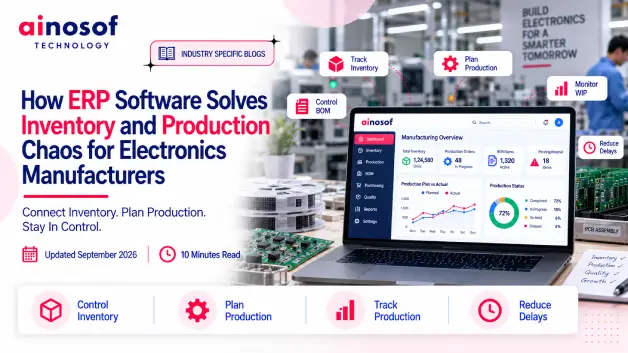 How ERP Software Solves Inventory and Production Chaos for Electronics Manufacturers
22 Sep, 2026
How ERP Software Solves Inventory and Production Chaos for Electronics Manufacturers
22 Sep, 2026
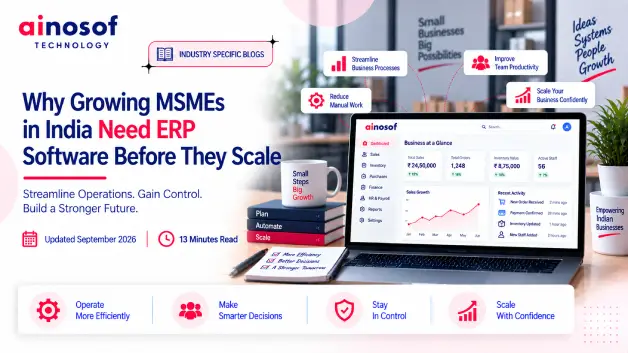 Why Growing MSMEs in India Need ERP Software Before They Scale
21 Sep, 2026
Why Growing MSMEs in India Need ERP Software Before They Scale
21 Sep, 2026
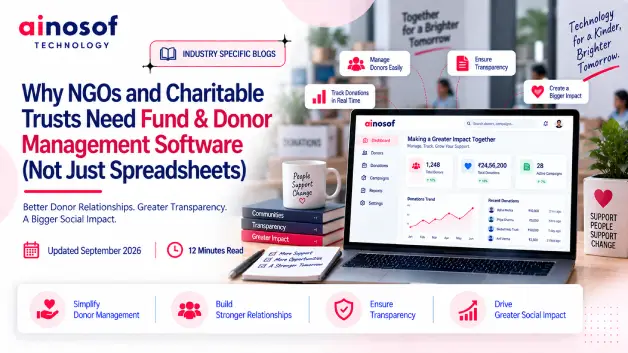 Why NGOs and Charitable Trusts Need Fund & Donor Management Software (Not Just Spreadsheets)
19 Sep, 2026
Why NGOs and Charitable Trusts Need Fund & Donor Management Software (Not Just Spreadsheets)
19 Sep, 2026
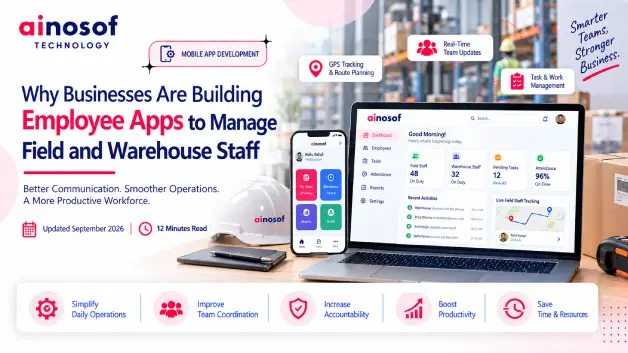 Why Businesses Are Building Employee Apps to Manage Field and Warehouse Staff
18 Sep, 2026
Why Businesses Are Building Employee Apps to Manage Field and Warehouse Staff
18 Sep, 2026
 How B2B Ecommerce Platforms Are Changing the Way Wholesalers Do Business
17 Sep, 2026
How B2B Ecommerce Platforms Are Changing the Way Wholesalers Do Business
17 Sep, 2026
 How Institute Management Software Simplifies Administration for Coaching Institutes
16 Sep, 2026
How Institute Management Software Simplifies Administration for Coaching Institutes
16 Sep, 2026
Comment with an expert and get our answer.
Comment with an expert and get our answer.
Explore more insights related to this topic and discover useful perspectives, ideas and strategies from our latest articles.