Custom Software Development Cost in India 2026: What Businesses Should Expect to Pay
 Iram


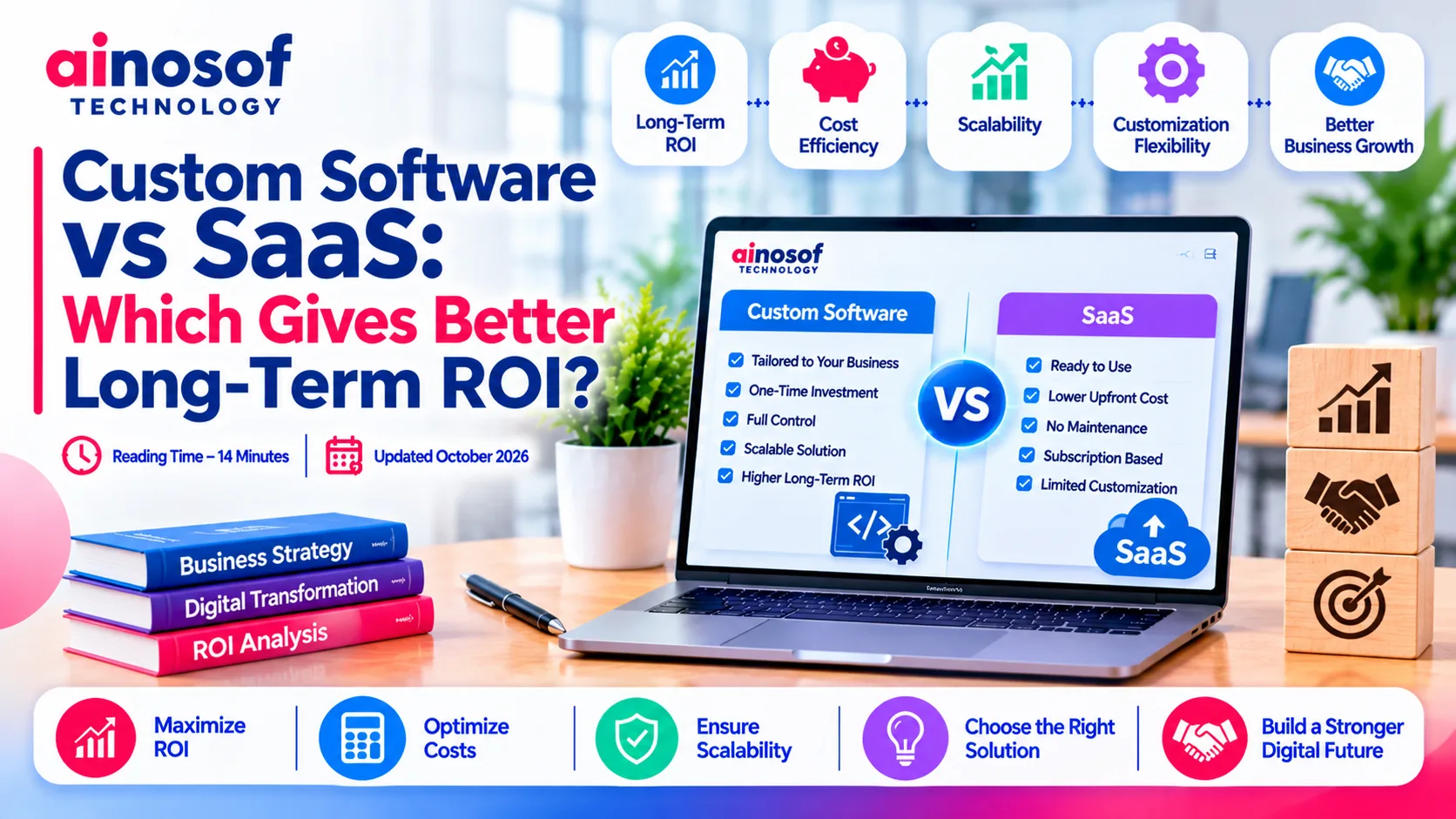
Choosing business software is not just a technology decision. It is a financial commitment that can influence operating costs, employee productivity, customer experience, and the ability to scale. A solution that appears affordable today may become expensive when the business adds more users, expands operations, or requires functionality that the software was never designed to support.
This is where the comparison between custom software and SaaS becomes important. SaaS platforms offer ready-to-use functionality through recurring subscriptions, while custom software is developed around a company's specific workflows and requirements. Both approaches can deliver value, but their financial impact changes over time.
For a growing business, the real question is not simply which option costs less initially. It is which investment can support operations efficiently without creating unnecessary expenses in the coming years.
Let's compare custom software and SaaS from a long-term business ROI perspective, including ownership, scalability, integration costs, and the factors that should influence your investment decision.
When businesses evaluate software, the first comparison is usually between the upfront development cost and the monthly or annual subscription. This approach can lead to an incomplete financial decision.
A SaaS platform may require a relatively small initial payment, but subscription charges continue throughout its usage. Custom software generally requires a higher initial investment, but its cost structure is different because the business is investing in a solution built around its operations.
The right comparison should consider how much the software will cost to implement, operate, maintain, and expand over its expected useful life.
SaaS pricing often depends on the number of users, selected features, storage requirements, usage limits, or subscription plans. This makes it convenient for businesses starting with a small team. However, expenses can increase as operations expand.
Consider a business that initially needs software for 10 employees. A subscription plan may be affordable at that stage. As the company grows to 50 or 100 employees, the subscription expense can increase substantially, particularly when advanced features or additional modules are required.
Other expenses may also appear:
Custom software has a different cost structure. The initial development investment can be higher, and the business must account for hosting, maintenance, updates, and technical support. However, the company does not necessarily pay a separate per-user subscription to a software vendor for every employee.
The financial difference becomes clearer when businesses compare their expected costs over three to five years rather than looking only at the first invoice.
SaaS platforms are designed to serve multiple customers with standardised functionality. This works well when a company's processes match the platform's intended use.
Problems can emerge when the business develops workflows that do not fit the available features.
For example, a distributor may need a system that connects dealer-specific pricing, warehouse stock, order approvals, credit limits, and sales team reporting. A standard SaaS product might handle some of these activities but require separate applications or manual workarounds for the rest.
These limitations can create operational costs that are not immediately visible in the subscription price.
Businesses may experience:
When employees spend time working around software limitations, the company pays through lost productivity and slower processes.
This does not mean SaaS is unsuitable for growing businesses. It means decision-makers should regularly evaluate whether the software still matches their operational requirements. If workarounds, additional subscriptions, and integration expenses keep increasing, it may be time to compare the long-term economics of custom development.
The financial value of software depends on how effectively it supports business operations. SaaS can deliver strong ROI when a company needs standard functionality without managing development. Custom software can become more valuable when specialised workflows, integrations, and long-term control are important.
Neither option is automatically more profitable. The better investment depends on the relationship between total costs and the measurable business value generated over time.
The most important difference between custom software and SaaS is how each solution is built, managed, and paid for.
SaaS gives businesses access to an existing product maintained by its provider. Custom software is developed for a particular organisation, giving it greater influence over the system's functionality and future development.
|
Comparison Factor |
SaaS Software |
Custom Software |
|
Initial investment |
Usually lower |
Usually higher |
|
Payment model |
Recurring subscription |
Development investment with ongoing operating costs |
|
Ownership |
Provider controls the platform |
Depends on the development agreement and IP terms |
|
Customisation |
Limited to available options and APIs |
Can be designed around specific requirements |
|
Integrations |
Depends on supported integrations and APIs |
Can be developed around required business systems |
|
Scalability |
Depends on provider plans and technical limits |
Can be planned around expected business growth |
|
Maintenance |
Primarily handled by the provider |
Requires an agreed maintenance and support arrangement |
|
Feature updates |
Controlled by the provider |
Planned according to business priorities |
|
Vendor dependency |
Often significant |
Depends on documentation, code ownership, and support arrangements |
|
Long-term cost |
Recurring subscriptions and possible add-ons |
Development, infrastructure, maintenance, and upgrades |
Ownership needs special attention. Paying for does not automatically mean the business owns every part of the source code, intellectual property, or third-party components. These rights should be clearly documented in the development agreement.
The same principle applies to integrations. Custom software can be designed to connect with existing business systems, but integration quality depends on available APIs, technical architecture, security requirements, and ongoing maintenance.
Scalability also requires planning. A custom application is not automatically scalable simply because it is custom-built. Its architecture, database design, hosting infrastructure, and development standards must support future requirements.
For businesses with complex operations, enterprise software development solutions can provide a way to build connected systems around specific workflows. Instead of adapting every department to the limitations of separate tools, the business can plan a system that supports its operational model.
The long-term ROI improves when the software reduces manual work, prevents errors, improves visibility, and helps employees complete tasks more efficiently.
Custom development becomes worth evaluating when standard software no longer supports the way a business operates.
A company may benefit from custom software when:
Consider a manufacturing business managing production, raw materials, warehouse operations, purchase orders, quality checks, and dispatch. It may use different applications for each activity, but disconnected information can make it difficult to understand the complete operational picture.
A custom system can connect these processes according to the company's requirements. This may reduce duplicate entries, improve coordination, and provide management with more accurate information.
However, if a business only needs email marketing, basic accounting, online file storage, or standard project management, an established SaaS platform may remain the more economical choice.
A practical decision rule is to evaluate whether the business is paying more to adapt its operations to software limitations than it would reasonably invest in a tailored solution.
Comparing software investments requires more than calculating subscription fees or development quotations. Businesses should evaluate the total cost of ownership and the operational value each solution can generate.
A lower-cost system may not be the better investment if it creates manual work, delays, or additional software dependencies. Similarly, expensive custom development may not produce sufficient returns if the business does not need specialised functionality.
The goal is to identify the solution that delivers measurable value at a sustainable cost.
Before choosing custom software or SaaS, calculate the expected expenses over a realistic period, such as three or five years.
For SaaS, include:
For custom software, consider:
A hypothetical five-year comparison can help explain the calculation:
|
Cost Component |
Custom Software |
SaaS |
|
Initial investment |
Development and implementation |
Setup and configuration |
|
Recurring payments |
Hosting and maintenance |
Monthly or annual subscription |
|
Additional users |
Depends on infrastructure and licensing |
May increase subscription charges |
|
Customisation |
Development of required functionality |
May require premium plans or external integrations |
|
Maintenance |
Business-specific maintenance agreement |
Primarily provider-managed |
|
Five-year total |
Initial investment + operating costs |
Setup + subscriptions + add-ons + integrations |
The actual figures will vary depending on the application, number of users, complexity, provider pricing, and maintenance requirements. Businesses should use real quotations and realistic growth assumptions rather than relying on generic cost estimates.
They should also calculate the expected financial return.
A simple ROI formula is:
ROI (%) = [(Total Financial Benefits − Total Investment Cost) ÷ Total Investment Cost] × 100
For software, financial benefits may include:
For example, if automation saves employees 100 working hours every month, the business can estimate the financial value of those hours using its actual labour costs. It should then compare that value with the total cost of implementing and operating the software.
Not every benefit will translate directly into cash savings. Improved reporting, customer experience, and operational control can also support business growth, but these benefits should be measured using relevant business indicators.
If custom software appears to offer better long-term value, selecting the right development partner becomes an important part of the investment decision.
A development company should understand business processes, not just programming requirements. A technically functional application may still fail to deliver ROI if it does not solve the actual operational problem.
Before hiring an enterprise software development services company, evaluate the following:
Businesses should also compare proposals based on their scope rather than selecting a company simply because it offers the lowest quotation.
A useful development proposal should explain what will be delivered, what is excluded, how integrations will work, and what ongoing expenses the business should expect.
A company offering custom enterprise software development services should also be able to explain why a particular feature or technology is necessary. If the proposed solution is more complex than the business actually needs, the additional investment may not improve ROI.
Ainosof Technology approaches custom software development from the perspective of business requirements, operational workflows, and future scalability. Businesses evaluating a tailored system can explore its development approach to understand how software can be aligned with their specific processes.
The right partner should help you make a sensible technology investment, not simply sell you a larger development project.
Choosing the right software is one part of building a more connected and efficient business. Understanding how different systems support your operations can help you make better technology investment decisions.
Explore these related topics:
If your current software is creating operational limitations, reviewing your technology requirements before investing in another subscription can help you identify a more sustainable direction.
The comparison between custom software and SaaS should not end with the initial price. Both options solve different business problems, and their long-term ROI depends on how well they support the company's requirements.
SaaS is often a practical choice when businesses need standard functionality, quick deployment, and predictable subscription-based access. Custom software becomes worth considering when specialised workflows, integration requirements, operational control, and recurring subscription expenses make ready-made platforms less suitable.
The better investment is the one that reduces unnecessary costs, improves productivity, and supports future business requirements without introducing avoidable complexity.
Before making a decision, calculate the total cost of ownership, estimate measurable operational benefits, and evaluate how your software requirements may change over the next three to five years. A well-planned technology investment should support the business as it grows rather than become another limitation it eventually needs to replace.
Custom software is developed around a particular business's requirements, while SaaS is ready-made software accessed through a subscription. Custom software offers greater control over functionality and development priorities, whereas SaaS generally provides faster implementation with less initial investment.
Custom software can become more cost-effective when a business has specialised workflows, many users, complex integrations, or high recurring subscription expenses. However, SaaS may remain more economical for standard business requirements. The decision should be based on total ownership costs and expected financial returns.
SaaS expenses may increase because of additional users, premium features, storage requirements, higher subscription tiers, and integration needs. As a company expands, it may also require multiple SaaS applications to support different departments, increasing its combined software expenses.
A business should evaluate custom software when SaaS limitations repeatedly affect productivity, recurring costs become difficult to justify, integrations are complicated, or standard functionality no longer supports its workflows. The decision should follow a cost and operational assessment rather than business growth alone.
Custom software can be designed around a company's expected growth, user requirements, and operational complexity. However, scalability depends on the application's architecture, infrastructure, and development quality. SaaS platforms can also scale effectively within their available plans and technical capabilities.
In SaaS, the provider owns and manages the platform, while customers generally retain rights to their business data under the applicable agreement. In custom software projects, ownership of source code and intellectual property depends on the development contract. Businesses should clarify code ownership, data rights, hosting access, and third-party licensing before signing an agreement.
Businesses can calculate ROI by comparing measurable financial benefits with the complete investment cost. Benefits may include reduced manual work, fewer operational errors, lower software expenses, faster processes, and improved resource utilisation. Development, hosting, maintenance, upgrades, and support should all be included in the investment calculation.
Businesses should evaluate the provider's business analysis capabilities, relevant project experience, technical architecture, integration expertise, security practices, documentation, ownership terms, and ongoing support. Comparing project scope and long-term costs is more useful than selecting a provider based only on the initial quotation.
 Custom Software Development Cost in India 2026: What Businesses Should Expect to Pay
26 Nov, 2026
 How Custom Construction Management Software Helps Builders Track Projects in Real Time
24 Nov, 2026
 Why Consultants and Agencies Need Custom Software to Manage Projects and Clients
23 Oct, 2026
 How Custom Billing and Inventory Software Helps Retail Stores Reduce Daily Errors
22 Oct, 2026
 Why Hospitals and Clinics Need Custom Software Beyond Generic Management Tools
21 Oct, 2026
 Why Businesses Are Moving From Web Portals to Custom Mobile Apps for Internal Teams
20 Oct, 2026
Comment with an expert and get our answer.
Comment with an expert and get our answer.
Continue exploring with related articles, practical guides and insights covering similar subjects. Discover more information, useful perspectives and ideas to help you learn about the topics that matter to your business.