Why Manual Attendance Tracking Is Costing Your Business Time and Money
 Iram


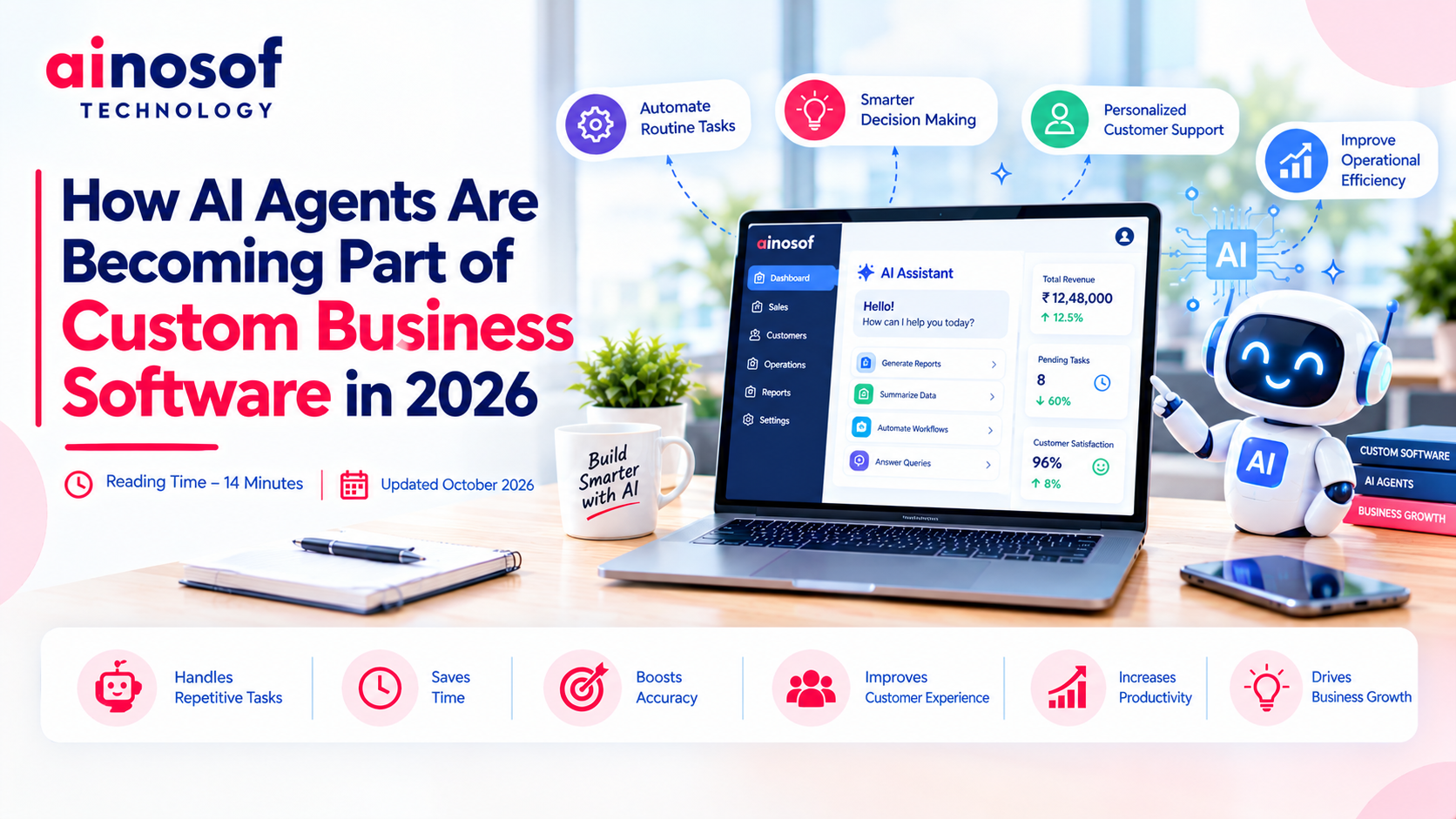
Businesses in 2026 are looking beyond AI tools that simply answer questions or generate content. They want technology that can help move work forward—organizing customer requests, retrieving business information, preparing reports and supporting everyday operational decisions.
The challenge is that business work rarely happens in one place. Sales teams use CRM systems, finance teams manage billing, HR departments maintain employee records, and operations teams depend on ERP or other internal applications. When AI operates separately from these systems, employees may still need to copy information, verify results and complete tasks manually.
This is where AI agents are becoming relevant to custom business software. Instead of functioning only as standalone assistants, they can be designed to interact with approved business systems, follow defined workflows and complete specific tasks under appropriate supervision.
However, adding an AI agent does not automatically make a business more productive. The real value depends on the problem being solved, the quality of available data, the systems involved and the level of control retained by the business.
This article explores how AI agents are entering custom business software in 2026, where they can help, what risks businesses should evaluate and when custom AI integration makes practical sense.
Businesses often introduce AI through separate applications, but operational improvements become harder to achieve when employees must repeatedly move information between disconnected tools.
Integrating AI agents into business software offers another approach: placing AI capabilities inside the workflows employees already use. This can help organizations reduce repetitive work while keeping business information and processes connected.
A traditional chatbot primarily responds to user questions. It may explain a process, retrieve information or guide someone through a conversation. Traditional automation, meanwhile, usually follows predefined rules: when a particular event occurs, the system performs a specified action.
AI agents can go further by interpreting a goal, gathering relevant information, selecting from permitted actions and carrying out multiple steps toward a defined outcome. Their exact capabilities depend on the underlying AI model, available tools, system integrations and configured permissions.
Consider a customer who asks for an update on an order.
A basic chatbot might explain where customers can check order status. A rule-based automation might send a notification when the order status changes. An AI agent connected to an authorized order management system could retrieve the relevant order information, prepare a personalized response and submit it for approval or send it automatically if the action falls within an approved policy.
The distinction is not that AI agents can perform every task independently. Rather, they can handle more flexible, multi-step workflows when the required information and actions are available.
|
Area |
Traditional automation |
AI agents |
|
Main approach |
Executes predefined rules |
Interprets goals and selects permitted actions |
|
Input handling |
Often structured and predictable |
Can interpret varied natural-language inputs |
|
Workflow |
Usually follows a predefined sequence |
May adapt its steps within defined boundaries |
|
System interaction |
Uses configured triggers and integrations |
Can use approved tools and system integrations |
|
Oversight |
Rules and exceptions require monitoring |
Requires monitoring of decisions, actions and outputs |
|
Best suited for |
Stable, repetitive processes |
Workflows involving interpretation and multiple steps |
Neither approach replaces the other. Many effective business applications will combine rule-based automation for predictable tasks with AI agents for tasks requiring interpretation, information gathering or flexible coordination.
An AI agent is more useful when it can access the information required to complete its assigned task. Without appropriate integration, it may only generate suggestions that employees must manually verify and transfer into other applications.
For example, a sales agent might need customer history from a CRM, product availability from inventory software and approved pricing from a business database. If these systems remain disconnected, the agent cannot reliably complete the workflow using current information.
Custom business software can provide a structured way to connect these systems through APIs, controlled data access and approved actions. It can also enforce business rules that determine which information an agent may retrieve and which actions require approval.
The goal is not to connect AI to everything indiscriminately. It is to give the agent access to the minimum information and tools necessary to perform a defined job.
For growing businesses, this approach can make AI a practical part of daily operations rather than another separate application employees must manage.
AI agents are most useful when a business has a clearly defined workflow involving repeated information gathering, interpretation, coordination or communication. They are less suitable for tasks that lack reliable data, require unrestricted judgment or carry significant consequences without appropriate human review.
The right starting point is a specific operational problem—not the desire to add AI to every department.
Different departments have different requirements, but several workflows can be suitable for carefully designed AI agents.
Customer service: An agent can classify incoming requests, retrieve relevant support documentation, check approved order information and draft responses. Complex complaints, refunds or sensitive cases can be routed to a human representative.
Sales operations: An agent may summarize customer interactions, organize incoming enquiries, prepare follow-up drafts and identify missing information in a lead record. Sending commitments, changing prices or making decisions about customer eligibility should remain subject to defined business policies.
Human resources: An agent can help employees find approved policy information, guide them through internal procedures or prepare summaries of HR requests. Sensitive employee decisions should not be delegated without appropriate controls and human accountability.
Finance and administration: An agent may collect information required for an invoice review, identify missing documentation or prepare a report for an authorized employee. Payments, financial approvals and changes to financial records need stronger controls than routine information retrieval.
Operations: An agent can help summarize pending tasks, retrieve inventory information, flag discrepancies or coordinate requests across connected systems.
These are potential applications rather than guaranteed outcomes. Their suitability depends on data availability, integration quality, error tolerance and the consequences of an incorrect action.
Businesses should begin with a workflow where the expected improvement can be measured and mistakes can be detected before they cause significant disruption.
ERP, CRM and HR systems contain information that employees use to coordinate business operations. AI agents can make certain workflows easier by allowing authorized users to interact with these systems through natural language or task-oriented interfaces.
For example, an employee might ask an internal business assistant to summarize pending customer orders. The agent could retrieve permitted information from the order management system, organize the results and present a concise summary.
A CRM-connected agent might prepare a customer interaction summary using approved records. An ERP-connected agent could identify items requiring replenishment based on defined inventory thresholds and current stock information.
An HR-connected agent might answer questions about an approved leave policy or help an employee locate the appropriate application process.
However, the agent should not become an unrestricted alternative to the underlying software. Business systems must remain responsible for authoritative records, access permissions, validation and transaction rules.
A practical integration usually requires:
When designed properly, AI agents can help employees interact with existing business systems more efficiently without removing the controls those systems provide.
The main implementation challenge is not simply selecting an AI model. Businesses must ensure that the agent has reliable information, clearly defined responsibilities and appropriate limits on what it can do.
A useful pilot should establish these conditions before the agent is allowed to influence important business processes.
AI agents depend on the information available to them. If customer records are outdated, product details are inconsistent or internal documents contradict one another, the agent may produce incomplete or incorrect results.
Before implementation, identify the systems that contain the required information and determine which records should be treated as authoritative.
For example, an agent preparing an order update should use the current order management record rather than an old email or an unverified document. An agent answering company policy questions should retrieve the approved version of the relevant policy.
Businesses should also test how the agent handles missing information, conflicting records, ambiguous requests and unavailable systems.
A reliable workflow should allow the agent to acknowledge uncertainty, request clarification or transfer the task to a person instead of inventing an answer.
Useful evaluation measures include:
These measures help businesses determine whether the system delivers genuine operational value rather than simply producing convincing responses.
AI agents may interact with customer information, employee records, financial data or commercially sensitive documents. Giving an agent broad access without clear controls can create security, privacy and operational risks.
Businesses should define what the agent can read, what it can change and which actions it cannot perform. Permissions should follow the principle of least privilege: provide only the access required for the assigned task.
Human approval is particularly important when actions can affect payments, contracts, employee records, customer commitments or other consequential business decisions.
For example, an agent may prepare a payment summary or flag an invoice discrepancy, while an authorized employee remains responsible for approving the payment. Similarly, an agent may draft a customer response without being permitted to issue an exceptional refund.
Businesses should also consider:
Testing should include both normal business scenarios and attempts to trigger unauthorized behavior.
AI governance should not be treated as a final technical step. It needs to be part of the software design, implementation and ongoing monitoring process.
Businesses do not always need a new application to use AI agents. Some requirements can be addressed through existing software features, approved integrations or automation platforms.
Custom development becomes more relevant when a business needs specialized workflows, deeper integration or greater control over how AI interacts with its internal systems.
The decision should follow an assessment of requirements, existing technology and total ownership costs.
Existing software may be sufficient when the required workflow is straightforward, the current platform supports the necessary integrations and the business can operate within its permissions and configuration options.
For example, a company might use an existing CRM integration to summarize customer conversations or a standard automation platform to route enquiries and prepare response drafts.
This approach can reduce initial development effort and allow a business to test an idea before committing to a larger project.
Before selecting it, confirm:
A ready-made solution is often a sensible starting point when it meets the business requirement without creating excessive workarounds.
Custom development should not be the default choice simply because AI is involved.
A business may need a custom solution when its workflows differ significantly from standard processes or when existing systems cannot provide the required level of integration and control.
Examples include coordinating information across multiple internal applications, implementing specialized approval rules, supporting industry-specific workflows or creating a unified interface for employees working across different systems.
A custom software development agency can help assess these requirements, map existing processes and determine whether custom integration, an extension to existing software or a new application is the most appropriate approach.
When evaluating custom software development companies, businesses should look beyond claims about AI expertise. Relevant questions include whether the team understands the business process, can integrate with existing systems, can establish appropriate access controls and can support the application after deployment.
Likewise, software development agencies should be assessed on their ability to test, monitor and maintain AI-powered workflows—not only on their ability to deliver a demonstration.
Ainosof Technology can be considered when a business is exploring custom software development and connected business workflows. The first step should be to define the operational problem, evaluate existing systems and identify where AI can provide measurable value.
A practical development process generally includes:
This approach reduces the risk of investing in an AI system before the business understands what it needs and whether the proposed solution can deliver it.
Explore these related areas to understand how AI agents can fit into a broader business technology strategy:
The most effective technology decisions begin with a clear business requirement. Explore the areas that align with your current operational challenges before deciding where AI investment is justified.
AI agents are becoming part of custom business software because businesses increasingly want technology that can help complete tasks, not just provide information. When connected to approved systems and carefully defined workflows, agents can support customer service, sales operations, reporting and internal coordination.
However, successful implementation depends on more than choosing an AI model. Businesses need reliable data, secure integrations, clear permissions, suitable human oversight and measurable performance targets.
For some organizations, existing software and integrations will be enough. Others may benefit from custom development when specialized workflows or system limitations make standard options impractical.
A business considering AI should start with one meaningful operational problem, test a limited solution and evaluate the results before expanding its use. A suitable technology partner, including Ainosof Technology where its services match the requirement, can help assess the options and plan an appropriate implementation.
The objective is not to introduce AI everywhere. It is to build business software that solves real problems, supports employees and delivers measurable value without creating unnecessary complexity.
AI agents are software components that can interpret a defined goal, gather relevant information and perform permitted actions through connected tools or applications. In custom business software, they can support workflows such as customer service, information retrieval, reporting and internal coordination. Their capabilities depend on the system design, available data and configured permissions.
Traditional automation generally follows predefined rules and workflows. AI agents can interpret more varied inputs, choose among permitted actions and coordinate multiple steps toward a goal. Businesses may combine both approaches, using traditional automation for predictable tasks and AI agents for workflows that require interpretation or flexible information handling.
Yes, provided the relevant systems expose suitable integration methods and the necessary access permissions are configured. AI agents can retrieve approved information, prepare summaries and initiate selected workflows. Important changes should be validated, and sensitive transactions should follow the organization's approval procedures.
Suitable workflows may include customer enquiry classification, sales follow-up preparation, internal knowledge retrieval, report preparation, support request routing and operational information gathering. The best candidates have a clear objective, accessible data, measurable results and manageable risks if an error occurs.
Some low-risk, well-tested tasks can be automated within carefully defined boundaries. However, AI agents can misunderstand requests, retrieve incorrect information or behave unexpectedly. Businesses should use testing, permissions, action limits, monitoring and human approval wherever the potential consequences justify additional oversight.
Existing tools may be sufficient when they support the required workflow, integrations and security controls. Custom AI software may be appropriate when business processes are specialized or existing solutions cannot meet important requirements. The decision should consider implementation costs, maintenance, flexibility, risks and measurable business value.
A development agency can assess business workflows, evaluate technical feasibility, integrate existing applications, design permissions and approval mechanisms, test agent behavior and support deployment. Its role should include helping the business decide whether custom development is justified rather than assuming every AI requirement needs a new application.
Compare experience with relevant business systems, integration capabilities, security practices, testing procedures, project communication, ongoing maintenance and support. Ask how the team will measure performance and handle errors. A strong partner should explain technical limitations, implementation risks and alternative approaches clearly.
Software development agencies can help monitor system performance, investigate failures, update integrations, manage access permissions and test changes as business requirements evolve. Ongoing maintenance is important because connected applications, AI models, data sources and security requirements may change after launch.
 Why Your Business Website Should Integrate With Your Internal Software Systems
12 Oct, 2026
 Why Manual Attendance Tracking Is Costing Your Business Time and Money
09 Oct, 2026
 How to Build a Client Portal That Improves Customer Experience and Reduces Support Load
08 Oct, 2026
 What Is an MIS and Why Growing Businesses Can't Scale Without One
07 Oct, 2026
 Billing Software: How It Helps Businesses Eliminate Invoice Errors and Delays
06 Oct, 2026
 How to Choose the Right HRMS Software for Your Growing Team
05 Oct, 2026
Comment with an expert and get our answer.
Comment with an expert and get our answer.
Explore more insights related to this topic and discover useful perspectives, ideas and strategies from our latest articles.