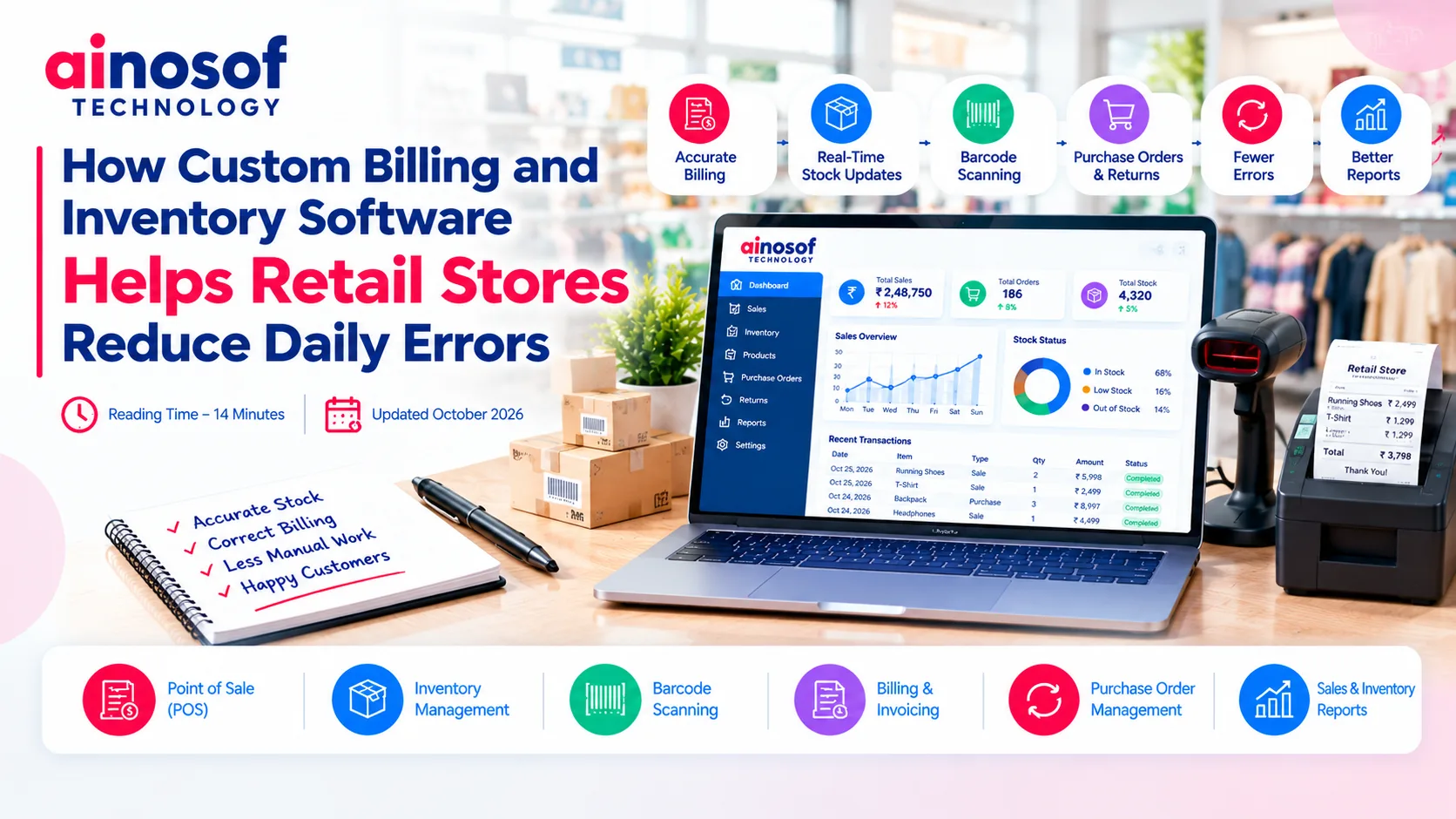
How Custom Billing and Inventory Software Helps Retail Stores Reduce Daily Errors
 Iram


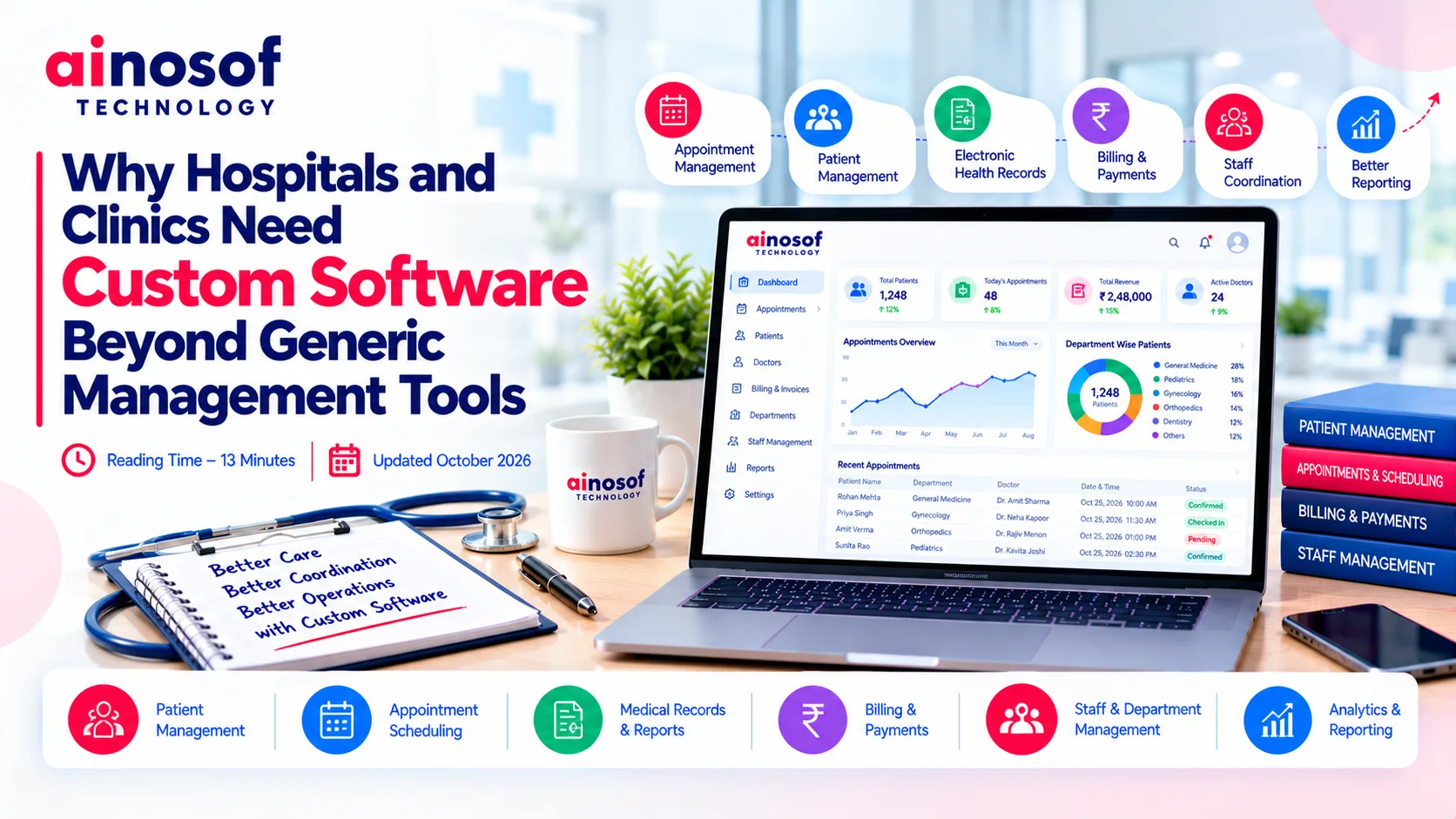
As a hospital or clinic grows, managing daily operations becomes more complicated. More patients, additional departments, new services, and increasing administrative responsibilities can put pressure on systems that once seemed sufficient. Appointment scheduling, patient records, billing, staff coordination, and reporting all need to work together for the organization to operate efficiently.
Generic healthcare management tools can provide a useful starting point. However, problems may emerge when a hospital's workflows do not fit the software's standard processes. Staff may start maintaining separate spreadsheets, entering information into multiple systems, or relying on manual communication to complete routine tasks.
These workarounds can increase administrative effort and make it harder for management to maintain a clear view of operations. The solution is not necessarily to replace every existing system. Sometimes, better integration or targeted improvements are enough. In other situations, custom software can provide the flexibility needed to support the organization's specific requirements.
Understanding when customization becomes worthwhile helps hospitals and clinics make a more informed technology investment.
Healthcare organizations manage interconnected activities, but different departments often have different operational needs. A reception team handles appointments and registrations, finance staff manage billing, clinicians need access to relevant patient information, and administrators monitor resources and performance.
When these activities are supported by disconnected systems, staff may spend more time coordinating information than completing their actual work.
Consider a clinic where appointments are recorded in one system, billing is handled through another application, and administrative reports are maintained in spreadsheets. Even if each tool performs its individual function, employees may still need to transfer information manually between them.
This creates several operational challenges.
These problems do not necessarily mean the existing software is poor. They may indicate that the organization's needs have evolved beyond the way its systems were originally configured.
For example, a multi-location clinic may need a consistent way to review appointments, monitor resource utilization, and access authorized operational information across branches. If the existing tools cannot support these workflows effectively, the organization should evaluate whether integration, configuration, or custom development is the most practical solution.
Standard tools become restrictive when important business processes cannot be supported without repeated workarounds.
A hospital might require approval workflows that reflect its internal policies, specialized operational reports, connections with existing systems, or different access permissions for different roles. A clinic network may need centralized oversight while allowing each branch to manage its own day-to-day activities.
If the software cannot accommodate these requirements, employees may adapt their work to the system rather than having the system support their work.
However, customization should not be the first response to every limitation. A hospital should first assess whether its current software can be configured, whether another suitable module is available, or whether an integration can close the gap.
Custom software becomes more relevant when the requirement is specific to the organization, operationally important, and difficult to address through existing tools. The objective is to solve a genuine workflow problem rather than build a separate application simply because the organization wants more features.
Custom healthcare software can be designed around an organization's actual processes, user roles, and system requirements. Instead of forcing every department to follow the same standard workflow, the solution can support the way the organization needs its operations to function.
The most effective approach is usually to identify the areas where better coordination would create the greatest value and develop around those priorities.
The right solution depends on the organization's size, services, existing technology, and operational challenges. Potential areas include:
|
Operational area |
How customized software may help |
|
Appointment coordination |
Connect scheduling workflows with relevant staff, service availability, and operational requirements. |
|
Patient administration |
Streamline registration and administrative information handling, with appropriate access controls. |
|
Billing workflows |
Connect billing processes with relevant service records and financial reporting systems. |
|
Department coordination |
Support internal requests, task assignments, approvals, and status updates. |
|
Management reporting |
Bring authorized operational data together for more consistent reporting and oversight. |
|
Multi-location management |
Support centralized visibility while accommodating branch-specific workflows. |
These capabilities should be planned carefully. For example, a clinic that mainly struggles with appointment coordination may benefit from improving scheduling and patient communication workflows. A larger hospital may have more complex requirements involving departmental systems, billing processes, reporting, and integrations.
Custom software can also connect with existing hospital management systems or other healthcare applications where supported integration methods are available. This may reduce duplicate work without requiring the organization to replace every application it already uses.
Patient-facing features and clinical decision-making functions require particular care. Any software handling patient information or supporting clinical workflows should be designed with appropriate privacy, security, validation, and applicable regulatory requirements in mind. A custom application should not be treated as automatically compliant or clinically safe simply because it has been built for one organization.
Customization should solve current problems without making the software unnecessarily complicated to maintain.
Hospitals and clinics should begin by documenting their essential workflows, user roles, integration requirements, and reporting needs. They should then distinguish between requirements that are necessary for the first release and improvements that can be introduced later.
Security must be considered from the beginning. Depending on the system's purpose, requirements may include role-based access, secure authentication, encryption, audit logs, backup procedures, and controlled access to sensitive information. The appropriate controls depend on the data being handled, the deployment environment, and applicable legal and regulatory obligations.
Scalability also matters. A clinic may initially need support for one location, but later expand to multiple branches. A hospital may introduce new departments or require additional integrations. The software architecture should account for realistic growth without introducing unnecessary complexity at the outset.
A phased implementation can help manage these decisions. Organizations can start with a clearly defined operational problem, test the solution with relevant users, and expand after reviewing performance and feedback.
Selecting a development partner is an important business decision because healthcare software may affect sensitive information, daily operations, and coordination between departments.
The right partner should understand both the technical requirements and the operational environment in which the software will be used.
Before investing in a new solution, compare three practical options.
|
Approach |
When it may be suitable |
|
Improve existing software |
The current system supports core workflows but needs configuration, usability improvements, or additional modules. |
|
Integrate existing systems |
Individual applications work adequately, but information needs to move more reliably between them. |
|
Build custom software |
Important workflows remain unsupported, and existing products or integrations cannot meet the requirements effectively. |
The decision should account for the total cost of ownership, not only the initial development price. Integration, data migration, testing, training, security, support, and ongoing maintenance can all influence the investment.
Healthcare organizations should also consider implementation risk. Replacing a critical system may require careful migration planning, staff training, testing, and a controlled transition to reduce disruption. In some cases, a smaller integration project can deliver value sooner than a complete replacement.
The strongest business case for custom development exists when the operational problem is clearly defined, the limitations of existing tools are understood, and the expected improvements justify the investment.
When comparing software development companies in India, hospitals and clinics should look beyond price and feature lists. They need a development partner capable of translating operational requirements into a secure, maintainable solution.
Evaluate potential partners against the following checklist:
Some organizations also search for software development companies near me because they prefer local meetings and closer collaboration. However, location alone does not establish a company's suitability. A remote development team may work effectively if communication, domain understanding, project governance, and support arrangements are strong.
Similarly, the best software development company is not necessarily the largest or the least expensive. It is the partner whose experience, development approach, technical capabilities, and support model match the organization's actual requirements.
Ainosof Technology can be considered when evaluating custom software development options. As with any prospective partner, healthcare organizations should first discuss their workflows, required integrations, data security expectations, project scope, and long-term support needs before deciding whether the proposed approach is suitable.
Healthcare organizations evaluating custom software should also consider how their wider technology systems support daily operations. Depending on their requirements, useful areas to explore include custom software development, business process automation, ERP integration, and secure website development.
Explore relevant Ainosof Technology services and resources to assess which technology approach may fit your organization's needs.
Generic healthcare management tools can be an effective starting point, but their suitability may change as hospitals and clinics expand, add departments, or develop more specialized workflows. When disconnected systems, repetitive data entry, and limited reporting begin to affect daily operations, organizations should assess whether better configuration, integration, or custom development is the most practical response.
Custom software is worth considering when it addresses clearly defined operational requirements that existing tools cannot meet effectively. The decision should account for security, integration, implementation risk, long-term maintenance, and the needs of the people who will use the system.
For hospitals and clinics, the goal is not to build the most complex software. It is to create a reliable technology environment that supports efficient operations, protects sensitive information, and can adapt as the organization grows. A careful assessment of requirements and the right development partner can help make that investment more purposeful.
Hospitals and clinics may need custom healthcare software when generic tools cannot support their specific workflows, integrations, reporting requirements, or operational processes. Custom development can help connect activities across departments and reduce reliance on manual workarounds. The decision should be based on clearly identified requirements and the limitations of existing systems.
Generic healthcare software provides standard features designed for a broad range of organizations. Custom software is developed or adapted to meet particular business requirements. Generic tools may be more practical when their features are sufficient, while custom solutions may be appropriate when essential workflows or integration needs cannot be handled effectively.
Depending on the project scope, custom software may support appointment coordination, administrative workflows, billing processes, internal task management, reporting, and multi-location operations. Clinical records and patient-facing functions may also be included where appropriate, with careful attention to security, clinical safety, and applicable requirements.
Yes. A small clinic may benefit from custom software if a specific operational problem cannot be addressed effectively by existing products. However, it should compare development and maintenance costs against suitable off-the-shelf solutions before investing. A focused solution addressing one or two important workflows may be more practical than developing a complete management platform.
Yes, if the existing system supports suitable APIs, standards, or other integration methods. The feasibility depends on the system's technical capabilities, access permissions, vendor restrictions, and data requirements. Integration should be planned carefully to maintain data consistency, protect sensitive information, and define which system is authoritative for each type of record.
Hospitals should assess authentication, role-based permissions, encryption, audit logs, backup and recovery arrangements, secure data handling, and ongoing maintenance. They should also identify applicable privacy and regulatory obligations. Security requirements should be documented and tested throughout development rather than added only after the application is completed.
The cost depends on the number of workflows, system integrations, user roles, security requirements, reporting needs, deployment approach, and ongoing support. A focused administrative tool will generally have a different scope from a multi-department platform. A reliable estimate requires a requirements assessment and a clearly defined project scope.
Hospitals should evaluate a development company's requirement-analysis process, relevant project experience, integration capabilities, security approach, testing practices, documentation, and support model. They should also review the proposed scope, milestones, ownership arrangements, and total cost of ownership before making a decision.
Both approaches can work. A local company may offer convenient in-person meetings, while a remote team can provide suitable technical capabilities without being geographically close. Clinics should prioritize relevant expertise, clear communication, reliable project management, security practices, and ongoing support rather than location alone.
Businesses may consider software development companies in India for access to a broad technology services market and different development and engagement models. However, organizations should evaluate each provider individually, particularly its ability to understand healthcare workflows, protect sensitive data, integrate existing systems, and provide long-term maintenance.
 How Custom Billing and Inventory Software Helps Retail Stores Reduce Daily Errors
22 Oct, 2026
 Why Businesses Are Moving From Web Portals to Custom Mobile Apps for Internal Teams
20 Oct, 2026
 Why Growing Ecommerce Brands Eventually Need Custom Software Beyond Shopify
19 Oct, 2026
 How Custom Learning Platforms Are Replacing Generic LMS Software for Institutes
17 Oct, 2026
 Why Custom Software Companies Need Strong Branding to Win Enterprise Clients
16 Oct, 2026
 How a CRM System Complements Custom Business Software for Better Sales Visibility
15 Oct, 2026
Comment with an expert and get our answer.
Comment with an expert and get our answer.
Continue exploring with related articles, practical guides and insights covering similar subjects. Discover more information, useful perspectives and ideas to help you learn about the topics that matter to your business.