How B2B Ecommerce Platforms Are Changing the Way Wholesalers Do Business
 Iram


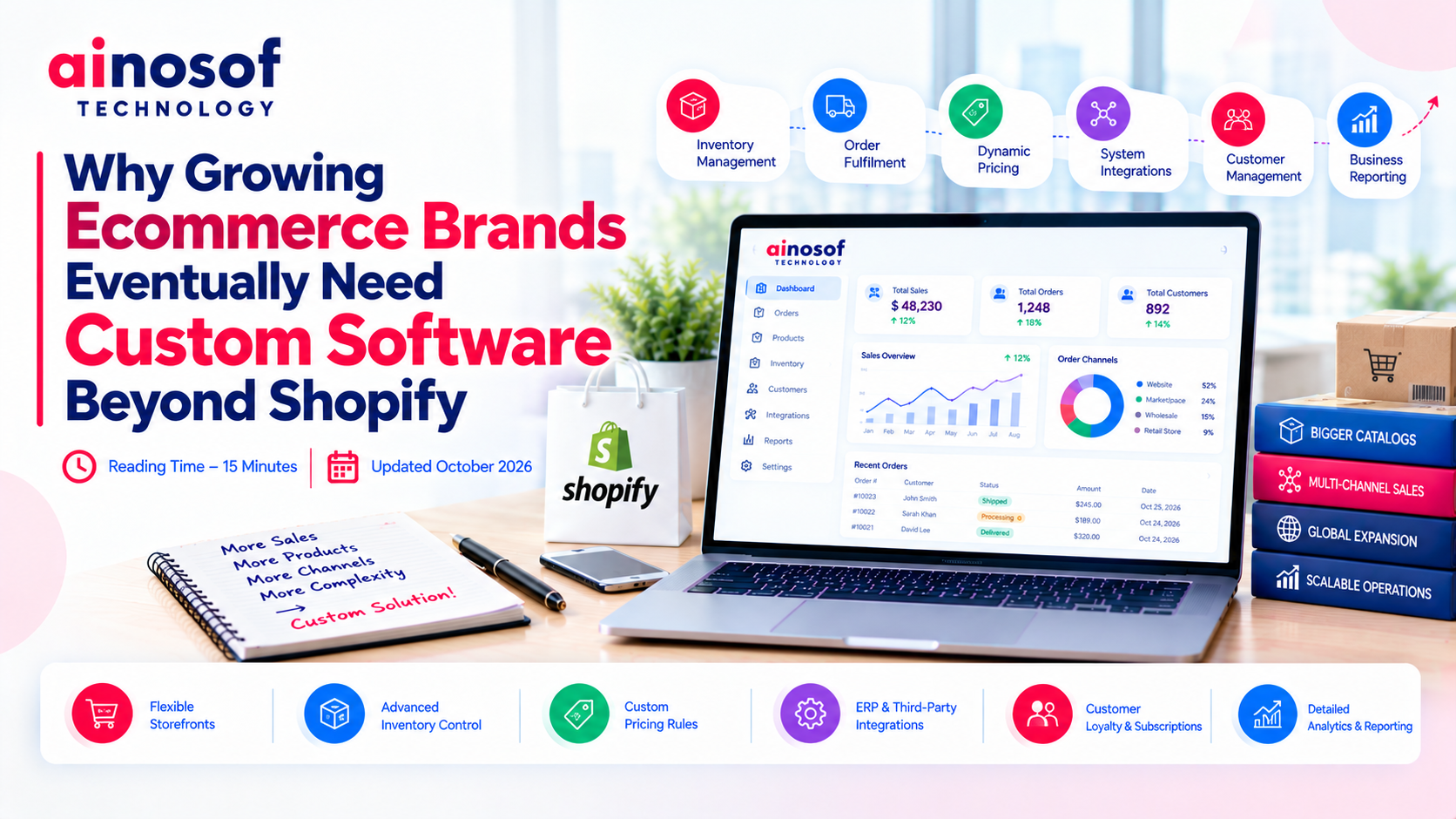
Shopify makes it easier for businesses to launch an online store, manage products, accept payments, and start selling without building an entire ecommerce system from scratch. For many brands, it remains a practical solution even as sales increase.
However, growth can change the way an ecommerce business operates. A brand that once managed a small product catalogue may now handle thousands of orders, multiple warehouses, marketplace sales, complex pricing rules, wholesale customers, and integrations with accounting or inventory systems.
At this stage, the challenge is no longer simply running an online store. It is coordinating the systems and processes behind the business.
Some brands respond by adding more apps and creating manual workarounds. Others begin exploring custom software to address the operational gaps. The right choice depends on what is slowing the business down, what Shopify can still support, and whether the cost of customization is justified.
Shopify offers a ready-made foundation for ecommerce operations. Its core features and available integrations can support a wide range of businesses, so reaching a particular sales volume does not automatically mean a brand has outgrown it.
The real pressure appears when a company's operational requirements become more specialized than its existing setup can handle efficiently.
As an ecommerce brand grows, the number of connected business activities increases. Product availability affects order acceptance, inventory levels affect fulfilment, promotions affect pricing, and customer information may need to move between several systems.
A business selling through its Shopify store alone may have relatively straightforward workflows. But a brand selling through its website, marketplaces, wholesale partners, and physical outlets may need more advanced coordination.
Common challenges include:
Shopify and its ecosystem may support many of these needs through native capabilities, apps, or APIs. Custom development becomes relevant when the available options cannot support a critical workflow reliably or when maintaining multiple workarounds creates unnecessary complexity.
The important question is not whether Shopify has limitations. Every platform does. The question is whether those limitations are affecting the brand's ability to operate efficiently and grow.
Adding an app is often the quickest way to solve a specific ecommerce problem. A brand may install separate tools for subscriptions, loyalty programmes, product reviews, inventory management, shipping, and customer communication.
Initially, this approach can be more affordable and faster than building custom software. Problems may arise when the business relies on many tools that need to exchange information but do not work together smoothly.
For example, an inventory application may update stock levels while a separate order management tool handles fulfilment. If synchronization is delayed or an integration fails, staff may need to investigate discrepancies and correct records manually.
The cost is not limited to monthly subscriptions. Businesses should also consider integration maintenance, overlapping features, staff training, support issues, and time spent managing inconsistent data.
Before replacing Shopify or investing in custom development, review the current setup:
If the issues can be resolved by removing redundant tools or improving existing integrations, a complete custom build may be unnecessary. If critical workflows remain difficult to support, custom software may provide a more sustainable solution.
Custom ecommerce software is designed around a business's specific requirements rather than relying exclusively on standard platform features. It can operate alongside Shopify, extend its capabilities, or form part of a more extensively customized ecommerce architecture.
The goal is to improve the processes that directly affect the customer experience, operational efficiency, and business growth.
Custom development becomes valuable when a brand has requirements that are difficult to meet through existing platform settings and available applications.
Inventory and warehouse coordination: A brand managing multiple warehouses may need customized stock allocation, replenishment rules, or order routing based on location and delivery commitments.
ERP and accounting integration: Businesses may need orders, invoices, refunds, inventory movements, and financial records to synchronize with their existing systems. Well-designed integration can reduce duplicate entry and improve record consistency.
B2B and wholesale operations: A brand selling to distributors or corporate buyers may need negotiated pricing, customer-specific catalogues, bulk ordering, approval workflows, or credit-related processes.
Complex product configuration: Businesses selling configurable products may need specialized selection tools, pricing calculations, compatibility rules, or quotation workflows.
Order fulfilment: Custom logic may help coordinate split shipments, special handling, supplier fulfilment, or routing rules that are not adequately supported by the current setup.
Management dashboards: A business may need a consolidated view of sales, stock, order status, returns, and fulfilment performance across several channels.
Consider a growing ecommerce brand that sells directly to consumers and also supplies wholesale distributors. Its consumer store may work well on Shopify, but its wholesale operations could require customer-specific prices, bulk-order approvals, and integration with an ERP system.
In that situation, the business may not need to abandon Shopify. It could retain Shopify for storefront operations and develop a connected application for the specialized wholesale and operational workflows.
This approach allows the company to address its actual bottlenecks instead of rebuilding functionality that already works.
There is no single architecture that suits every growing ecommerce business. The right choice depends on which part of the system needs to change.
|
Approach |
Best suited for |
Main consideration |
|
Continue with Shopify |
Standard ecommerce operations that are working effectively |
Keep the existing setup manageable and cost-effective |
|
Extend Shopify |
Businesses needing additional workflows or integrations |
Confirm that the required features and APIs support the solution |
|
Hybrid approach |
Brands retaining Shopify while adding custom operational software |
Plan data synchronization, system responsibilities, and support |
|
Headless commerce |
Businesses needing greater control over the storefront experience while using a commerce backend |
Account for additional development, infrastructure, and maintenance |
|
More extensively custom-built ecommerce |
Businesses with specialized requirements that existing platforms cannot reasonably support |
Evaluate the full cost, complexity, security, and long-term responsibility |
Headless commerce separates the customer-facing storefront from the commerce backend. It can provide greater control over the front-end experience, but it does not automatically solve inventory, fulfilment, or other operational challenges. Those may require integrations or separate applications.
A fully custom ecommerce platform offers more control over architecture and functionality, but it also places greater responsibility on the business and its technology partner.
For many growing brands, a hybrid approach is worth evaluating first. Shopify can continue managing the parts of the business it handles well, while custom software addresses specific gaps.
A phased approach can also reduce risk. Businesses can begin with one high-impact workflow, evaluate the results, and expand only when the business case supports further investment.
A growing order volume alone is not sufficient reason to replace an ecommerce platform. Businesses should first identify the operational problems they need to solve and compare the cost of different solutions.
The decision should balance current requirements, future plans, technical complexity, and the resources needed to maintain the system.
The most useful comparison considers the total cost of ownership rather than the initial development estimate or monthly platform fee alone.
Shopify typically provides a quicker path to market because much of the core commerce infrastructure is already available. Costs may include subscriptions, paid apps, transaction-related charges where applicable, and integration work.
Custom software usually requires more upfront planning and development. Ongoing costs may include hosting, monitoring, security updates, support, testing, and future enhancements.
Before choosing either approach, evaluate the following factors.
Business value: Identify the delays, errors, missed opportunities, or manual tasks that the proposed solution is expected to reduce. Establish a baseline so results can be measured after implementation.
Flexibility: Determine whether the business genuinely needs specialized workflows or whether existing configuration options can meet its requirements.
Integration reliability: Consider how orders, customer records, inventory, payments, and financial information will move between systems. Define which system is the source of truth for each type of data.
Scalability: Assess expected growth in orders, users, product data, and simultaneous activity. The solution should be designed for realistic demand rather than an undefined expectation of unlimited growth.
Maintenance responsibility: Establish who will monitor integrations, resolve issues, manage updates, and maintain compatibility as connected platforms change.
Ownership and control: Clarify rights to custom code, access to data, third-party licensing, documentation, and the ability to change development partners.
A business should also estimate the cost of doing nothing. If a manual process consumes substantial staff time or recurring integration failures affect order fulfilment, retaining the current setup has a cost too.
The decision becomes clearer when these costs are compared over a realistic planning period. If Shopify continues to meet the brand's requirements at a reasonable total cost, keeping it may be the most sensible choice. If important operational problems persist despite reasonable improvements, custom development deserves serious consideration.
Choosing an ecommerce website development company requires more than reviewing storefront designs. A growing brand may need help with business logic, data integration, performance, security, and long-term system maintenance.
Look for a partner that understands how ecommerce operations connect to the wider business.
Start with the discovery process. The company should ask about order volumes, product structures, fulfilment rules, inventory management, customer segments, existing applications, and the problems that prompted the project.
Then assess its approach to delivery.
Professional ecommerce website development services should begin with the business problem, not an assumption that every growing brand needs a completely new platform.
Ainosof Technology can be considered by businesses exploring custom software and digital solutions. As with any potential development partner, ecommerce brands should evaluate the proposed scope, relevant experience, technical approach, and ongoing support arrangements before making a decision.
The best partner will help determine what should remain on Shopify, what should be integrated, and what genuinely needs to be custom-built.
Ecommerce growth depends on more than the storefront. Brands also need connected operations, reliable business information, and technology that supports their next stage of development.
Review these options in the context of your existing technology stack. A coordinated approach can help your business improve efficiency without replacing systems that already perform well.
Shopify remains a practical ecommerce platform for many businesses, including brands experiencing significant growth. The need for custom software emerges when a company's operational complexity begins to exceed what its existing platform, configuration, and integrations can handle effectively.
For some brands, the answer is a better app stack. For others, it may be a custom integration, a hybrid system, or a headless storefront. A complete custom ecommerce platform is only one of several options and should be considered when the business requirements justify the additional investment and responsibility.
Before making the change, document the problems, estimate their business impact, compare realistic alternatives, and plan for maintenance as carefully as development.
The goal is not to move beyond Shopify simply because the business is growing. It is to build an ecommerce technology setup that supports the way the business actually operates—and gives it room to grow without unnecessary complexity.
A business should consider alternatives when important operational workflows cannot be supported efficiently, integrations repeatedly create problems, or the cost of workarounds becomes difficult to justify. Growth alone does not require a move; the decision should be based on specific limitations and business objectives.
Not necessarily. Shopify is effective for many growing businesses, while custom software can be better suited to specialized workflows, complex integrations, or unique operational requirements. Some brands benefit most from keeping Shopify and extending it with custom applications.
Yes. Depending on the requirements, Shopify can connect with custom applications and external business systems through supported APIs and integration methods. The design should define data ownership, synchronization frequency, error handling, and security requirements.
Examples include specialized inventory allocation, complex wholesale pricing, customized order routing, configurable product workflows, multi-system reporting, and integrations with ERP or warehouse systems. Whether custom development is necessary depends on the capabilities of the existing platform and its available extensions.
Yes. Headless commerce can allow a business to build a customized storefront while retaining Shopify or another commerce backend. However, it introduces additional development and maintenance requirements and may not address operational issues outside the storefront.
The cost depends on the features, integration complexity, architecture, security requirements, and ongoing support needed. Extending an existing Shopify store with a focused application may require a different investment from building a complete ecommerce platform. A clear scope is necessary for a reliable estimate.
Look for business understanding, relevant platform and integration expertise, clear project planning, transparent pricing, appropriate security practices, and ongoing support. The company should be able to justify its recommendations based on actual business requirements.
Yes. Custom software can help synchronize orders, stock levels, invoices, and other relevant data between ecommerce stores and business systems. The integration should specify which system controls each record and how errors or conflicting updates will be handled.
They can help improve storefront experiences, integrate business systems, automate selected workflows, and address technical bottlenecks. Effective services focus on the business's actual growth constraints rather than adding complexity without a clear purpose.
The brand should first identify which functions Shopify handles well and which create measurable operational problems. If only a few workflows need improvement, extending Shopify may be more cost-effective. A more extensive replacement should be considered when core requirements cannot reasonably be met by the existing platform and the long-term business case justifies the investment.
 How Custom Learning Platforms Are Replacing Generic LMS Software for Institutes
17 Oct, 2026
 Why Custom Software Companies Need Strong Branding to Win Enterprise Clients
16 Oct, 2026
 How a CRM System Complements Custom Business Software for Better Sales Visibility
15 Oct, 2026
 ERP vs Custom Software: Which One Does Your Business Actually Need?
14 Oct, 2026
 How to Build an SEO Strategy for a B2B SaaS or Software Company
13 Oct, 2026
 Why Your Business Website Should Integrate With Your Internal Software Systems
12 Oct, 2026
Comment with an expert and get our answer.
Comment with an expert and get our answer.
Explore more insights related to this topic and discover useful perspectives, ideas and strategies from our latest articles.