

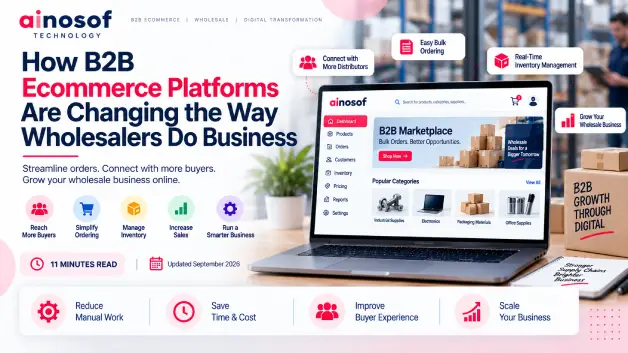
How B2B Ecommerce Platforms Are Changing the Way Wholesalers Do Business

Introduction
For many wholesalers, growth brings an unexpected challenge: the process that worked well with a few customers becomes difficult to manage when orders, products, pricing rules and customer accounts start increasing. Sales teams may spend hours responding to order requests, confirming prices, checking stock and entering the same information into different systems. At the same time, buyers increasingly expect a faster and more convenient way to browse products, place bulk orders and repeat their purchases.
This creates a bigger business question than simply whether a wholesaler should start selling online. The real question is whether the existing wholesale process can support the next stage of growth without creating more manual work, order errors and operational complexity.
A B2B ecommerce platform for wholesalers can change how customers place orders and how businesses manage pricing, products, inventory and customer relationships. But its value depends on how well the platform fits the wholesaler's actual business model and existing systems. For some businesses, a straightforward digital ordering system may be enough. Others may require customer-specific pricing, bulk-order workflows, ERP, CRM and billing integrations.
In this article, we will examine how B2B ecommerce is changing wholesale operations, what happens to the buyer and seller experience, when a wholesale business is ready to adopt ecommerce, and what to evaluate before investing in a wholesale ecommerce platform or B2B ecommerce software India.
Why Traditional Wholesale Processes Start Breaking Down as the Business Grows
Wholesale businesses often begin with simple processes. A customer calls the sales team, asks about products, confirms the price, sends an order on WhatsApp, and someone enters the details into a spreadsheet or business system. This can work when the number of customers and orders is manageable.
The problem starts when the business grows. More customers mean more messages, more price requests, more stock checks and more orders to process. A process that once felt convenient can gradually become a source of delays and mistakes.
A B2B ecommerce platform for wholesalers becomes relevant at this stage because it can shift repetitive ordering activities from manual communication to a structured digital process.
Where do phone calls, WhatsApp orders and spreadsheets create operational gaps?
Phone calls and WhatsApp are useful communication channels, but they are not designed to manage an entire wholesale ordering process.
An order received through WhatsApp may contain product names, quantities and delivery details in a message that later has to be entered manually. Another customer may call for a different price. A third may send an old product list or ask for stock availability separately.
This creates several gaps:
- Order information can be scattered across different conversations.
- Sales staff may need to repeatedly confirm product availability.
- Prices can be communicated inconsistently.
- Manual data entry can lead to quantity or product errors.
- It becomes harder to track the complete order history of each customer.
- Important customer or order information can remain dependent on individual employees.
For example, imagine a wholesaler receiving 40–50 orders a day through calls and WhatsApp. Even if each order takes only a few minutes to verify and enter, the team can spend several hours handling repetitive administrative work instead of focusing on customer relationships and sales opportunities.
The issue is therefore not that WhatsApp or phone calls are bad for business. The issue is that they become difficult to control when they are carrying more operational responsibility than they were designed for.
Why does increasing order volume make manual wholesale management harder to control?
As order volume increases, the number of individual decisions increases with it. The team may need to check which price applies to a customer, whether the requested quantity is available, whether the customer has a minimum order requirement, and whether the order needs approval before processing.
When these checks happen manually, every additional order adds another opportunity for inconsistency.
Consider a wholesaler serving 100 business customers with different pricing arrangements. If orders are handled manually, employees may have to remember or look up customer-specific rates for every transaction. When order volume doubles, the problem is not simply twice as many orders—it is twice as many opportunities for pricing, inventory and data-entry mistakes.
A digital ordering system can bring these processes into one controlled environment. Customers can access the products and information relevant to their account, while the business can manage orders through a consistent workflow.
This becomes increasingly important when the goal is not just to handle today's orders, but to build a wholesale operation that can support future growth without increasing manual workload at the same rate.
How B2B Ecommerce Changes the Way Wholesalers and Buyers Place Orders
The biggest change brought by B2B ecommerce is not simply putting products on a website. It changes how a business customer interacts with the wholesaler.
Instead of depending on a salesperson for every product inquiry or order, customers can access an organized digital purchasing environment. This gives the wholesaler an opportunity to make routine buying more self-service while allowing the sales team to spend more time on activities that require human interaction.
For a growing wholesale business, this can create a more structured connection between customer demand and internal order processing.
How can business customers check products and place orders without depending on sales staff?
A well-designed B2B ecommerce platform for wholesalers can give approved business customers access to products, quantities, prices and ordering options through their own accounts.
A customer can log in, find the required products, review available information, select quantities and submit an order without having to call the sales team for every routine purchase.
This is particularly useful when customers already know what they want to buy. The sales team does not need to manually recreate the same order process each time.
For example, a retailer regularly purchasing 20 products from a distributor could use the online platform to select those products and submit an order directly. The distributor receives a structured order instead of having an employee interpret a phone call or manually copy details from a message.
The sales team can then focus on new opportunities, larger accounts, negotiations and customer relationships rather than spending most of its time processing routine orders.
Why can digital ordering make repeat and bulk purchases easier for wholesale buyers?
Wholesale purchasing is often repetitive. Customers may reorder the same products every week or month, while some businesses may purchase large quantities at once.
A digital ordering system can make these purchasing patterns easier to manage. Customers can return to the same platform, find products quickly and place another order without restarting the entire conversation with the sales team.
For bulk buyers, the system can also present quantities and ordering rules in a more structured way. Instead of exchanging multiple messages to confirm what is required, the customer can enter the order directly.
For example, a retailer that normally sends a WhatsApp message containing a long list of products can use an ecommerce account to select those products and quantities in one place. This reduces unnecessary back-and-forth and gives both sides a clearer record of what was ordered.
The result is a purchasing process designed around the way wholesale customers actually buy: frequently, in quantities, and often with repeat requirements.
How does a better buyer experience affect the wholesaler's day-to-day sales process?
A better customer experience can also improve the wholesaler's internal workflow.
When customers can independently handle routine product searches and orders, sales employees have fewer repetitive tasks to manage. This can reduce interruptions and make it easier for the team to prioritize customers who need consultation, negotiation or additional support.
It also creates a more consistent ordering experience. Customers are not necessarily dependent on whether a particular salesperson is available to answer a message or call.
For instance, if a customer wants to place an order outside normal sales-team working hours, an online B2B ordering system can still provide a channel for submitting the order. The internal team can then process it according to the business's workflow.
This does not eliminate the role of salespeople. Instead, it can shift their time from order taking toward relationship building and revenue-generating activities.
How Digital Wholesale Selling Changes Pricing and Commercial Control
Pricing is one of the areas where B2B wholesale differs significantly from simple online retail.
A wholesaler may sell the same product to different customers under different commercial arrangements. Prices can depend on customer category, order quantity, negotiated agreements or other business rules.
That means a wholesale ecommerce platform needs to support the commercial logic of the business rather than displaying one universal price to everyone.
How can wholesalers manage customer-specific pricing and product access?
A B2B ecommerce system can be designed around individual business accounts instead of treating every visitor as the same customer.
For example, a distributor may have:
- Retailer pricing
- Dealer pricing
- Distributor pricing
- Special negotiated pricing
- Different product access for different customer groups
Instead of manually communicating these arrangements every time a customer places an order, the platform can display the appropriate information based on the customer's account and permissions.
The same principle can apply to product visibility. Some products may be available only to selected dealers or specific business customers.
This creates greater control over how commercial information is presented while reducing the need for employees to manually manage every routine pricing interaction.
How can a B2B ecommerce system support minimum quantities, bulk orders and different customer terms?
Wholesale transactions often have rules that do not apply to ordinary retail purchases.
A business may require a minimum order quantity, sell products in cases rather than individual units, provide quantity-based pricing or follow specific ordering terms for particular customers.
A properly configured B2B ecommerce platform for wholesalers can incorporate these rules into the ordering process.
For example, if a product can only be purchased in quantities of 50 units, the system can be structured around that requirement instead of allowing a customer to submit an order for an unsuitable quantity.
Similarly, quantity-based pricing can be presented according to the business's commercial model. A customer purchasing a larger volume may see the applicable pricing structure rather than having to negotiate the same information manually for every order.
The important point is that ecommerce should reflect the wholesaler's existing commercial rules rather than forcing the business to change its model simply to fit the software.
Why does centralized pricing information matter when multiple customers and sales channels are involved?
The more customers and sales channels a wholesaler manages, the harder it becomes to maintain pricing consistency manually.
If one price is stored in a spreadsheet, another is communicated through WhatsApp and another is maintained by a salesperson, discrepancies can occur. Even a small pricing mistake can create confusion with customers and additional work for the sales team.
Centralizing pricing information gives the business a clearer system for managing these commercial rules.
For example, when a customer logs into the B2B platform, the system can use the customer's account information to determine which pricing arrangement should apply. This reduces the need for employees to repeatedly communicate routine prices.
It also creates a more controlled foundation for future growth, especially when the business operates through multiple salespeople, branches or digital channels.
The goal is not simply to put prices online; it is to make commercial information easier to manage, control and apply consistently.
What Changes When B2B Ecommerce Connects With Inventory, ERP, CRM and Billing
An ecommerce platform does not operate in isolation in a growing wholesale business. Orders, inventory, customer records, invoices and financial information are usually connected to other business processes.
If these systems remain disconnected, employees may still need to copy information from one system to another. That means some of the manual work the business wanted to reduce can continue after launching ecommerce.
This is why system integration becomes an important part of evaluating B2B ecommerce software India.
How can ecommerce and inventory information stay aligned?
When ecommerce and inventory systems are connected appropriately, information can move between the customer-facing ordering process and internal inventory operations.
For example, when a customer places an order, the business may need that order to affect inventory records and become visible to the relevant internal team.
Without a connected workflow, employees may have to manually transfer order information and update inventory separately. This creates additional work and increases the possibility of discrepancies.
Integration can help create a more continuous process:
Customer order → Order processing → Inventory update → Fulfilment → Billing
The exact workflow depends on the business's existing systems, but the principle remains the same: the ecommerce platform should fit into the operational system rather than becoming another isolated place where information is stored.
When does a wholesaler need ERP, CRM or billing integration?
Integration becomes more important when the wholesale business already depends heavily on separate systems for daily operations.
An ERP may manage inventory, purchasing and business operations. A CRM may hold customer and sales information. Billing software may handle invoices and financial records.
If the ecommerce platform and these systems do not communicate, employees may have to enter the same information multiple times.
For a smaller wholesaler with limited operations, this may initially be manageable. But as customer numbers, orders and internal processes increase, integration can become much more valuable.
The right question is therefore not simply, “Do I need ERP integration?”
It is:
“Which business information is already being managed elsewhere, and would connecting these systems remove meaningful manual work or reduce operational errors?”
That approach helps wholesalers invest in integration where it solves a real business problem rather than adding technology without a clear purpose.
Why can disconnected business systems create problems even after launching an ecommerce platform?
Launching an ecommerce website does not automatically digitize the entire wholesale operation.
Imagine a customer places an order online, but an employee still has to manually check inventory in another system, enter the customer details into a CRM, create an invoice separately and update another spreadsheet.
The customer may have experienced a digital ordering process, but the business behind that process is still largely manual.
This creates a hidden operational gap. The front end appears modern, while the back-office workflow continues to depend on repetitive data entry.
For this reason, wholesalers should evaluate the complete order journey before choosing a platform. The objective should be to create a connected process in which customers, orders, inventory, customer records and billing information move through the business with as little unnecessary duplication as possible.
A successful B2B ecommerce transformation is therefore not just about accepting orders online—it is about creating a wholesale operation that can manage those orders efficiently from purchase to fulfilment and beyond.
When Is a Wholesale Business Actually Ready for B2B Ecommerce?
A wholesale business does not need to move to ecommerce simply because competitors are doing it. The decision should come from a real operational need. If order handling is becoming slower, customers are asking for easier ways to buy, or employees are spending too much time managing repetitive tasks, it may be time to consider a B2B ecommerce platform for wholesalers.
The important question is not whether the business is large enough. It is whether the current way of selling is starting to limit growth, customer service or operational control.
What operational signals suggest that manual wholesale processes are becoming a limitation?
Several practical signs can indicate that manual processes are no longer working efficiently.
For example:
- Sales staff spend a large part of their day taking routine orders.
- Customers repeatedly ask for product prices and availability.
- Orders arrive through calls, WhatsApp, email and spreadsheets.
- Employees manually enter the same order information into different systems.
- Pricing mistakes or quantity errors occur regularly.
- Customers frequently reorder the same products.
- It is difficult to track customer-specific pricing and purchase history.
- Management has limited visibility into orders and customer activity.
- Increasing order volume requires adding more administrative staff.
Imagine a wholesaler whose orders have doubled over two years. The business may have more customers and revenue, but if every new order also requires another round of calls, messages, stock checks and manual data entry, growth is increasing operational pressure.
That is a strong signal to examine whether the existing process should be digitized.
Which wholesalers can benefit from starting with a simpler digital ordering system?
Not every wholesaler needs a highly customized ecommerce ecosystem from day one.
A simpler digital ordering system can be suitable when the business has a relatively straightforward product catalogue, limited pricing variations and customers who mainly need an easier way to browse products and place orders.
For example, a wholesaler selling a defined range of products to retailers may initially need:
- A searchable product catalogue
- Business customer accounts
- Wholesale pricing
- Bulk quantity selection
- Online order placement
- Order history
- Repeat ordering
This approach can provide a practical starting point without introducing unnecessary complexity.
As the business grows, additional capabilities such as ERP integration, CRM connectivity, automated workflows or more advanced customer rules can be added according to actual requirements.
The right starting point is therefore the system that solves the current business problem while leaving room for future development.
When does a customized B2B ecommerce solution make more sense than a standard platform?
A customized solution becomes more relevant when the wholesaler's selling process does not fit neatly into a standard ecommerce model.
This can happen when the business has complex customer-specific pricing, dealer networks, approval workflows, credit arrangements, minimum order rules, multiple warehouses, specialized product configurations or existing software that needs to be integrated.
For example, one customer may receive a negotiated price, another may have different minimum quantities, and a third may only be allowed to purchase selected products. If these rules are central to the business, forcing them into a generic ecommerce setup can create limitations.
A custom B2B ecommerce solution can instead be designed around the actual workflow of the business.
The decision should therefore be based on business complexity, integration requirements and long-term operational needs—not simply on the number of products or customers.
How Wholesalers Should Evaluate a B2B Ecommerce Platform Before Investing
Choosing a wholesale ecommerce platform should not begin with a list of software features. It should begin with the way the business actually sells.
A platform may look impressive in a demonstration but still be unsuitable if it cannot support the wholesaler's pricing structure, ordering process, customer relationships or existing business systems.
Before investing, wholesalers should evaluate the platform against their current workflow and the direction in which they expect the business to grow.
Does the platform match the way your wholesale business actually sells?
Start by mapping the actual customer journey.
Ask how customers currently discover products, request prices, place orders, receive confirmations, make payments and reorder. Then check whether the platform can support that journey without forcing the business into an unsuitable process.
For example, a wholesaler selling through dealers may need separate customer accounts, dealer pricing and approval-based ordering. Another wholesaler may mainly need a simple catalogue with bulk ordering and repeat purchases.
The platform should fit the business model rather than requiring the business to redesign important commercial processes just to accommodate the software.
A useful evaluation question is:
Can this platform make our existing wholesale process more efficient without removing the rules that make our business work?
Can it support your pricing, ordering, customer and integration requirements?
The next step is to examine the areas where wholesale ecommerce differs from ordinary online selling.
Check whether the platform can support:
- Customer-specific pricing
- Bulk orders
- Minimum order quantities
- Business customer accounts
- Customer-specific product access
- Repeat orders
- Order approval workflows
- Inventory visibility
- ERP integration
- CRM integration
- Billing and invoicing workflows
For example, if your ERP already controls inventory but the ecommerce platform cannot exchange inventory information with it, employees may still need to manually check and update stock.
Similarly, if customer pricing is negotiated individually, a platform that only supports one public price may not match the business model.
The technology should therefore be evaluated according to the business processes it needs to support, not just the features shown on a product page.
Will the platform continue to support the business as customers and order volumes grow?
A platform should solve today's problem without creating tomorrow's limitation.
Before choosing one, consider what happens if the business doubles its customers, adds more products, opens another warehouse, introduces new customer categories or connects additional business systems.
For example, a platform that works for 50 customers may become difficult to manage if customer-specific pricing and order workflows become much more complex at 500 customers.
Scalability also includes the ability to improve the system over time. The business may eventually require additional automation, reporting, integrations or customized workflows.
This is where working with an experienced B2B ecommerce software India provider can become useful. A technology partner should be able to understand the business process, identify integration requirements and build or adapt the system around long-term needs.
The right platform is not necessarily the one with the longest feature list. It is the one that can support the way the business operates today and evolve with it tomorrow.
Continue Your Business Development Journey
Moving wholesale operations online is only one part of a broader digital business strategy. Once ordering becomes more structured, wholesalers can also examine how their ERP, CRM, billing software, inventory management and customer data work together.
Businesses evaluating this transition should look at the complete workflow—from attracting and managing business customers to processing orders, maintaining inventory, generating invoices and building repeat sales.
A connected technology strategy can help ensure that ecommerce becomes part of the business infrastructure rather than another isolated system.
For wholesalers planning a digital transformation, the next step should be to identify the processes that consume the most manual effort and determine which ones can be improved through ecommerce, automation or custom software.
Conclusion
The shift toward B2B ecommerce is changing wholesale business because customers are no longer limited to traditional ordering methods. They increasingly expect convenient product access, faster ordering and clearer digital interactions, while wholesalers need greater control over pricing, orders, inventory and customer relationships.
A B2B ecommerce platform for wholesalers can address these needs, but its value depends on how well it fits the business. A simple digital ordering system may be enough for one wholesaler, while another may require customized pricing, bulk-order workflows and connections with ERP, CRM and billing systems.
The most important decision is therefore not simply whether to sell online. It is whether the technology can make the wholesale operation easier to manage, easier for customers to use and capable of supporting future growth.
For a wholesaler considering this transition, the right starting point is a clear assessment of the current process, the problems slowing the business down and the technology required to solve them.
Frequently Asked Questions
Q1. What is a B2B ecommerce platform for wholesalers?
A B2B ecommerce platform for wholesalers is an online business ordering system designed around wholesale transactions. It can allow approved business customers to view products, access relevant pricing, place bulk orders, manage repeat purchases and track their orders.
Unlike a basic retail ecommerce store, a B2B system can be designed around business-specific requirements such as customer accounts, negotiated pricing, minimum quantities and integrations with internal software.
Q2. How does B2B ecommerce change traditional wholesale ordering?
It moves routine ordering from conversations and manual data entry toward a structured digital process.
Instead of calling a salesperson for every order, a customer can log in, find products, select quantities and submit an order. This can reduce repetitive work for sales teams while giving customers a more convenient purchasing process.
Q3. Can wholesalers offer different prices to different customers through ecommerce?
Yes. A suitable wholesale ecommerce platform can be configured to support customer-specific pricing or pricing groups.
For example, dealers, distributors and retailers may have different commercial arrangements. The platform can use customer accounts or business rules to show the appropriate pricing rather than displaying one price to every customer.
Q4. Can a B2B ecommerce platform handle bulk and repeat orders?
Yes. B2B ecommerce can be designed for wholesale purchasing patterns, including larger quantities and recurring orders.
Customers can use product search, quantity selection, saved information or order history to make repeat purchasing easier, depending on the platform's capabilities.
Q5. When should a wholesaler connect ecommerce with ERP, CRM or billing software?
Integration becomes more important when these systems already play a significant role in daily operations.
If employees are repeatedly copying order, customer, inventory or billing information between systems, integration may reduce duplicated work and improve information flow.
The right integration depends on the wholesaler's existing technology and the specific processes that need to be connected.
Q6. Is B2B ecommerce software India suitable for traditional wholesale businesses?
Yes. Traditional wholesale businesses can use B2B ecommerce software India to digitize ordering and other business processes while continuing to operate their existing wholesale model.
The important consideration is whether the software supports requirements such as customer-specific pricing, bulk orders, inventory, billing, ERP integration and other workflows relevant to the business.
Q7. Should a wholesaler choose a standard platform or customized B2B ecommerce software?
The decision depends on the complexity of the wholesale operation.
A standard platform may be suitable when the business has straightforward ordering and pricing requirements. Customized B2B ecommerce software can make more sense when the business depends on complex pricing, customer rules, approval workflows, multiple systems or specialized processes.
The choice should be based on the business requirements and expected future growth rather than simply the initial development cost.
-
 How Institute Management Software Simplifies Administration for Coaching Institutes
16 Sep, 2026
How Institute Management Software Simplifies Administration for Coaching Institutes
16 Sep, 2026
-
 Why Corporate Identity Matters More for B2B and Manufacturing Companies
15 Sep, 2026
Why Corporate Identity Matters More for B2B and Manufacturing Companies
15 Sep, 2026
-
 How CRM and ERP Integration Improves Sales and Operations Together
14 Sep, 2026
How CRM and ERP Integration Improves Sales and Operations Together
14 Sep, 2026
-
 What is Answer Engine Optimization (AEO) and How Can Businesses Get Featured in AI-Generated Answers?
03 Aug, 2026
What is Answer Engine Optimization (AEO) and How Can Businesses Get Featured in AI-Generated Answers?
03 Aug, 2026
-
 How a Professional Website Builds Credibility for Manufacturing and B2B Companies
10 Sep, 2026
How a Professional Website Builds Credibility for Manufacturing and B2B Companies
10 Sep, 2026
-
 How B2B Companies Can Use LinkedIn and SEO Together to Generate Leads
11 Sep, 2026
How B2B Companies Can Use LinkedIn and SEO Together to Generate Leads
11 Sep, 2026
Still have some doubts?
Comment with an expert and get our answer.