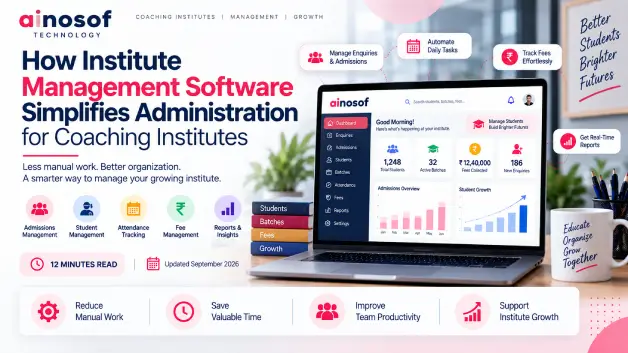
How Institute Management Software Simplifies Administration for Coaching Institutes
 Iram


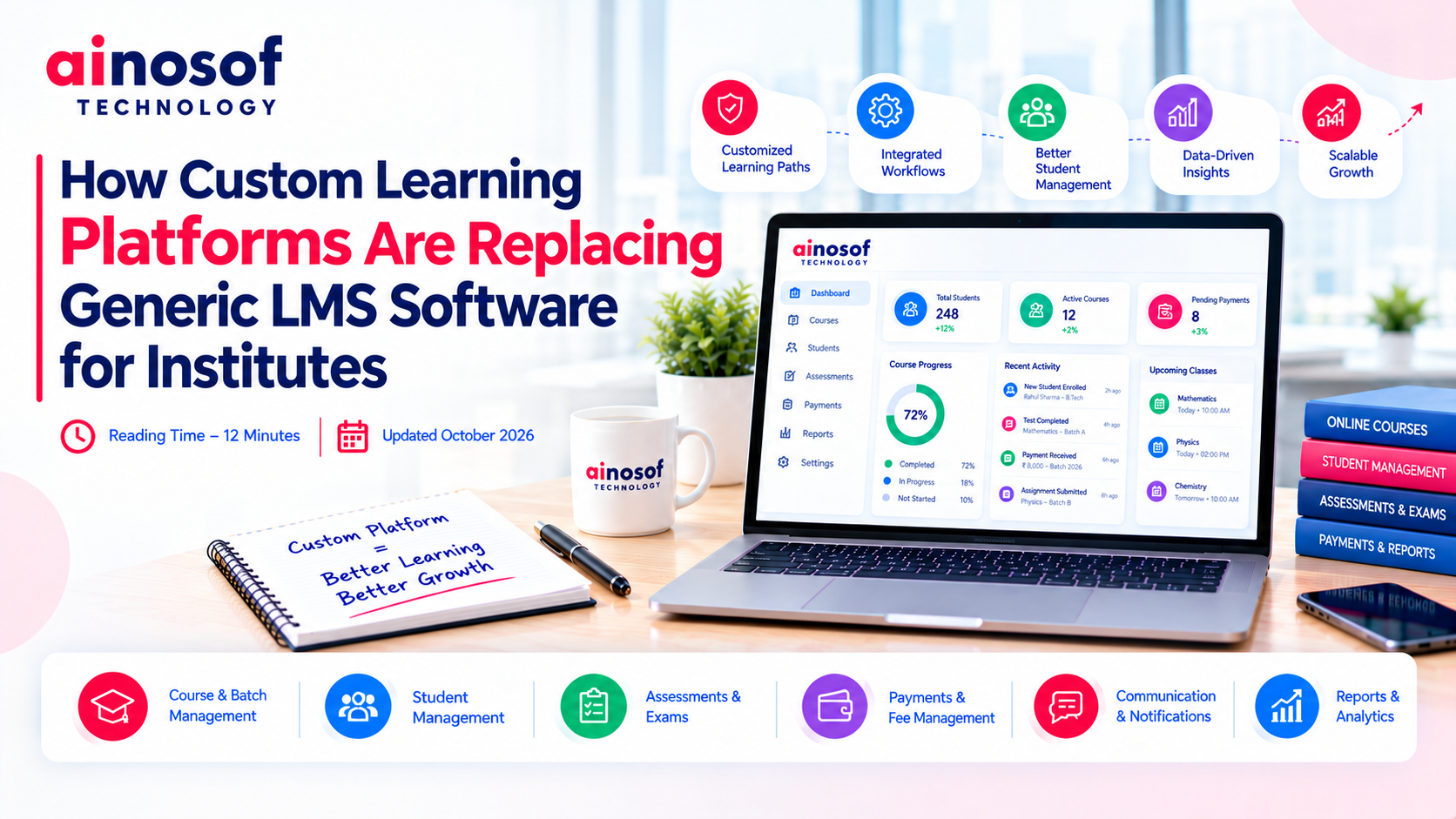
Educational institutes are under pressure to deliver better learning experiences while managing admissions, assessments, student records, fees, and communication more efficiently. A generic Learning Management System (LMS) can help with basic course delivery, but the requirements of a growing coaching institute, college, or training business may extend far beyond standard learning features.
For example, an institute may need batch-wise assessments, automated fee reminders, separate dashboards for teachers and administrators, branded student apps, or integration with its existing student management software. When these requirements cannot be handled smoothly by a ready-made LMS, teams may end up relying on spreadsheets, manual processes, and multiple disconnected tools.
This is why some educational businesses are exploring custom learning platforms. Rather than adapting every process to a standard product, they can develop a platform around their academic model and operational needs.
However, custom development is not automatically the right choice for every institute. The decision depends on the problems that need solving, the available budget, and the institution's long-term plans.
Generic LMS software provides a ready-made foundation for activities such as course distribution, student enrolment, learning materials, and assessments. For institutes with straightforward requirements, these capabilities may be sufficient.
The challenge appears when an institute develops its own teaching methods, expands into new courses, or needs learning activities to work alongside administrative operations. At that stage, the limitations of a standard platform can become more noticeable.
Most ready-made LMS platforms are designed to serve a broad range of users. This makes them useful for common learning activities, but a standard workflow may not match the way every educational business operates.
Consider a coaching institute that manages multiple courses, batches, faculty members, mock tests, and individual student progress. It may need different assessment rules for each course, customized reporting for mentors, and a dedicated process for students to access purchased test series.
If the chosen LMS does not support these requirements adequately, the institute may need workarounds, additional software, or manual administration. Some platforms offer plugins and configuration options, so a missing feature does not always mean custom development is necessary. The real issue is whether the available options solve the problem reliably.
A growing institute should examine questions such as:
When these requirements are central to daily operations, the institute should evaluate whether its current LMS can accommodate them without excessive complexity.
An institute's learning operations rarely exist in isolation. Student enrolment may affect course access, payments may determine eligibility, assessments may influence mentoring decisions, and attendance records may help identify students who need additional support.
When these activities operate across disconnected systems, employees may have to enter the same information repeatedly, reconcile different records, and manually communicate updates.
For example, if a student's payment status is stored separately from the learning platform, an administrator may need to verify the payment before granting access to a course. If test results are maintained in another system, a mentor may have to collect the data before discussing a student's progress.
These small tasks can accumulate as the number of students and courses increases. They may also create inconsistencies, slow down support, and make it harder for management to understand overall performance.
A connected learning platform can reduce these gaps by linking relevant workflows and giving authorized users access to consistent information. The objective is not to automate everything indiscriminately. It is to remove repetitive work that prevents faculty and administrative teams from focusing on students.
A custom learning platform is developed around an institute's specific learning model, operational processes, and growth objectives. Depending on the requirements, it may combine LMS capabilities with student management, assessment tools, payment workflows, reporting, and other institutional functions.
The main advantage is control over how these components work together. Instead of selecting a platform solely on its existing feature list, the institute can prioritize the capabilities that directly support its teaching and business model.
Customization can cover different parts of the learning experience, depending on the institute's requirements and budget.
Course and batch management: A platform can organize courses, batches, schedules, learning materials, and access permissions according to the institute's academic structure.
Assessments and performance tracking: Institutes can implement mock tests, assignment submissions, evaluation workflows, performance dashboards, and progress reports suited to their teaching methods.
Student and faculty management: The platform can provide separate dashboards for students, teachers, mentors, and administrators, with access determined by their responsibilities.
Payments and enrolment: Where required, the system can connect enrolment, payment confirmation, course access, invoices, and reminders. The exact workflow should reflect the institute's policies and payment provider capabilities.
Communication and notifications: Course updates, schedule changes, assessment deadlines, and other relevant announcements can be delivered through suitable communication channels.
Management reporting: Administrators can review enrolment, course activity, assessment performance, and other relevant operational data without manually combining information from several sources.
These capabilities should be prioritized according to actual needs. An institute that only requires video lessons and quizzes may not need a large custom platform. A multi-course education business with specialized assessments and connected administrative workflows may have a stronger case for customization.
An institute should consider a SaaS software development company when its requirements go beyond selecting and configuring an existing product, particularly if it intends to deliver learning services through a scalable, subscription-based platform.
For instance, an education business may want to offer its learning solution to multiple institutes, with each institution receiving its own workspace, branding options, user permissions, and administrative controls. This introduces requirements that differ from building a platform for one institute alone.
A SaaS-based solution may need to support:
A software development partner can help translate these requirements into a technical plan, identify the essential first version, and decide which features can be introduced later.
Ainosof Technology is a potential technology partner for businesses exploring custom software and digital solutions. Institutes considering such a project should first define their users, workflows, integration needs, and business objectives before evaluating any development partner.
It is also important to distinguish between an LMS used internally by one institute and a commercial SaaS platform sold to many institutes. The second model generally requires additional planning for tenant separation, subscription management, customer onboarding, and ongoing product support.
Choosing between a ready-made LMS and custom development requires more than comparing feature lists. Institutes should consider the total cost, the complexity of their workflows, the integrations they need, and the amount of control they want over future changes.
A generic LMS may be the better starting point when standard features meet current requirements. Custom development becomes more compelling when important business processes remain unsupported or when the platform itself is part of the institute's commercial offering.
The first step is to compare the full cost of operating each option rather than looking only at the initial price.
A ready-made LMS may involve subscription or licensing fees, paid extensions, integration charges, and restrictions tied to the chosen plan. Custom development may require a larger initial investment, followed by hosting, maintenance, security updates, support, and future enhancements.
The following table provides a practical starting point.
|
Decision factor |
Generic LMS |
Custom learning platform |
|
Initial launch |
Usually faster |
Requires requirements, design, and development |
|
Core functionality |
Based on existing features |
Built around defined institutional needs |
|
Workflow flexibility |
Depends on configuration and extensions |
Greater control over workflow design |
|
Integrations |
Depends on available connectors and APIs |
Can be designed for required integrations |
|
Branding |
Varies by provider and plan |
Greater control over the user experience |
|
Ongoing costs |
Subscription, licensing, and add-ons |
Maintenance, hosting, support, and enhancements |
|
Future changes |
Subject to vendor capabilities and product roadmap |
Changes can be planned around business priorities |
|
Technical responsibility |
Much of the platform operation is handled by the vendor |
The institute or its development partner must manage agreed responsibilities |
Custom development does not automatically mean complete ownership of every component. Contracts should clarify source code rights, third-party licences, hosting responsibilities, data access, maintenance, and exit arrangements.
Institutes should also assess scalability in practical terms. Can the solution support the expected number of students, simultaneous assessments, file storage, and future courses? Will the infrastructure and support arrangements be adequate during peak examination periods?
A sensible approach is to list essential requirements, compare available LMS products against them, and estimate the total cost over a realistic period. If a ready-made product meets the requirements at a lower cost and with less operational burden, customization may not be justified.
Choosing SaaS development services requires evaluating the partner's ability to understand education workflows and build a maintainable product, not simply its ability to develop screens or add features.
Begin with the discovery process. The development partner should ask how students enrol, how courses are delivered, how assessments are evaluated, what administrators need to monitor, and which existing systems must connect to the new platform.
Next, assess the proposed technical and delivery approach.
For a subscription-based learning product, also evaluate how the platform will manage separate customer accounts, plan limits, onboarding, and billing.
Before committing to a full build, consider validating the core requirements through a prototype or minimum viable product (MVP). This allows the institute to test the most important workflows with actual users before investing in a larger system.
The right development partner should be able to explain trade-offs, identify unnecessary complexity, and recommend a phased approach where appropriate. A credible plan may involve using an existing LMS initially and developing custom modules only when the business case supports them.
Selecting the right learning platform is one part of building a sustainable education business. Institutes should also consider how their website, mobile experience, and administrative workflows work together.
A connected digital approach can help institutes improve the experience for students and staff while keeping technology investments aligned with measurable business objectives.
Generic LMS software remains a practical option for institutes whose requirements fit standard learning workflows. It can help them launch quickly without taking on the cost and responsibility of building a platform from scratch.
Custom learning platforms become worth considering when an institute needs greater control over academic processes, student management, assessments, integrations, or a specialized digital learning experience. For education businesses planning to sell their platform to multiple institutions, SaaS architecture may also support a distinct commercial model.
The decision should begin with the institute's actual operational challenges, not a long list of desirable features. Identify what the current system cannot handle, estimate the cost of those limitations, and compare ready-made products with a realistic custom development plan.
When existing software no longer supports the way an institute teaches, operates, or grows, a carefully scoped custom platform can provide a more suitable long-term foundation. The right approach is the one that solves genuine problems while remaining manageable, secure, and financially sustainable.
Generic LMS software provides standard learning and course management features for a broad range of users. A custom learning platform is developed or extended around specific institutional workflows, integrations, branding, and reporting requirements. The best option depends on the complexity of the institute's needs.
Some institutes choose custom platforms because they need specialized assessments, integrated student management, customized dashboards, or workflows that existing LMS products cannot support adequately. Others want greater control over the learning experience as their operations grow.
It can be suitable when a coaching institute has specific requirements that cannot be met cost-effectively by available products. However, smaller institutes with straightforward needs may be better served by an affordable ready-made LMS. The decision should be based on requirements, budget, and long-term plans.
The cost depends on the number of features, user roles, integrations, security requirements, design complexity, and expected usage. A platform for a single institute will generally have different requirements from a multi-institute SaaS product. A detailed scope and phased estimate are needed for a meaningful cost assessment.
The timeline depends on project scope, integration complexity, testing requirements, and the availability of stakeholders. A focused MVP can be delivered sooner than a comprehensive platform with advanced assessments, reporting, payments, and multi-tenant functionality. Timelines should be established after requirements discovery.
A SaaS software company can help plan the architecture, develop core learning workflows, connect required services, and prepare the platform for ongoing updates. For a product serving multiple institutes, it can also design account separation, subscription management, and administrative controls.
Yes, provided the required systems offer suitable integration options or the functionality is developed as part of the platform. The design should define how enrolment, payment confirmation, course access, assessments, and student records interact, while maintaining appropriate access controls.
An institute should evaluate SaaS development services when standard products cannot support important workflows, required integrations, or a planned commercial learning product. If existing LMS software meets the institute's needs, adopting and configuring it may be more practical and cost-effective.
 Why Custom Software Companies Need Strong Branding to Win Enterprise Clients
16 Oct, 2026
 How a CRM System Complements Custom Business Software for Better Sales Visibility
15 Oct, 2026
 ERP vs Custom Software: Which One Does Your Business Actually Need?
14 Oct, 2026
 How to Build an SEO Strategy for a B2B SaaS or Software Company
13 Oct, 2026
 Why Your Business Website Should Integrate With Your Internal Software Systems
12 Oct, 2026
 How AI Agents Are Becoming Part of Custom Business Software in 2026
10 Oct, 2026
Comment with an expert and get our answer.
Comment with an expert and get our answer.
Explore more insights related to this topic and discover useful perspectives, ideas and strategies from our latest articles.