Why Growing MSMEs in India Need ERP Software Before They Scale
 Iram
Iram


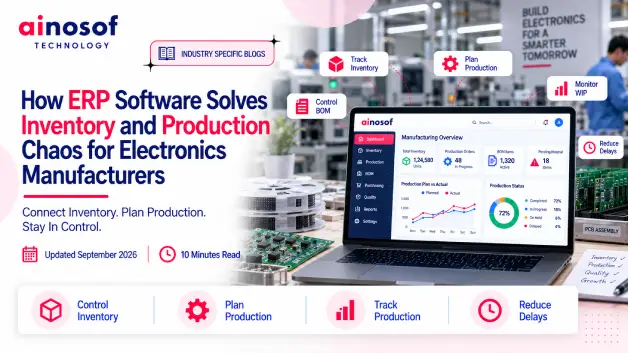
For an electronics manufacturer, production rarely stops because the factory cannot manufacture. It often stops because the right component is not available at the right time, the BOM is outdated, or production planning is working with information that no longer matches the shop floor.
As product lines expand, these problems become harder to control. Inventory may show sufficient stock while production is still waiting for a critical component. Purchasing may order materials without seeing the latest production requirements. A revised BOM may reach production late. Meanwhile, managers may have limited visibility into what has been consumed, what is in WIP, and why an order is delayed.
The real challenge is not simply having more inventory or better production planning. It is keeping inventory, purchasing, BOMs, production, and operational decisions connected.
This is where ERP for electronics manufacturing becomes relevant. Instead of managing each operational area separately, an integrated system can connect the information that drives material and production decisions.
In this article, we will look at where inventory and production chaos begins, how ERP connects these processes, how manufacturing ERP for the electronics industry can improve planning and control, and what electronics manufacturers should evaluate before choosing an ERP system.
In electronics manufacturing, inventory is directly connected to production continuity. A factory may have hundreds or thousands of components in stock, but production can still stop if one critical resistor, IC, connector, PCB, or other required component is unavailable.
The problem becomes more serious when inventory decisions are based on incomplete or outdated information. Production may be scheduled according to customer orders, while the purchasing team is working with different stock figures and the stores team is maintaining another record.
A reliable ERP for electronics manufacturing helps connect these decisions so that inventory is managed according to actual production requirements rather than assumptions.
Electronics products are usually built from multiple components that must come together before a production order can move forward. If even one critical component is missing, the production team may not be able to complete the required assembly.
For example, suppose an electronics manufacturer has enough PCBs, connectors, and other components to start an order, but a specific microcontroller is short by 100 units. The rest of the material may already be available, but the finished product still cannot be completed.
This creates more than a stock shortage. It can affect production schedules, machine utilization, delivery commitments, and customer relationships.
With manufacturing ERP for the electronics industry, material requirements can be connected to production orders and BOMs. This gives the team a clearer view of which components are required and where shortages may affect production.
The important point is that inventory should be managed according to production requirements, not simply according to the total quantity sitting in the warehouse.
Inventory uncertainty becomes a production risk when the business cannot confidently answer three simple questions:
If these answers depend on spreadsheets, phone calls, manual checks, or different departmental records, production planning becomes reactive.
Consider a manufacturer that sees 5,000 units of a component in its inventory system. On closer inspection, some stock may already be reserved for another production order, some may be defective, and some may be waiting for inspection. The actual usable quantity could therefore be much lower than the reported quantity.
This is where inventory visibility becomes a production requirement rather than just a warehouse concern. ERP can bring stock status, production requirements, reservations, and purchasing information into a connected workflow.
When a manufacturer cannot confidently determine what material is available for the next production order, inventory uncertainty has already become a production risk.
Inventory problems are often symptoms of a larger issue: different teams are working with different information.
Purchasing may know what has been ordered. The warehouse may know what has arrived. Production may know what it needs. Management may only see a periodic report. When these pieces are not connected, even experienced teams can struggle to make timely decisions.
The value of ERP is therefore not simply storing more data. It is creating a single operational view that connects the information needed to plan and execute production.
When departments work with separate data, small information gaps can quickly become operational problems.
Production may request a component that purchasing does not know is urgent. Purchasing may place an order based on an older requirement. The warehouse may receive material without the production team having visibility of it. Management may then see the production delay without immediately knowing where the problem started.
This creates a chain reaction:
Incorrect or delayed information → Poor material decision → Production disruption → Delivery pressure
For an electronics manufacturer, this becomes especially difficult when product variants, BOMs, and component requirements change frequently.
A connected ERP system allows purchasing, inventory, and production to work from related information instead of maintaining separate versions of the same operational reality.
The goal is not simply better departmental data. The goal is better decisions between departments.
The quantity shown in an inventory record does not always represent the quantity that production can immediately use.
Some material may already be allocated to another order. Some may be under inspection. Some may be damaged or rejected. Other material may be physically available but not included in the latest production requirement.
Without connected information, teams may have to manually check multiple records before deciding whether an order can begin.
An ERP system can connect inventory quantities with production orders, material reservations, BOM requirements, and purchasing status. This makes it easier to distinguish between total stock and stock that is genuinely available for a specific production requirement.
For example, if 1,000 components are physically present but 700 are already committed to another order, the production team should not treat all 1,000 as freely available.
Production planning becomes more reliable when “stock available” means stock that is actually usable for the production requirement being planned.
Once inventory and production information are connected, manufacturers can move from reacting to shortages toward identifying them before they interrupt production.
This is one of the most important roles of ERP for electronics manufacturing. The system can connect production requirements with BOM quantities, current inventory, committed stock, and purchasing information.
Instead of asking the warehouse whether a component is available after production has already been scheduled, the business can check material readiness as part of the planning process.
ERP can compare the material required for a production order with the inventory that is available or already committed elsewhere.
For example, if a production order requires 2,000 units of a particular component and only 1,500 usable units are available, the shortage becomes visible before production starts.
This gives the purchasing and production teams time to respond. They can place an order, adjust the production schedule, check an approved alternative component, or prioritize another production order.
This approach is particularly useful in electronics manufacturing, where one missing component can hold up an otherwise ready production order.
The business value comes from finding the shortage while there is still time to act—not after the production line is waiting for material.
Purchasing becomes more controlled when purchase requirements are connected to actual production demand.
Instead of ordering components simply because stock appears low, the business can consider upcoming production orders, BOM requirements, existing inventory, committed quantities, and open purchase orders.
For example, if current stock looks low but enough material has already been ordered and is scheduled to arrive before production begins, another purchase may not be necessary. On the other hand, if a new production order creates a genuine shortage, the purchasing team can see the requirement earlier.
Production planning software for manufacturers can therefore support purchasing decisions by connecting what the factory plans to produce with what it needs to buy.
The result is a more deliberate purchasing process, with fewer emergency purchases and less unnecessary inventory.
Inventory alone cannot solve production problems if the business is working with incorrect or outdated product requirements.
In electronics manufacturing, the BOM determines which components are required to build a product. When a component changes, a specification is revised, or an approved substitute is introduced, production needs to work from the correct version.
ERP can connect BOM management, inventory, purchasing, and production planning so that material requirements reflect the product version actually being manufactured.
BOM changes can create serious problems when different teams continue using different versions.
A revised BOM may require a different component quantity, a new component, or an approved substitute. If purchasing works from one version while production works from another, the business can end up with incorrect material purchases or production interruptions.
ERP can provide controlled BOM versions so that the production team can identify which material structure applies to a particular product or production order.
It can also help record approved component substitutions rather than relying on informal communication between departments.
For example, if an original component is unavailable and the manufacturer has an approved alternative, the change can be recorded within the relevant production process instead of being communicated only through a message or spreadsheet.
Controlled BOM revisions help ensure that purchasing and production are working toward the same product requirement.
Production planning becomes more realistic when it considers what material is genuinely available instead of planning only around customer orders or desired production dates.
An ERP system can connect production requirements with inventory status, purchase orders, BOMs, and material availability. This allows planners to identify which orders are ready to proceed and which may require material action first.
For example, if two production orders are scheduled for the same week but only one has all critical components available, the planner has better information for deciding how to sequence the work.
This does not eliminate every production constraint, but it gives the manufacturer a clearer basis for planning.
When production plans reflect actual material availability, manufacturers can make decisions earlier, reduce avoidable interruptions, and keep inventory and production working toward the same objective.
Once production starts, knowing what was planned is not enough. Manufacturers also need to know what was actually consumed, what is still in production, and where differences are occurring. This is where ERP for electronics manufacturing can connect planning with production execution.
A production order may specify a particular quantity of each component, but actual consumption can be different. Components may be damaged, additional material may be required, or production may use more material than originally planned.
ERP can record the material issued against a production order and compare it with the quantity expected from the BOM.
For example, if a production order requires 1,000 units of a component but production consumes 1,080 units, the difference becomes visible. The manufacturer can then investigate whether the additional consumption came from wastage, quality issues, production conditions, or an inaccurate BOM.
This gives management a clearer understanding of how materials are actually being used rather than relying only on planned quantities.
The real value is not simply recording consumption; it is identifying where planned and actual usage start to differ.
Work-in-progress can become difficult to track when production moves through multiple stages. Managers may know that an order has started but still lack clarity about its exact position, pending material, or stage of completion.
An ERP system can connect production orders with their current stages, material movement, and completion status.
For example, an electronics order may move through assembly, testing, quality inspection, and final packing. If the order is delayed at testing, the production team can see where the delay is occurring instead of treating the entire order as simply “in production.”
This makes it easier to identify bottlenecks and take action before a small delay affects the final delivery date.
Better WIP visibility helps manufacturers manage production based on what is actually happening on the shop floor.
Material wastage becomes a business problem when manufacturers know that extra material is being consumed but cannot identify where or why.
ERP can record planned quantities against actual consumption and production output. This makes it easier to identify material variance, wastage, and recurring differences between expected and actual production.
For example, if the same product repeatedly consumes more components than its BOM indicates, the manufacturer can investigate whether the issue is related to the BOM, process, component quality, or production method.
Instead of treating every variance as an isolated incident, management can identify recurring patterns and make better operational decisions.
When wastage and variance are visible, manufacturers can move from accepting production losses to understanding their causes.
Inventory and production control become more valuable when the manufacturer can also understand where materials came from, where they were used, and what the final production actually cost.
For electronics manufacturers, traceability and production cost visibility can connect operational records with quality, accountability, and financial decisions.
Yes, when the ERP system supports the required batch, lot, or serial-level traceability.
A manufacturer may need to know which component batch was used in a particular production order or which finished products were created from a specific material lot.
For example, if a component is later found to have a quality issue, production records can help identify the orders and finished goods associated with that component batch.
This can make investigation and corrective action more structured, especially when production volumes and component varieties increase.
Traceability gives manufacturers a clearer connection between incoming material, production activity, and finished products.
Production cost can change when material consumption, wastage, labour, processing time, or other production inputs differ from the original plan.
ERP can bring these records together so manufacturers can compare planned production cost with actual production cost.
For example, if a product was expected to cost ₹500 to manufacture but repeated production records show an actual cost of ₹540, management can investigate the difference rather than simply accepting the higher cost.
This can reveal recurring material variance, excessive wastage, inefficient production processes, or outdated cost assumptions.
Cost visibility becomes useful when it helps management understand why production costs are changing, not just what the final cost was.
Not every ERP system will fit every electronics manufacturing business. The right system needs to support the way the manufacturer actually purchases materials, manages BOMs, plans production, tracks inventory, and controls finished goods.
Before choosing an ERP, manufacturers should evaluate the system against their real operational requirements rather than selecting it only from a list of features.
The system should be able to manage the manufacturer's actual BOM structure, revisions, component substitutions, production stages, and material requirements.
A system may appear suitable during a demonstration but become difficult to use when the business introduces product variations or changes its production process.
Manufacturers should therefore test the ERP using real examples from their own operations.
The ERP should fit the manufacturing process, not force the manufacturer to build its process around the software.
An ERP becomes more valuable when different departments can work from the same operational information.
Inventory should connect with purchasing. Purchasing should reflect production requirements. Production should connect with material consumption. Financial information should reflect the resulting business activity.
For example, when production requirements change, purchasing should be able to see the impact instead of continuing with an outdated requirement.
This connected approach reduces unnecessary manual coordination between departments.
The real test of an ERP is how well information moves between business functions, not how many screens the software contains.
An ERP should support the business not only at its current size but also as its manufacturing operation grows.
The manufacturer may add new products, more SKUs, additional production stages, new warehouses, or higher production volumes. The ERP should be able to accommodate these changes without requiring the business to replace its core system every time it expands.
For a growing electronics manufacturer, scalability should therefore be considered from the beginning.
A suitable ERP should provide control today while leaving enough flexibility for tomorrow's manufacturing requirements.
If inventory, production planning, and operational data are becoming difficult to manage separately, the next step is to examine which business processes should be connected first.
Explore Ainosof Technology's ERP Software Development and Custom ERP Software Development solutions to evaluate how a system can be aligned with your existing manufacturing workflow and future business requirements.
Inventory and production problems in electronics manufacturing rarely come from one isolated issue. They often develop when inventory, BOMs, purchasing, production planning, material consumption, and management data are not properly connected.
An ERP system can bring these processes into one operational workflow, helping manufacturers identify material shortages earlier, plan production around actual availability, monitor WIP, understand material variance, improve traceability, and compare planned and actual production costs.
The important decision is not simply whether a manufacturer needs ERP software. It is whether the chosen system can solve the specific operational problems that are slowing production and limiting visibility.
For electronics manufacturers, the right ERP should ultimately make one thing easier: knowing what needs to happen next, why it needs to happen, and whether the business has the information and material required to make it happen.
ERP connects inventory with BOMs, production orders, purchasing, and material requirements. This helps manufacturers see what is available, what is already committed, and what needs to be purchased for upcoming production.
ERP cannot physically prevent every shortage, but it can make upcoming material requirements and shortages visible earlier. This gives purchasing and production teams more time to respond before a missing component interrupts production.
ERP can maintain controlled BOM versions and connect them with production orders. It can also record actual material consumption and compare it with planned requirements to identify differences.
Yes. A suitable ERP can track production stages, material movement, WIP status, actual consumption, and wastage, giving management better visibility into production performance.
They should check whether the system can handle their BOMs, inventory, purchasing, production planning, material consumption, WIP, traceability, costing, and future growth requirements.
Yes. Ainosof Technology can develop customized ERP solutions around specific business workflows, including inventory, purchasing, production, BOM management, and other manufacturing requirements
 Why Growing MSMEs in India Need ERP Software Before They Scale
21 Sep, 2026
Why Growing MSMEs in India Need ERP Software Before They Scale
21 Sep, 2026
 Why NGOs and Charitable Trusts Need Fund & Donor Management Software (Not Just Spreadsheets)
19 Sep, 2026
Why NGOs and Charitable Trusts Need Fund & Donor Management Software (Not Just Spreadsheets)
19 Sep, 2026
 Why Businesses Are Building Employee Apps to Manage Field and Warehouse Staff
18 Sep, 2026
Why Businesses Are Building Employee Apps to Manage Field and Warehouse Staff
18 Sep, 2026
 How B2B Ecommerce Platforms Are Changing the Way Wholesalers Do Business
17 Sep, 2026
How B2B Ecommerce Platforms Are Changing the Way Wholesalers Do Business
17 Sep, 2026
 How Institute Management Software Simplifies Administration for Coaching Institutes
16 Sep, 2026
How Institute Management Software Simplifies Administration for Coaching Institutes
16 Sep, 2026
 Why Corporate Identity Matters More for B2B and Manufacturing Companies
15 Sep, 2026
Why Corporate Identity Matters More for B2B and Manufacturing Companies
15 Sep, 2026
Comment with an expert and get our answer.
Comment with an expert and get our answer.
Explore more insights related to this topic and discover useful perspectives, ideas and strategies from our latest articles.