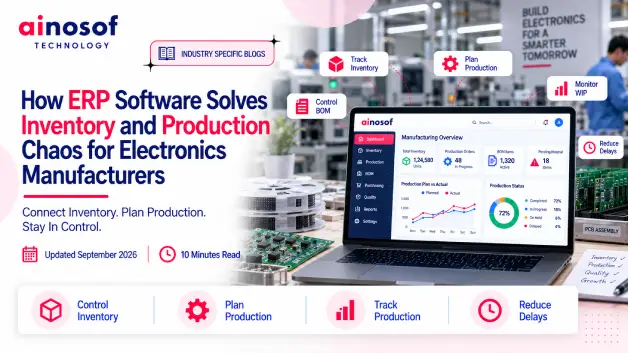
How ERP Software Solves Inventory and Production Chaos for Electronics Manufacturers
 Iram
Iram


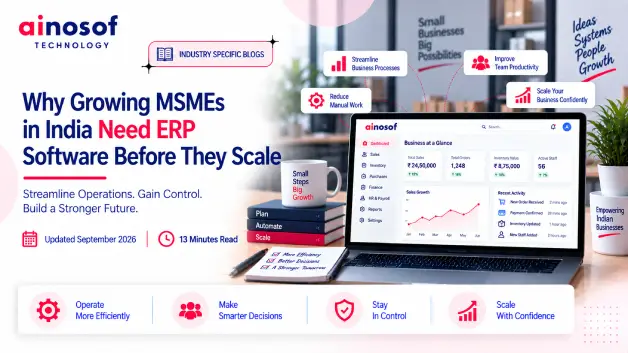
A growing MSME rarely struggles because there is suddenly too much business. The real challenge often begins when the systems used to manage that business cannot keep up with the growth. More customers bring more orders, more products create more inventory movements, and a larger team creates more information that needs to be shared and updated accurately.
In the early stage, spreadsheets, accounting software, WhatsApp updates and separate departmental tools may work well enough. But as operations become more complex, the same approach can create gaps between sales, purchasing, inventory, finance and customer management. Employees may enter the same information more than once, managers may wait for reports, and important decisions may depend on information collected from different places.
This becomes especially important when an MSME is preparing to expand. Adding new products, customers, employees or locations without improving operational control can make existing problems harder to manage. A business may be growing in revenue while becoming increasingly difficult to monitor internally.
That is why ERP software for MSMEs India should be considered as a business decision, not simply as another technology investment. The question is not whether every growing MSME needs ERP immediately. The more important question is whether disconnected processes are already creating limitations that could become more expensive as the business scales.
In this article, we will look at the warning signs that an MSME has outgrown its current systems, what changes when core operations become connected, when ERP for small and medium businesses makes practical sense, and when MSME business management software may need to be customized around specific workflows. We will also cover what businesses should evaluate before investing and how to measure whether the system is actually improving operational control.
Business growth changes the way an MSME operates. A business that once handled a few orders, products and customers may eventually be managing hundreds of transactions, larger inventory, more employees and several departments. Processes that worked at a smaller level can become difficult to control when the volume increases.
This is where many MSMEs start facing operational problems. The issue is not growth itself. The issue is that business systems and processes often do not grow at the same pace as the business.
Different departments often maintain information in different places. Sales may use one system, finance may work in accounting software, inventory may be tracked through spreadsheets, and employees may share updates through email or messaging apps.
The information may exist, but it is not always connected.
For example, a sales employee may confirm an order without having a clear view of current stock. The inventory team may then discover that the required products are unavailable. Finance may receive the billing information later and have to enter the same details again.
These small gaps can create delays, duplicate work and misunderstandings between teams.
As an MSME grows, disconnected software and spreadsheets can make it harder to maintain one reliable view of what is happening across the business.
More business usually means more information to record and update. Every additional order can involve customer details, products, stock changes, purchasing requirements, billing and payment information.
When these activities are handled manually, employees have to perform more repetitive tasks.
For example, an MSME processing 20 orders a day may be able to update inventory and billing records manually. If the business starts processing 200 orders, the same process requires significantly more time and creates more opportunities for data-entry mistakes.
The problem can become even greater when product varieties, suppliers and customer accounts increase at the same time.
This is why manual management becomes harder as transaction volume grows. The business is not simply handling more sales; it is handling more connected information that needs to remain accurate.
Scaling means adding more business without allowing operational problems to grow at the same speed. That becomes difficult when important information remains separated between departments and systems.
A business owner may want to know which products are selling fastest, how much inventory is available, which payments are pending or how much has been purchased from a supplier. If employees have to collect this information from different systems, getting a clear answer can take time.
Imagine an MSME opening another branch. If each location maintains separate inventory and sales records, management may have to consolidate the information manually before understanding the overall position.
As the business adds customers, products, employees or locations, disconnected systems can therefore create additional management work.
Growth becomes easier to control when information can move with the business instead of remaining trapped in separate files and departments.
Growth without operational control can create a situation where the business becomes larger but not necessarily easier to manage. More orders, customers and transactions can increase revenue while also increasing the amount of manual coordination required behind the scenes.
For an MSME planning further expansion, this matters because operational problems that are manageable today can become much harder to correct when the business becomes significantly larger.
Manual work has a direct time cost. When employees repeatedly enter information, compare spreadsheets, prepare reports or reconcile records, more staff time is required as transaction volumes increase.
There is also an indirect cost. Employees spending hours on repetitive administrative work have less time for activities that require human attention, such as customer service, supplier coordination or improving operations.
For example, if three departments separately enter the same customer and order information, every increase in order volume increases the workload across all three departments.
The cost may not appear as a separate software expense, but it can show up through employee time, delays, errors and administrative workload.
A growing MSME should therefore consider not only how much it costs to introduce a better system, but also how much the current manual process is costing the business.
When information is delayed or incomplete, managers may make decisions using an outdated picture of the business.
Poor inventory visibility can result in overstocking or stock shortages. Limited order visibility can make it harder to identify pending deliveries. Delayed financial information can make receivables and cash-flow management more difficult. Incomplete customer information can also affect follow-ups and service.
For example, a business may continue purchasing a product because its purchasing team does not have an updated view of existing stock. At the same time, another department may already know that the product is moving slowly.
These situations happen when important information does not reach the right people at the right time.
Better operational visibility helps management understand what is happening across different parts of the business before making decisions.
Waiting until the business becomes much larger can make system changes more complicated. By that stage, the organization may have accumulated years of customer records, product data, transaction history and different working practices.
Employees may also become accustomed to manual processes, making it harder to change established habits.
For example, an MSME that expands from one location to five locations may eventually need to bring multiple sets of data and processes together. If the business had already established a connected system earlier, managing that growth could have been more structured.
This does not mean every MSME should implement ERP immediately. It means businesses should recognize when their current systems are becoming a constraint.
Early system planning can prevent operational complexity from becoming a barrier to future growth.
Once an MSME has several departments handling connected activities, the value of an ERP system becomes clearer. Instead of treating sales, purchasing, inventory and finance as completely separate activities, ERP can bring their information into a connected business system.
The purpose is not simply to put everything into one software application. The bigger goal is to create connected business processes where information entered in one part of the workflow can support the next part.
Consider a typical order.
A customer places an order through the sales team. The order affects inventory. If stock is insufficient, purchasing may need to procure additional products. Once the order is fulfilled, billing and financial records need to reflect the transaction.
When these activities are handled separately, employees may have to transfer information from one system to another.
An ERP system can connect these processes so that the relevant information flows through the business workflow.
For an MSME, this can create a clearer connection between sales, inventory, purchasing, billing and finance instead of requiring every department to maintain its own version of the information.
The exact workflow depends on the business, but the principle remains the same: connected processes reduce the need to repeatedly recreate the same information.
Business owners and managers regularly need answers about sales, stock, purchases, customers and finances. If information is scattered, getting those answers can require manual checking.
Centralized data can make relevant information easier to access and compare.
For example, a manager reviewing sales can also look at related inventory information rather than waiting for a separate stock report. A purchasing team can use current inventory information to make better-informed procurement decisions.
This does not mean ERP automatically makes decisions for management. Instead, it can give decision-makers more organized and timely business information.
That difference matters as an MSME grows because faster access to reliable information becomes increasingly important.
Every new customer, product or location adds another layer of information to manage. If the underlying system is already disconnected, expansion can multiply the administrative work.
A connected ERP system can provide a common structure for managing business information as operations expand.
For example, when an MSME adds a second location, management may need visibility into stock, sales and purchasing across both locations. A connected system can be designed to support this broader view instead of requiring separate spreadsheets to be combined manually.
This is one reason ERP software for MSMEs India should be considered before operational complexity becomes difficult to control.
The objective is not to make the business dependent on software. It is to create a stronger operational foundation so that growth adds business volume without adding the same amount of administrative confusion.
Connecting business information is only valuable when it improves everyday operations. ERP can change how employees handle orders, inventory, purchasing, billing and financial information by reducing unnecessary duplication and making related information easier to follow.
For a growing MSME, this can shift management from repeatedly collecting information toward monitoring and controlling business processes.
Inventory decisions depend on knowing what is available, what has been ordered, what has been sold and what may need to be purchased.
When these records are maintained separately, employees may have to compare multiple sources before making purchasing decisions.
ERP can connect sales and inventory information with purchasing workflows. This can help teams see stock movement more clearly and make purchasing decisions using the information available within the system.
For example, when sales activity increases for a particular product, the business can review its inventory position and purchasing requirements within the connected workflow instead of relying on separate manual updates.
Better inventory and purchase visibility can help MSMEs reduce avoidable stock-related confusion as their product volume grows.
An order does not end when the sales team confirms it. The business may need to fulfil the order, generate an invoice, record the transaction and track payment.
If each stage is handled separately, employees may enter the same information multiple times.
A connected ERP workflow can link relevant order, billing and financial information. This can reduce unnecessary re-entry and make it easier to trace a transaction from sale to payment.
For example, the sales team can record an order, the billing process can use the relevant information, and finance can work with the resulting transaction record instead of recreating it from another document.
This creates a more connected order-to-billing process and can make financial information easier to follow.
Repeated data entry creates two problems: it consumes employee time and creates opportunities for information to become inconsistent.
If the same customer, order or product information has to be entered into several systems, even a small mistake can create differences between records.
ERP can reduce some of this repetition by allowing connected processes to use shared information. It can also help teams reconcile related records within the same system instead of manually comparing separate files.
For example, when an order is recorded once and the relevant information flows into inventory and billing workflows, employees do not need to recreate the entire transaction at every stage.
The result is not that errors disappear completely. Human review is still important. But reducing unnecessary manual entry and disconnected reconciliation can make daily operations easier to control.
For a growing MSME, that operational control can become an important foundation for expansion.
ERP does not become necessary simply because an MSME reaches a particular turnover, employee count or number of customers. The more useful question is whether the business has reached a point where its existing systems are making everyday operations harder to control.
For some businesses, that point may come early because they manage complex inventory, manufacturing or distribution processes. For others, spreadsheets and separate software may remain practical for longer. The decision should therefore be based on operational complexity and business requirements, not on a fixed company size.
Several practical signs can indicate that the current system is no longer keeping pace with the business:
For example, an MSME may have separate spreadsheets for stock, customer orders and purchases. When management wants to know which products need replenishment, employees may have to compare all three sources manually.
At this stage, the problem is not that spreadsheets are incapable of storing information. The problem is that the business has more connected information than its current system can comfortably manage.
This is often a stronger signal for considering ERP than business size alone.
ERP becomes a practical investment when the business can clearly identify operational problems that a connected system could address.
For a growing MSME, this may include improving inventory visibility, connecting sales and billing, reducing duplicate data entry, bringing departments onto a common system or making management reporting easier.
The investment becomes easier to justify when the business can answer three questions:
For example, if a business spends significant employee time reconciling inventory and sales information every week, reducing that manual workload may provide a clear reason to evaluate ERP.
The decision should also consider implementation cost, employee adoption, data migration and long-term support.
ERP for small and medium businesses makes the most sense when it solves a real operational limitation rather than being purchased simply because larger companies use ERP.
Standard ERP can work well when its workflows match the way an MSME operates. Customization becomes more relevant when the business has requirements that standard systems cannot handle without major compromises.
This can happen when an MSME has:
For example, a manufacturer may need a workflow connecting production planning, raw materials, quality checks, inventory and dispatch in a particular sequence. If a standard ERP cannot support that workflow effectively, customization may become a practical consideration.
However, customization should have a clear business reason. MSME business management software should be customized where the difference in workflow genuinely matters—not simply to add more features.
The right question is whether customization will solve a requirement that the business cannot reasonably handle through a suitable standard system.
Once an MSME decides to explore ERP, the next challenge is choosing a system that will actually work for the business. Comparing software only by the number of modules or features can lead to the wrong decision.
A better approach is to start with the business's current processes, identify where control is weak and then check whether the ERP can address those areas.
Every MSME has its own way of handling sales, purchasing, inventory, finance and customer relationships. An ERP should support those important workflows rather than forcing employees to create workarounds.
Before selecting a system, map the current process from beginning to end.
For example:
Customer order → Stock check → Purchase/production → Fulfilment → Billing → Payment → Financial record
Then check how the proposed ERP handles each stage.
If employees still need separate spreadsheets or manual processes for important steps, the system may not be solving the original problem.
The focus should be on workflow fit, not simply on how many features the ERP vendor lists.
ERP implementation involves more than installing software. Existing customer, product, supplier, inventory and transaction information may need to be reviewed and migrated.
Employees also need to understand how their daily work will change.
For example, if sales employees have always maintained customer information in spreadsheets, they need to understand how and where that information will be recorded in the new system. The same applies to inventory, purchasing and finance teams.
Before implementation, an MSME should therefore consider:
Employee adoption is especially important. Even a technically capable ERP can fail to deliver its expected value if employees continue using unofficial spreadsheets and separate processes.
An ERP should solve today's operational problems without becoming a limitation when the business grows.
The MSME should consider whether the system can handle increasing customers, products, transactions, users and locations. It should also check whether new modules or integrations can be introduced later if business requirements change.
For example, a business may initially operate from one location but plan to add branches. If the ERP cannot support the required multi-location structure, the business may face another system change later.
The same applies to businesses planning to expand their product range, sales channels or manufacturing operations.
The objective is not to purchase the largest ERP available. It is to choose a system that provides enough flexibility for realistic future growth without unnecessary complexity today.
An ERP investment should be measured against the problems that led the business to consider it.
Useful measures can include:
For example, if an MSME previously needed several hours to prepare a consolidated inventory report, it can compare that process after ERP implementation.
Similarly, management can track whether employees are entering information fewer times, whether inventory discrepancies have reduced and whether reports are available more quickly.
The goal is not to assume that ERP automatically improves every process. The goal is to measure whether the chosen system is actually solving the operational problems for which it was introduced.
ERP can become one part of a broader digital business system. As an MSME grows, it may also need CRM, billing, inventory, ecommerce, workflow automation and custom software solutions that work together rather than creating another set of disconnected tools.
The next step should depend on the business's actual operational gaps. If customer management is becoming difficult, CRM integration may be useful. If online sales are growing, connecting ecommerce with ERP may become important. If existing systems cannot support specialized workflows, custom software development may provide another option.
For MSMEs evaluating these requirements, Ainosof Technology can help businesses think through their technology needs and develop ERP or customized business management solutions around their operational workflows.
The objective should remain simple: build the systems the business needs to operate with greater control as it grows.
Growth creates new opportunities for MSMEs, but it also creates more information, more transactions and more coordination between people and departments. If those operations continue to depend on disconnected spreadsheets and software, the complexity of managing the business can increase alongside its growth.
That does not mean every MSME needs ERP immediately. The stronger signal is whether the current system is creating manual work, limited visibility, data duplication, reconciliation problems or management delays that are becoming difficult to control.
For a business at that stage, ERP software for MSMEs India can provide a connected foundation for managing sales, inventory, purchasing, billing, finance and other core processes. The right solution may be standard ERP or, where genuine workflow requirements demand it, customized MSME business management software.
The decision should ultimately be based on operational needs, implementation readiness and measurable outcomes—not simply on the size of the business or the number of ERP features available.
Before an MSME adds more customers, products, employees or locations, it should make sure its systems are ready to support that growth.
Growing MSMEs may consider ERP software for MSMEs India when increasing customers, products, transactions and departments make existing systems difficult to control. ERP can connect important business processes and provide more organized information for daily operations and management decisions.
An MSME should consider moving beyond spreadsheets when information is scattered, employees repeatedly enter the same data, reports take too long, inventory records are difficult to reconcile or management lacks a clear view of operations.
Depending on the system, ERP can connect areas such as sales, purchasing, inventory, billing, finance, customer information, production and reporting. The exact modules should be selected according to the business's requirements.
Scaling without connected systems can increase manual work, duplicate data, reporting delays, inventory problems and coordination gaps. These issues do not occur in every business, but they can become harder to manage as transaction and operational complexity increases.
Yes, when the ERP matches the business's actual requirements. An MSME does not necessarily need a highly complex system. The right solution should address current operational problems while providing reasonable capacity for future growth.
Yes. ERP can connect these functions so that related information can move through the business workflow. This can reduce duplicate data entry and provide better visibility across sales, inventory, purchasing and finance.
A standard ERP can be suitable when its workflows match the business. Customized ERP software may make more sense when the MSME has specialized processes, reports, integrations or workflows that standard software cannot support effectively.
MSME business management software can help organize growing volumes of business information and connect important workflows. This can make it easier to manage additional customers, products, employees or locations without relying entirely on disconnected manual processes.
An MSME should evaluate workflow fit, required modules, data migration, employee adoption, integrations, security, scalability, customization requirements, implementation support and measurable business outcomes before making an investment.
 How ERP Software Solves Inventory and Production Chaos for Electronics Manufacturers
22 Sep, 2026
How ERP Software Solves Inventory and Production Chaos for Electronics Manufacturers
22 Sep, 2026
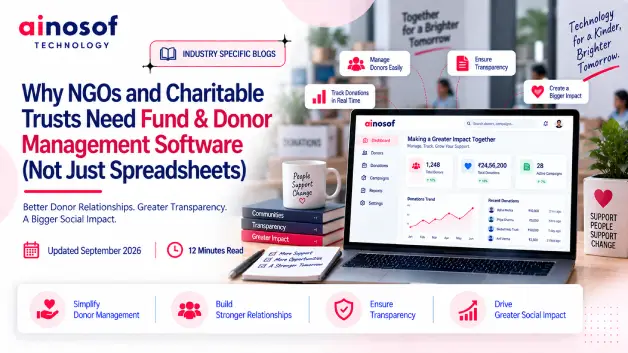 Why NGOs and Charitable Trusts Need Fund & Donor Management Software (Not Just Spreadsheets)
19 Sep, 2026
Why NGOs and Charitable Trusts Need Fund & Donor Management Software (Not Just Spreadsheets)
19 Sep, 2026
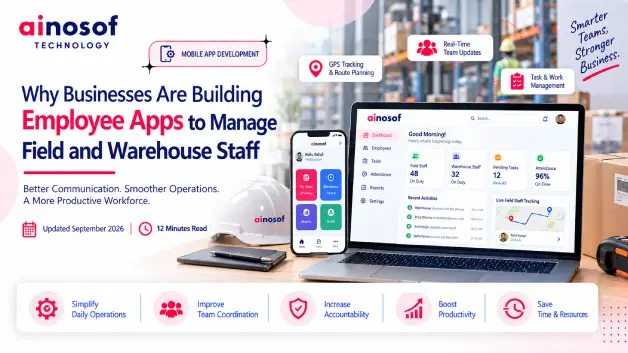 Why Businesses Are Building Employee Apps to Manage Field and Warehouse Staff
18 Sep, 2026
Why Businesses Are Building Employee Apps to Manage Field and Warehouse Staff
18 Sep, 2026
 How B2B Ecommerce Platforms Are Changing the Way Wholesalers Do Business
17 Sep, 2026
How B2B Ecommerce Platforms Are Changing the Way Wholesalers Do Business
17 Sep, 2026
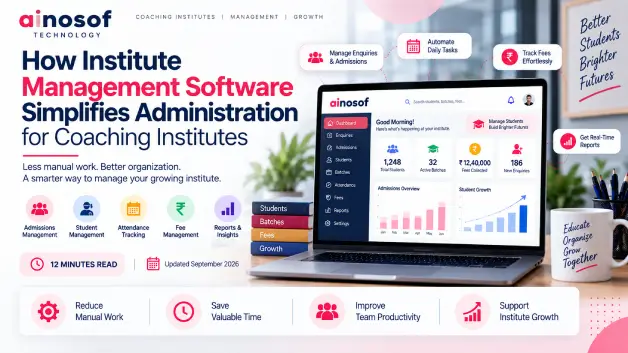 How Institute Management Software Simplifies Administration for Coaching Institutes
16 Sep, 2026
How Institute Management Software Simplifies Administration for Coaching Institutes
16 Sep, 2026
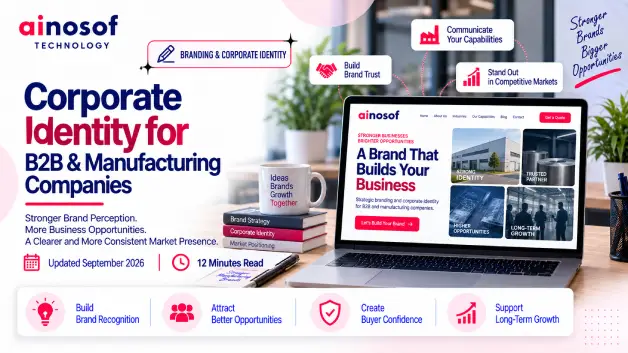 Why Corporate Identity Matters More for B2B and Manufacturing Companies
15 Sep, 2026
Why Corporate Identity Matters More for B2B and Manufacturing Companies
15 Sep, 2026
Comment with an expert and get our answer.
Comment with an expert and get our answer.
Explore more insights related to this topic and discover useful perspectives, ideas and strategies from our latest articles.