Workflow Automation Software: How It Saves Time for Growing Businesses
 Iram
Iram


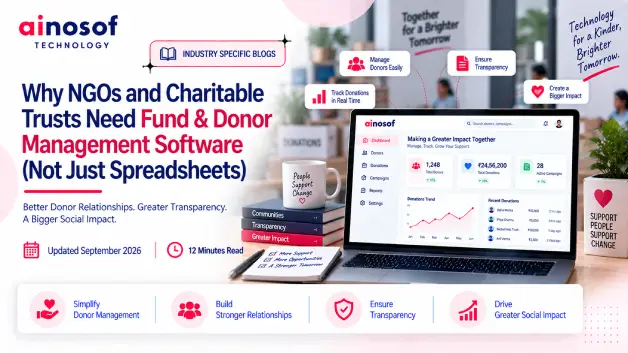
An NGO or charitable trust can begin with a simple spreadsheet and still manage its donors, contributions and expenses without much difficulty. When the organization is small, one person may know where the records are stored, which donors have contributed, which projects are active and what needs to be reported. As the organization grows, however, that same approach can become increasingly difficult to maintain.
More donors mean more records. More projects mean more fund allocations and expenses to track. More team members mean more people handling information. Soon, donor details may sit in one spreadsheet, contribution records in another, project expenses somewhere else and important updates in emails or messages. The organization may still have the information, but finding the right information at the right time becomes harder.
This creates a bigger problem than spreadsheet management. Teams can miss donor follow-ups, struggle to understand fund utilization, spend hours preparing reports and become dependent on specific employees who know how the records are maintained. For trustees and management, the challenge is having a clear and reliable view of donors, contributions, funds and projects without constantly combining information from different files.
This is where donor management software for NGOs India can become a practical business decision. The goal is not to replace spreadsheets simply because software is newer. The goal is to determine whether a centralized system can provide the control, visibility and continuity the organization needs as its operations become more complex.
In this article, we will explore where spreadsheets begin to create problems, how NGO management software can organize donor and contribution information, how fund management software for trusts can improve project-wise fund visibility, and when an organization should consider standard software or a customized solution.
For a small NGO or charitable trust, spreadsheets can be a practical way to record donor names, contributions, project expenses and other information. The problem usually starts when the organization grows and the amount of information increases. What was once easy to maintain can become difficult to control when several people are updating different files for different purposes.
A spreadsheet does not automatically become a problem because it is a spreadsheet. The difficulty comes from managing more donors, contributions, transactions, projects and expenses across files that may not be connected. Teams may spend more time checking records than using those records to manage the organization.
Donor information can become scattered when different employees maintain different spreadsheets. One file may contain basic donor details, another may record contributions, while communication history may exist in emails or separate notes.
This can make simple questions difficult to answer:
For example, if an NGO has several spreadsheets containing donor records, the same person may appear more than once with slightly different information. A team member preparing a report may then have to manually compare and correct the records.
This becomes especially difficult when donor management depends on manual updates. Even if the information exists somewhere, the organization may not have one reliable place to view it.
As an NGO or trust handles more donors and projects, the number of records grows quickly. Every new contribution can require updates to donor information, receipts, project records, fund allocation details and financial reports.
The workload becomes even higher when multiple projects or campaigns are running at the same time. Teams may need to track which money was received, where it was allocated, what expenses were made and how much remains available.
Consider a trust managing five projects with hundreds of contributions. If each project has separate spreadsheets, preparing a complete picture of fund utilization can require information from several files. A small error in one sheet can also affect the final report.
The issue is therefore not simply the amount of data. It is the growing effort required to keep information accurate, updated and connected.
Many organizations gradually develop processes around the people managing their spreadsheets. One employee may know which file contains donor history, another may maintain contribution records, and someone else may know how project-wise reports are prepared.
This creates a risk when an employee leaves, changes responsibilities or is unavailable. The organization may still have the files, but the knowledge about how those files were maintained may not be documented clearly.
For example, an employee may have created formulas, naming systems or separate sheets that other team members do not fully understand. When that person is no longer handling the records, another employee may need significant time to understand the existing system.
A more structured NGO management software approach can reduce this dependence by keeping important information in a centralized system with defined workflows, user access and records that can be understood by authorized team members.
Once donor information starts becoming difficult to manage across multiple files, the organization needs more than another spreadsheet. It needs a reliable way to keep donor details, contribution history and communication records connected.
Donor management software can provide a centralized place where authorized team members can access relevant donor information. Instead of searching through separate files, they can work with a structured record that brings important information together.
The value comes from creating a consistent source of donor information that can support both daily administration and long-term donor relationships.
A centralized system can bring important donor information into one structured record. Depending on the organization's requirements, this may include donor details, contribution history, receipts, preferred communication information and related project or campaign information.
For example, when a donor makes another contribution, the team can update the existing donor record instead of creating another entry in a separate spreadsheet.
This makes it easier to search and review information while reducing the chances of records becoming scattered across different files.
For organizations considering donor management software for NGOs India, the important question is not how many fields the software provides. It is whether the system can organize the information the NGO actually needs to manage its donors.
Donor relationships involve more than recording how much money was received. Teams may need to remember previous contributions, communication, follow-up dates and important interactions.
With centralized information, authorized staff can review a donor's history before contacting them. This can make communication more relevant and reduce repeated requests for information the organization already has.
For example, if a donor has supported the same campaign several times, the team can review that history before sending a follow-up message. Similarly, pending follow-ups can be recorded instead of being left in individual notes or message threads.
This creates a more consistent process for donor communication and follow-ups, particularly when several employees are involved.
Recurring and long-term donors require organizations to maintain accurate records over time. If each contribution is recorded separately without being connected to the donor's history, understanding the overall relationship becomes difficult.
A centralized system can connect multiple contributions to the same donor record. Teams can then review previous activity and identify recurring contribution patterns without manually combining different spreadsheets.
For example, an NGO may have a donor who contributes every month. Instead of treating each payment as an isolated transaction, the organization can maintain a connected contribution history.
This gives the team a clearer view of the donor relationship and creates a stronger foundation for consistent follow-up and future communication.
For a charitable trust, knowing how much money was received is only one part of financial management. The organization also needs to understand where funds were allocated, what expenses were made and how much has been utilized.
This becomes difficult when contributions, project budgets, expenses and utilization records are maintained separately. A centralized fund management software for trusts can connect these stages and provide a clearer view of the movement of funds.
The objective is to make the journey easier to follow:
Contribution received → Fund allocated → Project or campaign → Expense → Utilization → Reporting
A trust may receive contributions for different purposes. Some funds may support a specific project, while others may be associated with a campaign or a broader organizational purpose.
A structured system can allow funds to be associated with the appropriate project, campaign or purpose. This helps teams understand which funds belong to which activity.
For example, if a trust runs education, healthcare and community support projects, the team can maintain separate fund information for each project while keeping everything within one system.
This makes it easier to review project-wise financial information without depending on multiple manually maintained files.
Tracking these activities separately can make it difficult to understand what happened to a particular contribution or fund.
A connected system can link the major stages of the financial journey. A contribution can be recorded, allocated to a project or purpose, followed by related expenses and utilization information.
For example, suppose a trust receives ₹5 lakh for an education project. The system can record the contribution, associate the amount with the project, record eligible expenses and show the amount utilized or remaining according to the organization's workflow.
This does not remove the need for proper financial controls or accounting practices. Instead, it gives the management team a more organized operational record of fund allocation and utilization.
When funds are spread across several projects, management needs to know how much has been received, allocated and utilized for each activity.
Without project-wise visibility, teams may need to manually compare contribution records, expense sheets and project reports. This can make it harder to identify differences or prepare timely information for management.
With organized fund records, the organization can review project-level information more easily and identify where additional attention may be required.
For trustees and management teams, this visibility can support better internal control because financial information is easier to trace from the original contribution through allocation, expenses and utilization.
Reporting becomes harder when information is stored across disconnected files. Donor reports, contribution summaries, project information and fund utilization may all require different spreadsheets to be combined before management can see the complete picture.
Better data management does not simply mean storing more information. It means keeping important records structured, connected and accessible to the right people. This can reduce manual effort and make organizational information easier to review.
When donor, contribution and project information exists in one structured system, teams can retrieve related information without repeatedly combining separate files.
For example, an NGO may need a report showing contributions received for a particular campaign and the related utilization. If the records are connected, the team can work from the same underlying information instead of collecting figures from several spreadsheets.
The exact reports required will depend on the organization's internal processes and reporting requirements. The important point is that centralized records can reduce repetitive data collection and manual consolidation.
This can save administrative time while also reducing the possibility of inconsistencies between different reports.
NGOs and trusts may need information for trustees, management meetings, donors, project reviews or other organizational requirements. These requests can become difficult when employees have to search through multiple files every time a question is raised.
With structured records, authorized users can search and review information more systematically.
For example, management may want to know the total contributions associated with a particular campaign, the amount allocated to a project or the expenses recorded against it. If the information is organized properly, the team can retrieve it without rebuilding the entire report from scratch.
This improves management visibility and helps the organization spend less time searching for information and more time reviewing what that information means for its operations.
Not every employee needs access to every donor or financial record. Donor information and financial data can be sensitive, so organizations should consider who can view, add, edit or export particular information.
Management software can support role-based access by giving different users different permissions according to their responsibilities.
For example, a staff member responsible for donor communication may need access to donor profiles and communication history but may not need access to complete financial records. A finance team member may require access to contribution and expense information that is not necessary for other employees.
Access controls should be designed according to the organization's actual responsibilities, along with appropriate security, backups and data-management practices.
As an NGO or trust grows, protecting information becomes part of managing the organization responsibly. Centralized data with appropriate access controls can provide greater structure, continuity and accountability than relying on scattered files and individual knowledge.
Moving away from spreadsheets should not be based simply on the size or age of an organization. The more useful question is whether the current system is still helping the team manage donors, contributions, projects, funds and reporting accurately and efficiently.
If employees are spending increasing amounts of time searching for records, correcting duplicate information or preparing reports manually, spreadsheets may have become an operational limitation rather than a simple record-keeping tool.
Several practical signs can indicate that an NGO or charitable trust is beginning to outgrow spreadsheet-based management:
For example, an NGO may still be able to manage 200 donor records through spreadsheets, but if preparing a monthly contribution and utilization report requires checking six different files, the issue is no longer the number of donors alone. The process itself has become difficult to control.
The right time to consider NGO management software is when the organization needs better structure, visibility and continuity—not simply because it has reached an arbitrary number of records.
Standard software can be suitable when an organization's processes are relatively straightforward and match the workflows already supported by the software.
For example, a small NGO may mainly need:
If these requirements are already supported without major changes to the software, a standard solution may provide what the organization needs without unnecessary complexity.
Before choosing one, however, the team should check how easily it can import existing records, manage its current workflow and generate the reports it actually uses.
The key question is simple: Does the standard software solve the organization's real operational problems without forcing the team to change important processes unnecessarily?
Customized software becomes more relevant when the organization's processes, data structure or reporting requirements are significantly different from what standard software provides.
A trust may need a particular fund-allocation process, project-wise utilization tracking, specialized donor workflows, multiple levels of approval, custom reports or integration with existing systems.
For example, an organization managing several programs may need a workflow that connects donor contributions with specific projects, approved allocations, expenses and utilization reports in a way that standard software cannot support properly.
In such situations, customized NGO management software can be designed around the organization's actual workflow rather than requiring the organization to fit its operations into a fixed system.
Customization should still be based on genuine operational requirements. Building unnecessary complexity can increase cost, training requirements and long-term maintenance.
Choosing software is not simply about comparing the number of features shown on different product pages. An NGO or trust should first understand what is difficult to manage today and then check whether the proposed system directly addresses those problems.
The evaluation should cover donor management, contribution tracking, fund management, project records, reporting, access control and future growth.
Every organization may have a different way of working. Some NGOs manage donations by campaign, while others associate contributions with projects, programs or specific purposes.
Before investing, the team should map its current process and compare it with the software.
Ask:
For example, if a trust requires project-wise fund tracking but the software only provides basic donation records, the system may not address its main operational requirement.
Software should support the way the organization needs to work, particularly where those workflows are central to financial and donor management.
A useful management system should cover the complete information journey rather than solving only one part of it.
The organization should check whether the software can handle donor records, contribution history, receipts, fund allocation, projects or campaigns, expenses, fund utilization and reporting in a connected manner.
Security and access should also be considered. The system should provide appropriate user permissions so that employees can access the information required for their responsibilities.
Integration requirements matter as well. If the organization already uses accounting, CRM, billing or other systems, it should check whether information can be exchanged without creating another manual process.
A good evaluation therefore focuses on actual workflows rather than a long list of features. The software should make important information easier to maintain, find, connect and report.
The organization should decide how success will be measured before implementation.
Useful measures can include:
For example, if preparing a monthly donor report previously required two days of manual work, the organization can compare that process after implementation. Similarly, it can track whether employees are spending less time searching through files and whether management can access project and fund information more easily.
The purpose of measurement is not to prove that software is automatically successful. It is to determine whether the investment is actually reducing the operational problems that led the organization to consider software in the first place.
Managing donors and funds is only one part of building a more organized organization. As operational requirements grow, NGOs and charitable trusts may also need better systems for CRM, accounting, billing, reporting, workflow automation and centralized data management.
The next step should be based on the organization's actual gaps. If donor communication is becoming difficult, CRM capabilities may need attention. If financial and operational systems are disconnected, integration may be more important. If the existing workflow does not fit standard software, custom software development can provide a more organization-specific approach.
The goal is not to introduce technology for its own sake. It is to build systems that reduce repetitive work, improve information visibility and help teams manage organizational responsibilities with greater consistency.
The problem with spreadsheets is not that they are old or unsuitable for every NGO. They can remain useful for simple and limited record-keeping. The difficulty begins when an organization has to manage growing numbers of donors, contributions, projects, funds, expenses and reports across multiple files and people.
At that stage, dedicated software can provide a more structured way to connect donor information, contribution history, fund allocation, project activity and utilization records. It can also support reporting, user permissions and better continuity when responsibilities are shared across a growing team.
For some organizations, standard NGO management software may provide everything required. Others may need customized NGO management software because their donor, fund or project workflows require a more specific system.
The right decision is therefore not simply whether an NGO should replace spreadsheets with software. It is whether the organization has reached a point where better data control, fund visibility, donor management and reporting can meaningfully improve the way it operates.
When technology is selected around real operational needs, it becomes more than a replacement for spreadsheets—it becomes part of a stronger foundation for managing the organization's work as it grows.
NGOs may need donor management software when donor records, contributions, communication and follow-ups become difficult to manage through separate spreadsheets. A centralized system can help organize donor information and make historical records easier for authorized team members to access.
An NGO should consider moving beyond spreadsheets when records become scattered, duplicates appear, follow-ups are missed, reports take too long to prepare, or employees spend significant time combining information from different files.
Depending on the system, NGO management software can help manage donor profiles, contribution records, receipts, communication history, follow-ups, projects, campaigns, fund allocation, expenses, utilization and reporting.
Fund management software for trusts can help connect contributions with their intended project, campaign or purpose and maintain records of allocations, expenses and fund utilization. This can make project-wise financial information easier to review.
Yes, it can be suitable for small NGOs when the software matches their actual requirements and budget. A small organization does not necessarily need a highly customized system. A simpler solution may be sufficient if its donor and reporting processes are straightforward.
Yes. A suitable centralized system can connect donor records, contributions, projects, fund allocation, expenses and utilization. The exact workflow depends on the software and the organization's requirements.
The decision depends on how closely standard software matches the organization's workflow. Standard software may be enough for straightforward requirements, while customized NGO management software may make more sense when the organization has specialized workflows, reports, integrations or data structures.
NGOs should look for appropriate role-based access, user permissions, secure data handling, backups and data continuity measures. Access should be limited according to each employee's responsibilities, particularly when the system contains sensitive donor and financial information.
 Why Businesses Are Building Employee Apps to Manage Field and Warehouse Staff
18 Sep, 2026
Why Businesses Are Building Employee Apps to Manage Field and Warehouse Staff
18 Sep, 2026
 How B2B Ecommerce Platforms Are Changing the Way Wholesalers Do Business
17 Sep, 2026
How B2B Ecommerce Platforms Are Changing the Way Wholesalers Do Business
17 Sep, 2026
 How Institute Management Software Simplifies Administration for Coaching Institutes
16 Sep, 2026
How Institute Management Software Simplifies Administration for Coaching Institutes
16 Sep, 2026
 Why Corporate Identity Matters More for B2B and Manufacturing Companies
15 Sep, 2026
Why Corporate Identity Matters More for B2B and Manufacturing Companies
15 Sep, 2026
 How CRM and ERP Integration Improves Sales and Operations Together
14 Sep, 2026
How CRM and ERP Integration Improves Sales and Operations Together
14 Sep, 2026
 What is Answer Engine Optimization (AEO) and How Can Businesses Get Featured in AI-Generated Answers?
03 Aug, 2026
What is Answer Engine Optimization (AEO) and How Can Businesses Get Featured in AI-Generated Answers?
03 Aug, 2026
Comment with an expert and get our answer.
Comment with an expert and get our answer.
Explore more insights related to this topic and discover useful perspectives, ideas and strategies from our latest articles.