The Rise of Industry-Specific ERP Systems: Why One-Size-Fits-All ERP is Losing Relevance
 Iram
Iram


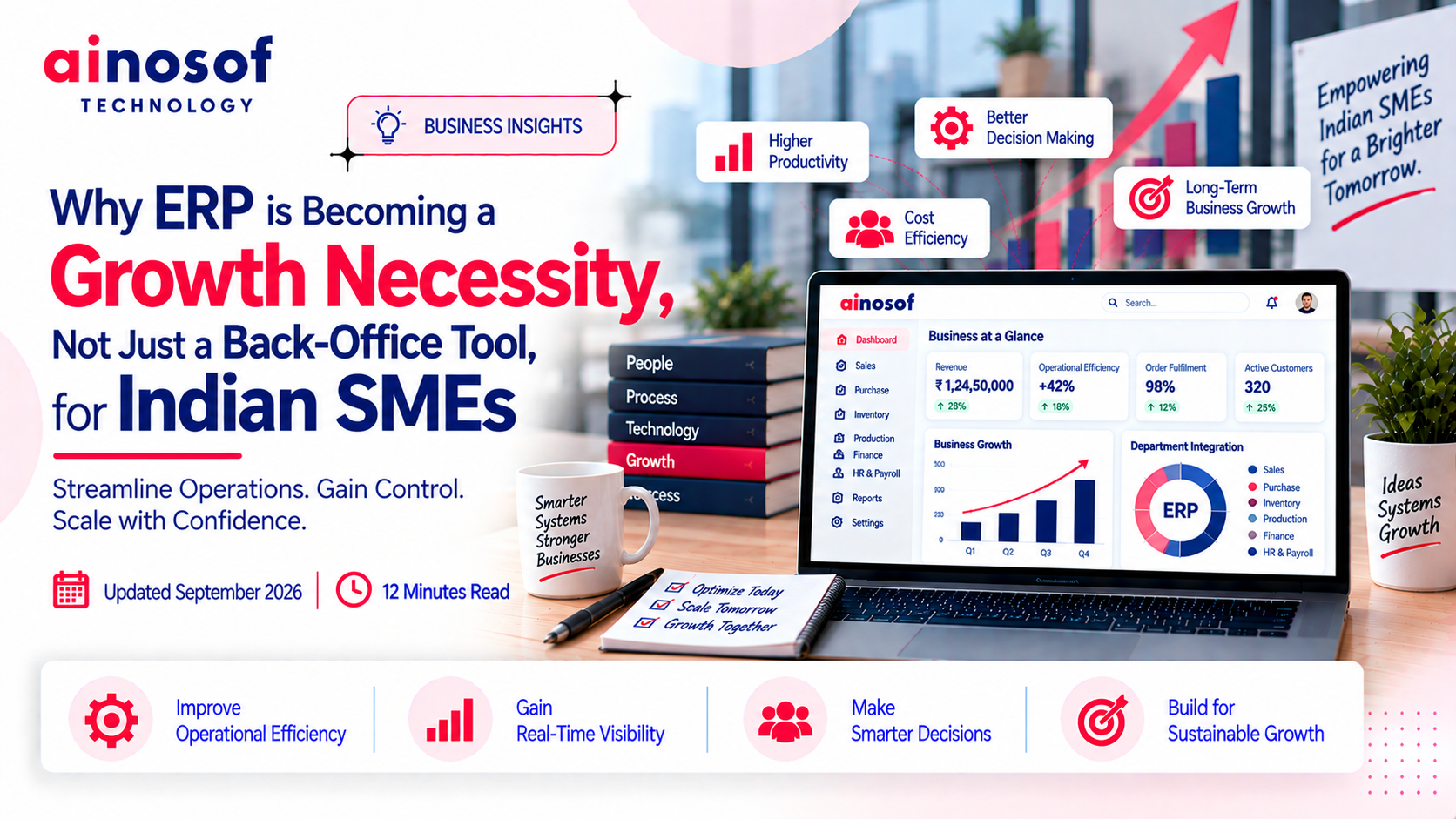
For an Indian SME, growth can look very different once the business moves beyond a small team and a manageable number of transactions. More customers bring more orders. More orders create more inventory movement. More employees create more approvals and coordination. Add multiple locations, suppliers, products, or sales channels, and information can quickly become difficult to control.
At this stage, many businesses continue using accounting software, spreadsheets, emails, and separate applications because those systems worked well in the earlier stages of the business. The problem is that business complexity can grow faster than the systems managing it. Employees spend more time entering and checking information, management waits for reports, and important decisions depend on data collected from different places.
This is where the role of ERP starts changing. It is no longer only about managing accounts or recording transactions. For a growing SME, ERP can become part of the infrastructure needed to coordinate operations, improve visibility, and handle greater business complexity without creating the same increase in manual work.
But that does not mean every growing SME needs ERP immediately. The more important question is whether the business has reached the point where its existing systems are becoming a constraint on growth.
In this article, we will look at ERP as a growth tool for SMEs, the operational problems that signal the need for stronger systems, the real ERP business impact India businesses can evaluate, and how to determine whether ERP makes sense now, later, or not yet.
Growth usually creates problems that were not visible when the business was smaller. A few spreadsheets, accounting software, emails and separate tools may work well when transactions are limited. But as an SME grows, the same systems can become difficult to manage.
The issue is not simply having more data. The issue is that business information becomes harder to connect, verify and use. Management may need information from sales, finance, inventory and purchasing before making one decision, while each department may be working with different records.
At an early stage, spreadsheets can be practical. One person may manage sales records, another may update stock, while accounting software handles financial transactions.
As the business grows, these systems start creating gaps.
A sales employee may update an order in one place while the inventory team maintains stock in another. Finance may receive information later. Management may then have to collect and compare these records before understanding what actually happened.
This creates duplicate data entry, repeated checking and dependency on individual employees.
For example, a growing distributor may receive hundreds of orders every month. If order details, stock records and purchasing information are maintained separately, employees may spend significant time checking whether the required stock is actually available before confirming an order.
The business has not necessarily outgrown spreadsheets because spreadsheets are bad. It has outgrown them because the number of connected decisions has increased.
Every new customer, transaction or department adds another layer of coordination.
A growing business may need sales to know what inventory is available, purchasing to know what needs to be ordered, finance to know what has been billed, and management to understand the overall position.
When these teams work through disconnected systems, small delays can create larger operational problems.
A customer may receive an incorrect delivery commitment because stock information was outdated. Purchasing may order material that is already available. Finance may spend time reconciling information that should have been connected from the beginning.
The more transactions a business handles, the harder it becomes to rely on manual coordination and employee memory.
For example, a business with 20 active customers may manage order information manually without much difficulty. The same approach becomes harder when the business handles hundreds of customers, multiple product categories and several departments.
The important change is not just volume. It is dependency between business processes.
Fragmented information creates costs that may not appear as a separate line item in the accounts.
Employees spend time entering the same information more than once. Managers spend time asking teams for updates. Finance teams reconcile different records. Operations teams investigate discrepancies. Sales teams wait for confirmation from other departments.
These activities consume time that could otherwise be used for customers, planning and growth.
There can also be direct operational costs. Incorrect stock information can lead to unnecessary purchases or missed sales. Delayed reporting can slow decisions. Duplicate records can create confusion over customer orders or payments.
For example, if management needs three different spreadsheets to understand sales, inventory and outstanding payments, the real cost is not only the spreadsheets. It is the time required to bring those numbers together and determine which information is reliable.
As an SME grows, fragmented information therefore becomes an operational cost.
Operational complexity becomes a growth problem when adding more business requires adding almost the same amount of manual coordination.
A useful warning sign is when employees say things like:
These are not automatically signs that an SME needs ERP. But when such situations become regular, they indicate that the existing business systems may be struggling to support the company's scale.
Imagine an SME planning to open another location. If the existing operation already depends heavily on manual stock updates, separate customer records and delayed reporting, adding another location can multiply the coordination problem.
This is the point where technology becomes a business-growth question rather than simply an IT question.
ERP becomes relevant when an SME needs its business processes to work together instead of being managed as separate activities.
The purpose is not simply to replace spreadsheets. The bigger objective is to create a connected operating system where information moves between departments with less manual intervention.
For a growing SME, this can make ERP a growth tool because the business can handle greater operational complexity without depending on the same level of manual coordination.
Management decisions become easier when important information is available through connected business processes.
An ERP system can bring information from sales, inventory, purchasing, finance and other operational areas into one system. Instead of asking several teams for separate updates, management can work from information captured through the business workflow.
For example, when a sales order is recorded, the business may be able to see its impact on inventory, purchasing requirements and financial records through connected processes.
This does not mean every ERP dashboard automatically provides perfect information. Data quality and correct process usage still matter.
But when information is captured consistently, management gains better visibility with less manual data gathering.
Manual work becomes more expensive as transaction volume increases.
If employees have to enter the same customer, product, order or payment information into several systems, the workload grows with every additional transaction.
ERP can reduce this repetition by connecting processes.
For example, an order entered into an ERP system can trigger related inventory, billing, purchasing or reporting activities depending on the business workflow. Employees still need to review and manage exceptions, but they do not necessarily need to repeat every piece of information manually.
This can reduce duplicate data entry, reconciliation work and routine administrative effort.
The real value appears when transaction volumes continue increasing. The business can process more activity without increasing manual coordination at exactly the same rate.
Good decisions often depend on having the right information at the right time.
Suppose an SME wants to increase sales of a particular product. Management may need to know current stock, pending purchase orders, sales performance, customer demand and payment status before making the decision.
If this information is spread across different systems, employees may need hours to collect it.
With connected ERP data, the same decision can be supported by information already flowing through the business.
For example, a manager can identify that sales are increasing while stock is falling and purchasing lead times are increasing. That combination may require action before customers begin experiencing availability problems.
ERP does not make the decision for management. It can make the information behind the decision easier to access and understand.
Scaling a business means handling more customers, orders, employees, products or locations. Without structured systems, every increase can create additional coordination work.
ERP can provide standardized workflows for activities that happen repeatedly.
For example, a business can define how sales orders move toward inventory checks, approvals, invoicing and fulfilment. As more employees join the process, they work within the same structure instead of creating their own versions of the process.
This helps create repeatable business operations.
The goal is not to remove human involvement. It is to ensure that growth does not depend entirely on adding more people to perform repetitive coordination.
The impact of ERP becomes clearer when viewed across the entire business rather than only through the finance department.
For an Indian SME, growth often involves more customers, suppliers, products, employees, locations and transactions. ERP can connect these activities so that one department does not operate without understanding what another department is doing.
These departments are closely connected even when businesses manage them separately.
Sales needs to know what can be delivered. Inventory needs to know what has been sold. Purchasing needs to know what needs replenishment. Finance needs accurate information about orders, invoices and payments.
ERP can connect these workflows.
For example, a confirmed order can update relevant inventory information, create purchasing requirements when necessary and provide information for billing and financial reporting.
This creates a clearer flow from customer order to fulfilment to payment.
The benefit is not simply faster data movement. It is fewer gaps between departments.
Growth increases the number of things management needs to control.
A business may start with one location and later operate across several branches. It may move from a small product range to hundreds or thousands of SKUs. Customer accounts and supplier relationships may also increase.
Managing this expansion through separate files can make visibility difficult.
ERP can provide a centralized structure for customers, products, inventory, transactions and locations, while still allowing businesses to define different workflows or access levels where required.
For example, management may need an overall view of inventory while each location needs access to its own operational information.
That structure becomes increasingly useful as the business expands.
More control does not have to mean more paperwork.
When controls are built into the workflow, employees can follow predefined processes instead of relying on manual reminders.
For example, an approval requirement can be built into a purchasing workflow. Required information can be captured when an order is created rather than requested later by another department.
This can improve process control while reducing unnecessary follow-up.
However, ERP should be designed around the actual business process. If every small activity requires unnecessary approvals, the system can create delays instead of removing them.
The objective is controlled execution, not control for its own sake.
For Indian SMEs, ERP can affect much more than accounting.
Its operational impact can include inventory visibility, purchasing control, sales coordination, production planning, order tracking, reporting and multi-location management.
Consider a manufacturing SME. Better integration between sales orders, inventory, purchasing and production can help management understand whether incoming demand can be supported by available materials and production capacity.
For a trading business, connected inventory and sales information can help reduce uncertainty around stock availability.
For a multi-location business, centralized information can make it easier to compare operations across locations.
The actual ERP business impact India businesses experience will depend on the processes implemented, data quality, employee adoption and how well the system fits the business.
ERP can improve the way information is captured, shared and used. It can reduce repetitive work, connect departments and provide stronger operational visibility.
But ERP cannot automatically fix every business problem.
It cannot compensate for poor management decisions, unclear processes, weak employee accountability, inaccurate data or an unsuitable business model.
For example, if a company has no clear purchasing policy, implementing ERP will not automatically create one. The business still needs to decide who can approve purchases, what limits apply and how exceptions should be handled.
This distinction matters because ERP is infrastructure, not a substitute for management.
The system can support better processes, but the business still has to design those processes and use the system properly.
The right time to consider ERP is not determined by a fixed revenue number or employee count.
A smaller SME can have complex operations, while a larger company may still manage effectively with simpler systems. The more useful question is whether the complexity of the business has started exceeding the ability of its current systems to control it.
Accounting software may continue to work well for financial management while the rest of the business becomes more complex.
Warning signs appear when teams increasingly depend on spreadsheets and manual processes outside the accounting system.
For example:
These signs do not automatically mean ERP is required. But together, they can indicate that accounting software is no longer sufficient as the central operating system for the business.
No.
ERP should be evaluated according to business complexity, not simply because a company is growing.
An SME with simple operations, limited transactions and little dependency between departments may continue using its existing systems effectively.
Another SME with fewer employees but complex inventory, manufacturing, multiple locations or large transaction volumes may need stronger integration much earlier.
The right question is therefore not, “Is my business growing?”
It is:
“Is my current system still capable of supporting the way my business now operates?”
This keeps the ERP decision connected to an actual business problem rather than treating ERP as a compulsory upgrade.
Before investing in ERP, management should understand the cost of the current way of working.
Useful areas to measure include:
For example, if five employees spend several hours every week reconciling information between systems, the business should calculate the annual cost of that activity.
This creates a more realistic basis for evaluating ERP ROI than comparing software prices alone.
ERP investment should be compared with the cost of continuing the existing system.
The ERP side may include software, implementation, customization, migration, training, integrations and ongoing maintenance.
The current-system side may include employee time, data errors, delayed reporting, inventory losses, duplicate software costs and the operational cost of slow decisions.
Consider an SME that spends significant employee time every month checking stock, reconciling sales information and preparing reports manually. That work may appear normal because it has become part of daily operations.
But when the cost is measured over a year, the business may discover that operational inefficiency itself has a meaningful financial cost.
The comparison should therefore be based on the total business impact, not just the ERP licence or development price.
Recognizing the need for ERP is only one part of the decision. The business also needs to be ready to implement it.
Before starting, management should ask:
A business that has identified every problem but has not prepared its processes, data or people may struggle even with a technically capable ERP system.
For this reason, ERP readiness is a business-readiness question, not only a technology question.
An Indian SME does not need ERP simply because it has reached a certain size. It becomes worth serious evaluation when fragmented systems, manual work and limited visibility begin making growth harder to manage. At that point, ERP can provide the structure needed to support growth without allowing operational complexity to grow at the same speed.
Once an SME starts viewing ERP as growth infrastructure rather than only back-office software, the next step is to understand what kind of ERP approach fits its actual operations.
A business may need a standard ERP solution, custom ERP software development, an industry-specific system, or a phased implementation. The right choice depends on processes, integrations, reporting requirements, business size and future plans.
Ainosof Technology can help businesses evaluate these requirements from a practical business perspective, including ERP software development, custom ERP development and ERP & CRM software development.
The goal should not be to implement the biggest system available. It should be to build an ERP environment that supports the way the business operates today while giving it room to grow tomorrow.
For an Indian SME, growth eventually changes the way the business needs to operate. More customers, transactions, employees, products and locations create more connections between departments. When those connections are managed through spreadsheets, separate software and manual coordination, operational complexity can become a growth constraint.
ERP can help address that problem by connecting business information, reducing repetitive work, improving visibility and creating more structured processes. But ERP is not automatically the right answer for every SME, and it cannot replace good management, clear processes or employee accountability.
The better approach is to evaluate the business honestly: Are current systems still supporting growth, or are they starting to slow it down?
If fragmented information, manual work and limited visibility are already affecting decisions and operations, ERP may have moved from being a future technology investment to becoming part of the infrastructure required for sustainable growth.
SMEs do not need ERP simply because they are growing. ERP becomes relevant when business complexity starts exceeding the ability of existing systems to manage it. More customers, transactions, departments, products and locations can make spreadsheets and disconnected software difficult to control. ERP can connect these processes, improve visibility and reduce repetitive manual work, giving the business stronger infrastructure for growth.
Accounting software primarily focuses on financial transactions, accounts, invoicing and reporting. ERP can connect finance with sales, inventory, purchasing, production, operations and other business processes. An SME may be able to manage its accounts effectively while still struggling to coordinate the rest of its operations. ERP addresses this wider operational requirement.
No. The decision should depend on business complexity and operational requirements, not simply revenue, employee count or growth rate. An SME with simple operations may continue using existing software effectively. ERP becomes worth evaluating when disconnected systems, manual processes, limited visibility or expansion plans begin creating operational problems.
Common signs include repeated data entry, spreadsheet dependency, slow reporting, inventory discrepancies, manual reconciliation, disconnected departments and difficulty managing multiple locations. Another strong sign is when management needs to collect information from several employees or systems before making routine decisions.
The ERP business impact in India can extend beyond accounting. Depending on the business, ERP can improve inventory visibility, purchasing control, sales coordination, production planning, order tracking, financial visibility and multi-location management. The actual impact depends on the quality of implementation, process design, data and employee adoption.
Yes. ERP can provide centralized information and standardized workflows across locations. Management can have a broader view of sales, inventory, purchasing and financial activity while individual locations can work with the information relevant to their operations. This can make expansion easier to control, although the ERP must be configured properly for the business structure.
An SME should compare the ERP investment with measurable improvements in the business. Useful measures include employee time saved, reduced data errors, faster reporting, better inventory control, lower reconciliation effort, improved order processing and reduced operational delays. ERP ROI should also consider implementation, training, customization and ongoing maintenance costs rather than only the software price.
Delaying ERP does not always create a problem. If current systems are still handling business operations effectively, waiting may be reasonable. However, when operational inefficiency is already limiting growth, continued reliance on fragmented systems can increase manual work, errors, reconciliation effort and management dependency on individual employees. The important question is whether the cost of waiting is becoming greater than the cost of improving the system.
 The Rise of Industry-Specific ERP Systems: Why One-Size-Fits-All ERP is Losing Relevance
28 Sep, 2026
The Rise of Industry-Specific ERP Systems: Why One-Size-Fits-All ERP is Losing Relevance
28 Sep, 2026
 How ERP Implementation Helped a Manufacturing Business Cut Inventory Errors by Half
26 Sep, 2026
How ERP Implementation Helped a Manufacturing Business Cut Inventory Errors by Half
26 Sep, 2026
 Manufacturing ERP vs Trading ERP: Which One Does Your Business Need?
25 Sep, 2026
Manufacturing ERP vs Trading ERP: Which One Does Your Business Need?
25 Sep, 2026
 What is LLM SEO and Why Is It Becoming Important for Business Visibility in 2026?
03 Aug, 2026
What is LLM SEO and Why Is It Becoming Important for Business Visibility in 2026?
03 Aug, 2026
 ERP Software Cost in India 2026: What Businesses Should Budget For
24 Sep, 2026
ERP Software Cost in India 2026: What Businesses Should Budget For
24 Sep, 2026
 Why Colleges and Universities Need ERP Software to Manage Admissions, Fees and Operations
23 Sep, 2026
Why Colleges and Universities Need ERP Software to Manage Admissions, Fees and Operations
23 Sep, 2026
Comment with an expert and get our answer.
Comment with an expert and get our answer.
Explore more insights related to this topic and discover useful perspectives, ideas and strategies from our latest articles.