How a Professional Website Builds Credibility for Manufacturing and B2B Companies
 Shivam Kumar


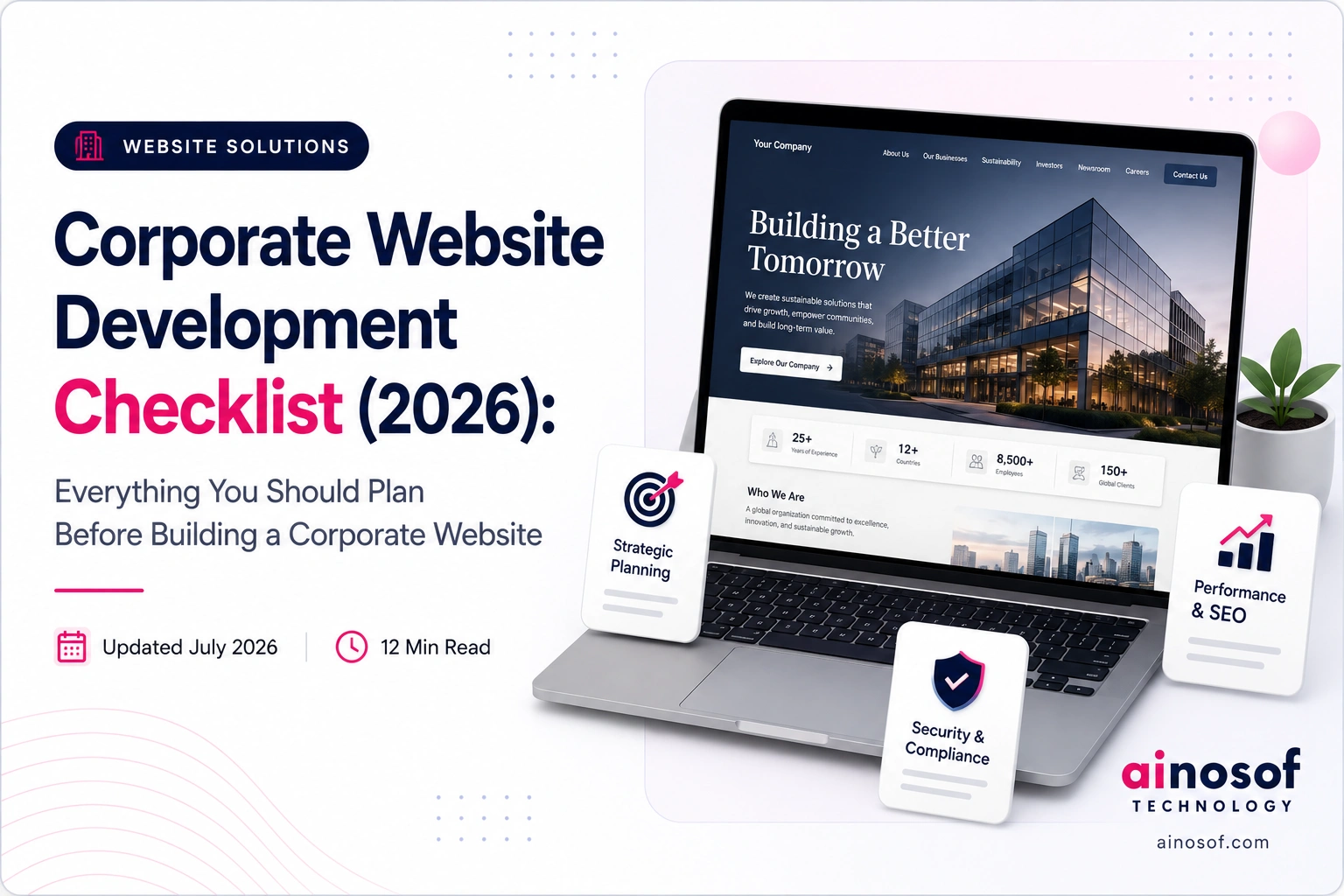
A corporate website is often the first place where people form an opinion about your organisation.
Whether someone is evaluating your company for a business partnership, considering a long-term contract, exploring career opportunities, reviewing investment potential, or researching your organisation before making contact, your website becomes an important source of information and credibility.
Unlike promotional websites that focus primarily on products or services, a corporate website represents the organisation as a whole. It communicates your company's vision, leadership, expertise, business capabilities, governance, achievements, and long-term stability.
For many organisations, a corporate website also becomes a central communication platform for customers, investors, vendors, partners, media representatives, and potential employees. Each of these audiences visits your website with different expectations, making thoughtful planning essential before development begins.
Many organisations invest heavily in branding, operations, and business development, yet their websites fail to communicate the scale, professionalism, and credibility of the organisation effectively. As a result, valuable opportunities are sometimes lost before the first conversation even begins.
This Corporate Website Development Checklist has been created to help organisations plan a website that reflects their identity, supports stakeholder communication, and builds long-term business credibility. Rather than focusing only on design or technology, this guide explains the strategic decisions that help create a corporate website capable of supporting organisational growth for years to come.
Although many people use the terms business website and corporate website interchangeably, they serve different purposes.
A business website is generally designed to present products or services and encourage customer enquiries. A corporate website has a broader responsibility. It represents the organisation itself and serves multiple audiences with different information needs.
Someone visiting a corporate website may not be looking to purchase a product immediately. Instead, they may be evaluating the organisation's credibility, leadership, experience, business operations, financial strength, governance, sustainability initiatives, certifications, or corporate values.
This means a corporate website must communicate much more than commercial offerings. It should provide stakeholders with the confidence that the organisation is well-established, professionally managed, and capable of building long-term business relationships.
A well-planned corporate website typically supports communication with:
Each audience arrives with different questions.
Some want to understand your business capabilities.
Others want to learn about your leadership team, company history, certifications, corporate policies, or career opportunities.
The more effectively your website answers these questions, the more confidence stakeholders develop before engaging with your organisation.
This is what distinguishes a corporate website from a standard business website. It is not designed simply to generate enquiries—it is designed to strengthen the organisation's reputation, communicate its values, and support relationships with every important stakeholder.
Unlike product-focused websites, a corporate website is rarely visited for a single reason. Different stakeholders arrive with different expectations, and each of them is trying to answer a different business question before taking the next step.
A prospective client may want to understand your business capabilities. An investor may be looking for organisational stability. A potential employee may be evaluating your work culture. A business partner may want to learn about your leadership, governance, or long-term vision.
This means a corporate website should not simply present information—it should help every important stakeholder understand, evaluate, and trust the organisation.
Before planning your website, consider the questions your stakeholders are likely to ask.
Every corporate website should answer one fundamental question as early as possible:
Who is this organisation, and what does it stand for?
Many organisations focus heavily on describing their products or services while giving very little attention to explaining the organisation behind them.
A well-planned corporate website should communicate:
This information helps visitors understand the organisation beyond its commercial offerings and establishes the foundation for long-term trust.
People may engage with your products, but they build relationships with your organisation.
Corporate credibility is often shaped by how clearly an organisation communicates its capabilities.
Visitors should not have to search across multiple pages to understand the size, experience, or expertise of the organisation.
Depending on your business, your website should clearly communicate:
The objective is not to impress visitors with numbers but to provide enough context for them to understand the organisation's strengths.
A corporate website should replace assumptions with confidence.
Leadership plays an important role in shaping how stakeholders perceive an organisation.
Investors, enterprise clients, media representatives, and prospective employees often want to understand the people responsible for guiding the business.
Where appropriate, consider including:
These sections humanise the organisation while demonstrating accountability and transparency.
For many stakeholders, understanding the leadership behind the organisation strengthens confidence in its long-term direction.
Corporate credibility is rarely built through promotional statements.
It is built by presenting genuine information that demonstrates the organisation's experience, governance, achievements, and business maturity.
Useful credibility indicators may include:
Rather than claiming excellence, allow stakeholders to evaluate your organisation through evidence.
Corporate reputation is strengthened by transparency, not by marketing language.
A corporate website serves multiple audiences simultaneously.
A prospective employee should not navigate the website in the same way as an investor.
Similarly, a supplier should not have to search through product pages to locate procurement information.
Planning dedicated sections for different stakeholder groups improves both usability and communication.
For example, your corporate website may include dedicated areas for:
When information is organised according to stakeholder needs rather than internal departments, visitors find relevant content more quickly and develop a better overall experience.
An effective corporate website doesn't try to speak to everyone at once—it provides the right information to the right audience at the right time.
A corporate website should not be planned only as a marketing asset. It should be designed as a long-term communication platform that grows alongside the organisation.
As businesses expand, new business units are introduced, leadership teams evolve, sustainability initiatives become more important, partnerships grow, and stakeholder expectations change. Your website should be capable of supporting these developments without requiring a complete restructuring every few years.
Planning these elements before development begins creates a website that remains organised, scalable, and valuable for every stakeholder who interacts with your organisation.
One of the most common planning mistakes is treating a corporate website like a catalogue of services.
While products and services remain important, they are only one part of the organisation's identity.
A corporate website should present the organisation as a complete business ecosystem by explaining:
This broader perspective helps stakeholders understand the organisation beyond individual offerings.
Corporate websites should communicate organisational strength—not just commercial capability.
Every stakeholder visits your website with a different purpose.
An investor may look for governance and business performance, while a prospective employee wants to understand workplace culture. A strategic partner may evaluate business capabilities, whereas a journalist may search for official announcements and corporate information.
Instead of organising content around internal departments, organise it around stakeholder journeys.
For example, consider dedicated sections for:
This approach improves usability while ensuring that each audience can quickly locate the information most relevant to them.
The easier stakeholders find relevant information, the stronger their confidence in the organisation becomes.
Corporate reputation is built over years, but a website has only a few minutes to communicate it effectively.
Rather than relying on broad statements about excellence or leadership, present measurable indicators that reflect the organisation's maturity and credibility.
These may include:
Evidence enables stakeholders to form their own opinion about your organisation instead of asking them to rely on promotional claims.
Credibility grows when organisations provide evidence instead of adjectives.
A corporate website should feel like one organisation—not a collection of unrelated pages.
Consistency in messaging, design, navigation, and visual identity helps reinforce professionalism while making the website easier to navigate.
Maintain consistency in areas such as:
When every page reflects the same corporate identity, stakeholders experience a stronger sense of professionalism and organisational discipline.
Consistency also strengthens brand recognition across all digital touchpoints.
Organisations rarely remain unchanged.
New business verticals emerge, acquisitions take place, offices expand, international markets develop, and new stakeholder groups become important.
A corporate website should be prepared to accommodate these changes without disrupting the overall information architecture.
Consider future planning for:
Planning with a long-term perspective reduces redevelopment costs while allowing the website to evolve naturally alongside the organisation.
A corporate website should reflect where your organisation is today while remaining prepared for where it wants to be tomorrow.
Every interaction with your organisation begins with communication.
Whether someone wants to request a partnership, contact investor relations, enquire about careers, connect with the media team, or discuss business opportunities, your website should make that process straightforward.
Depending on your organisation's structure, consider providing dedicated communication channels for:
Clear communication pathways improve stakeholder experience and demonstrate that the organisation values transparency and accessibility.
Well-planned communication builds stronger relationships long before meetings, proposals, or negotiations begin.
Developing a corporate website involves much more than creating attractive designs or publishing company information online. It is a structured process that transforms an organisation's identity, business capabilities, and stakeholder communication into a professional digital experience.
When organisations rush into design without proper planning, they often face inconsistent messaging, poor information architecture, unnecessary revisions, and websites that no longer support business growth after a short period.
A structured development process helps avoid these challenges by ensuring that every stage contributes to a website that accurately represents the organisation while serving the needs of its stakeholders.
Here's what an effective corporate website development process typically involves.
Every successful corporate website begins with understanding the organisation itself.
Before discussing layouts, colours, or technology, it's important to understand what the organisation represents and how it wants to be perceived by different stakeholders.
This stage typically involves understanding:
These discussions establish the strategic foundation for the entire project.
A corporate website should reflect the organisation's strategy—not simply its visual identity.
Unlike many business websites, a corporate website must communicate with multiple audiences simultaneously.
Each stakeholder expects different information, and the website should make that information easy to discover without creating unnecessary complexity.
During this stage, information is organised into logical categories based on stakeholder requirements.
This may include planning content for:
A well-structured information architecture improves both usability and long-term website management.
When information is organised around stakeholder expectations, every interaction with the organisation becomes more meaningful.
Corporate website design is not about following design trends.
Its primary objective is to communicate professionalism, consistency, and trust while making information easy to access.
Every design decision should support communication rather than compete with it.
A well-designed corporate website typically focuses on:
Visitors should leave with a stronger understanding of the organisation—not simply an impression of attractive design.
Professional design earns attention. Clear communication earns confidence.
Once the strategy and design are finalised, the development phase transforms those plans into a fully functional corporate website.
Beyond visual presentation, development focuses on creating a stable, secure, and scalable platform capable of supporting organisational communication for years to come.
Depending on business requirements, development may include:
The objective is not only to build a website but to create a digital platform that supports multiple organisational functions efficiently.
Before launching the website, it should be evaluated from the perspective of every major stakeholder group.
Rather than checking only whether pages function correctly, review how effectively the website supports real user journeys.
For example:
Testing from multiple perspectives helps identify communication gaps that technical testing alone may overlook.
A successful corporate website is measured by how easily stakeholders achieve their objectives—not simply by whether every page loads correctly.
A corporate website should continue evolving as the organisation grows.
New business initiatives, leadership changes, sustainability reports, certifications, awards, and strategic partnerships should all be reflected over time.
Regular reviews help ensure that the website continues representing the organisation accurately and professionally.
Areas that should be reviewed periodically include:
An organisation that actively maintains its website demonstrates the same commitment to professionalism online as it does in its day-to-day operations.
The strongest corporate websites are not those that launch successfully—they are the ones that continue evolving with the organisation they represent.
Choosing a corporate website development company is not simply about finding a team that can design attractive web pages. Your development partner should understand how organisations communicate with different stakeholders, present their business professionally, and build a website capable of supporting long-term organisational growth.
A corporate website often becomes the digital face of the organisation. It influences how clients, investors, partners, employees, media representatives, and other stakeholders perceive your business long before they interact with your team.
For this reason, the right development partner should contribute strategic thinking—not just technical execution.
Before making your decision, evaluate the following factors carefully.
Every organisation has its own structure, objectives, stakeholders, and communication priorities.
A corporate website that works well for a manufacturing company may not suit a financial institution, healthcare organisation, educational group, technology enterprise, or multinational corporation.
A professional website development company should invest time in understanding:
Only after understanding these aspects should they begin discussing design, functionality, or technology.
The quality of the website depends on the quality of understanding that comes before development begins.
As organisations grow, so does the complexity of their information.
Multiple business divisions, services, locations, leadership teams, investor resources, careers, media announcements, and corporate policies all need to be organised without overwhelming visitors.
Ask how the development company approaches:
An organised information architecture improves both stakeholder experience and long-term website management.
Well-structured information makes even large organisations easier to understand.
Design trends change regularly.
Corporate communication principles remain valuable for years.
An experienced development company understands that every design decision should strengthen clarity, professionalism, and stakeholder confidence rather than simply following the latest visual trend.
Discuss how they approach:
A corporate website should still feel professional and relevant several years after launch.
Timeless communication creates greater value than temporary design trends.
Your website should support the organisation you are becoming—not only the organisation you are today.
As your business evolves, your website may need to accommodate:
Ask how the proposed solution will support these future requirements.
A scalable website architecture helps reduce redevelopment costs while allowing the website to evolve naturally as the organisation grows.
Corporate websites require regular updates.
Leadership changes, company announcements, career opportunities, business achievements, reports, certifications, and corporate policies should all be updated without unnecessary delays.
Before selecting a development company, understand whether your internal team will be able to:
An easy-to-manage Content Management System (CMS) gives organisations greater flexibility while reducing dependence on external developers for routine updates.
Launching the website should mark the beginning of a long-term partnership rather than the end of a project.
As technology, security standards, and organisational requirements evolve, your website should continue receiving appropriate technical attention.
Discuss support services such as:
Website maintenance
The best development partners don't disappear after launch—they continue supporting the organisation as its digital presence evolves.
Planning a corporate website is one part of building a strong digital ecosystem. Depending on your organisational goals, these related website development guides may also help you make more informed decisions.
Each of these resources explores a different aspect of digital growth and complements the planning decisions discussed throughout this guide.
Before beginning your corporate website development project, review this checklist to ensure your organisation is prepared for a structured and successful implementation.
✔ Define the primary objectives of the corporate website.
✔ Identify the stakeholder groups the website should serve.
✔ Clarify your corporate positioning and messaging.
✔ Plan how the website will support future organisational growth.
✔ Prepare the company profile.
✔ Organise information about business divisions.
✔ Finalise leadership profiles and executive messages.
✔ Collect certifications, awards, and corporate achievements.
✔ Prepare sustainability, governance, or compliance information where applicable.
✔ Plan the overall navigation.
✔ Define dedicated sections for different stakeholder groups.
✔ Organise news, resources, and corporate announcements.
✔ Plan future expansion for new business units and locations.
✔ Verify contact information for all departments.
✔ Plan enquiry pathways for different stakeholder groups.
✔ Prepare media and partnership contact details.
✔ Review communication channels across the organisation.
✔ Select a suitable Content Management System (CMS).
✔ Finalise hosting and security requirements.
✔ Review mobile responsiveness.
✔ Plan website performance optimisation.
✔ Define long-term maintenance responsibilities.
A well-planned corporate website reflects the professionalism of the organisation behind it. The stronger your planning process, the stronger your digital presence will be after launch.
A corporate website is far more than an online company profile. It is a strategic communication platform that represents your organisation, strengthens stakeholder confidence, and supports long-term business relationships.
When thoughtfully planned, a corporate website helps different audiences understand your organisation's identity, capabilities, leadership, achievements, and future direction. It becomes a trusted source of information that supports business development, recruitment, partnerships, investor communication, and corporate reputation.
Rather than approaching corporate website development as a design project, organisations should view it as an opportunity to build a digital foundation that reflects their professionalism and prepares them for future growth.
By investing time in understanding stakeholder expectations, organising information effectively, and planning for long-term scalability, you create a website that continues delivering value well beyond its launch.
The strongest corporate websites don't simply describe an organisation—they help stakeholders understand why that organisation deserves their confidence.
A corporate website is the official digital presence of an organisation that represents its identity, business capabilities, leadership, values, and corporate information. Unlike a product-focused website, a corporate website communicates with multiple stakeholders—including clients, investors, partners, employees, media representatives, and government bodies—while helping them understand and evaluate the organisation.
Although both represent an organisation online, they serve different purposes.
A business website primarily focuses on promoting products or services, generating enquiries, and supporting customer acquisition.
A corporate website has a broader role. It represents the organisation itself by communicating leadership, governance, business divisions, corporate achievements, sustainability initiatives, careers, investor information, and long-term organisational credibility.
In simple terms, a business website helps customers understand what you offer, while a corporate website helps stakeholders understand who you are as an organisation.
The exact structure depends on the organisation, but most corporate websites include pages such as:
As organisations grow, additional sections such as sustainability reports, governance information, knowledge centres, and regional office pages may also become important.
Different stakeholders visit a corporate website with different expectations.
A prospective client may want to understand business capabilities, while a job seeker wants to explore career opportunities. Investors, media representatives, vendors, and business partners all require different information to make informed decisions.
Organising content around stakeholder needs improves usability while strengthening confidence in the organisation.
Yes.
A well-planned corporate website is designed to evolve alongside the organisation.
As new business divisions, office locations, leadership teams, products, sustainability initiatives, or international operations are introduced, the website should be capable of supporting these changes without requiring a complete redesign.
Planning for future growth from the beginning helps protect your long-term digital investment.
The ideal CMS depends on the size of the organisation, internal workflows, security requirements, and long-term objectives.
A suitable CMS should allow authorised teams to update content, publish news, manage corporate resources, and maintain website information without relying on developers for routine changes.
Scalability, security, ease of management, and future integration capabilities should all be considered before selecting a CMS.
The development timeline depends on several factors, including organisational size, website complexity, number of business divisions, availability of content, approval processes, and required functionality.
Projects involving multiple stakeholders generally require additional planning and review to ensure that all information is accurate and aligned with the organisation's communication objectives.
A corporate website should be reviewed regularly to ensure that organisational information remains accurate and relevant.
Leadership changes, business announcements, certifications, reports, career opportunities, office locations, and corporate achievements should all be updated as they evolve.
Regular maintenance also helps improve website security, performance, and long-term search visibility.
 Why Manual Attendance Tracking Is Costing Your Business Time and Money
09 Oct, 2026
Why Manual Attendance Tracking Is Costing Your Business Time and Money
09 Oct, 2026
 How to Build a Client Portal That Improves Customer Experience and Reduces Support Load
08 Oct, 2026
How to Build a Client Portal That Improves Customer Experience and Reduces Support Load
08 Oct, 2026
 What Is an MIS and Why Growing Businesses Can't Scale Without One
07 Oct, 2026
What Is an MIS and Why Growing Businesses Can't Scale Without One
07 Oct, 2026
 Billing Software: How It Helps Businesses Eliminate Invoice Errors and Delays
06 Oct, 2026
Billing Software: How It Helps Businesses Eliminate Invoice Errors and Delays
06 Oct, 2026
 How to Choose the Right HRMS Software for Your Growing Team
05 Oct, 2026
How to Choose the Right HRMS Software for Your Growing Team
05 Oct, 2026
 Custom Software vs Off-the-Shelf Software: Which Is Right for Your Business in 2026?
03 Oct, 2026
Custom Software vs Off-the-Shelf Software: Which Is Right for Your Business in 2026?
03 Oct, 2026
Comment with an expert and get our answer.
Comment with an expert and get our answer.
Explore more insights related to this topic and discover useful perspectives, ideas and strategies from our latest articles.