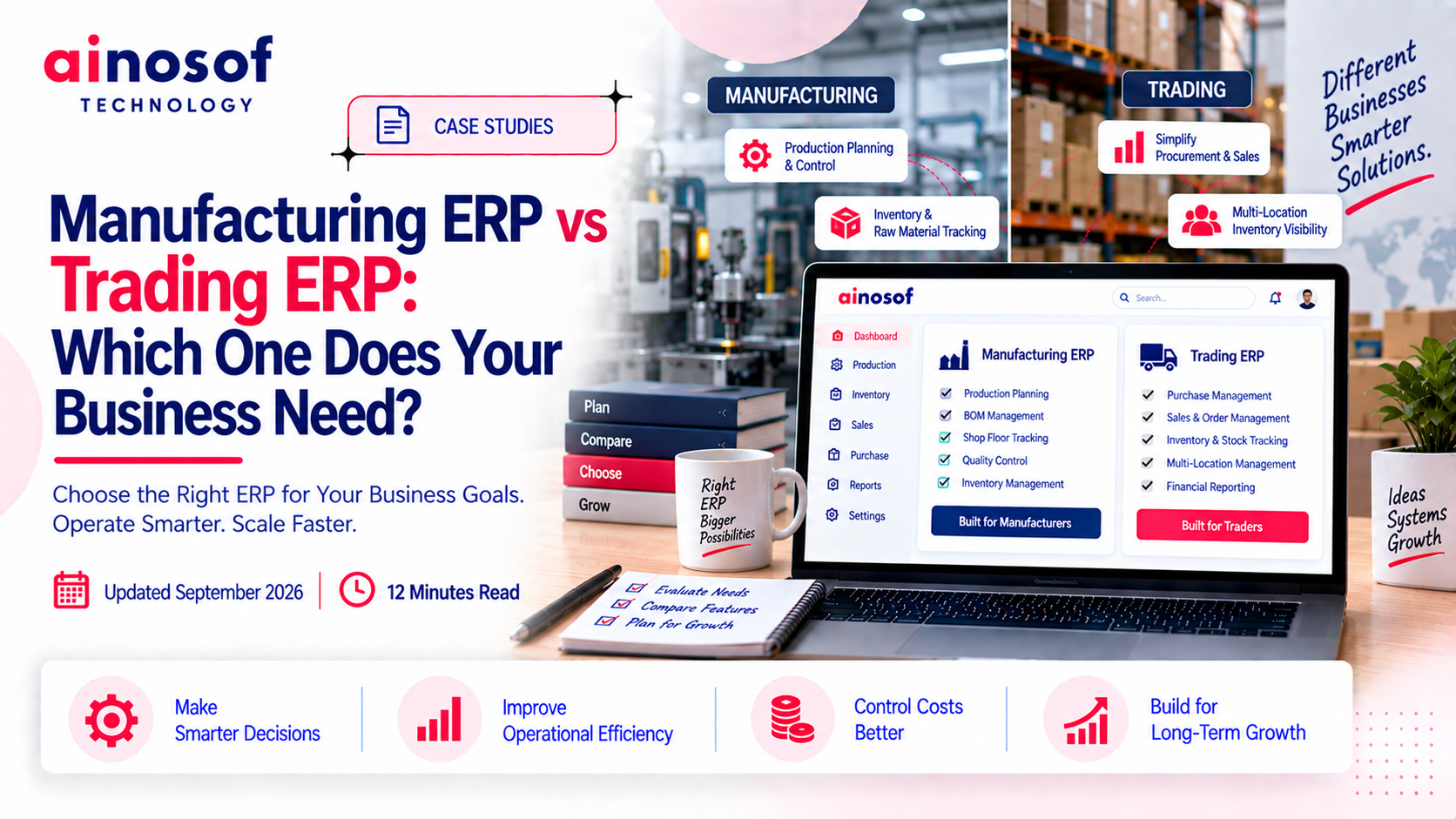
Manufacturing ERP vs Trading ERP: Which One Does Your Business Need?
 Iram
Iram


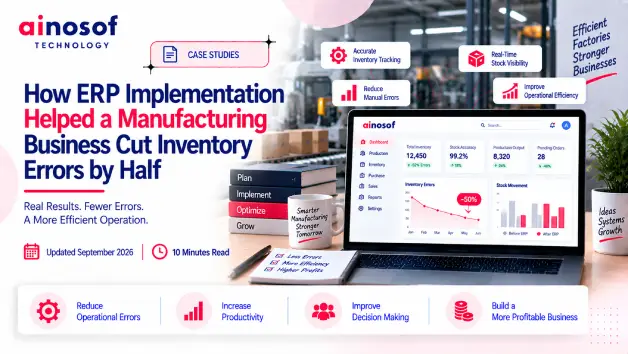
For a manufacturing business, inventory accuracy directly affects purchasing, production planning, order fulfilment, and cash flow. Yet inventory errors often do not begin inside the warehouse. They can come from delayed stock updates, manual entries, disconnected purchase and production records, or different teams working with different information.
For one manufacturing business, these problems had started creating a recurring operational challenge. Stock discrepancies were taking time to identify and reconcile, while management had limited visibility into where the errors were occurring. Improving individual processes was no longer enough; the business needed better coordination between the systems and teams handling inventory.
That is where the ERP implementation became a business decision rather than simply a technology upgrade.
This ERP implementation case study manufacturing businesses can learn from looks at what changed, why the implementation mattered, and how the business measured the outcome. We will examine the process before ERP, the changes introduced during implementation, the challenges involved, and how the business ultimately reduced inventory errors by half. The goal is to help other manufacturers understand which problems ERP can address—and what they should measure before making a similar decision.
Inventory errors rarely stay limited to the warehouse. When the quantity recorded in the system does not match the physical stock, the effect can move quickly into purchasing, production planning, dispatch, and financial reporting. For a manufacturing business handling multiple materials and regular stock movements, even small discrepancies can become a recurring operational issue.
The problem was not caused by one single mistake. Inventory moved through several stages—purchase, receiving, storage, production consumption, returns, and dispatch. When these movements were recorded manually or updated at different times, the information could easily become inconsistent.
For example, a material might be physically issued to production while the corresponding system entry was delayed. A purchase receipt could also be recorded separately from the warehouse update. Over time, these small gaps created differences between physical stock and recorded stock.
This is where an ERP implementation case study manufacturing businesses can learn from becomes useful. Instead of looking only at the final stock discrepancy, the business needed to understand where information was being lost or delayed during the process.
An incorrect inventory figure can influence the next business decision.
If purchasing teams see less stock than is actually available, they may order material unnecessarily. If the recorded quantity is higher than the physical quantity, production may plan around material that is not actually available. Warehouse teams then spend additional time checking records, locating material, and reconciling differences.
These issues also create unnecessary dependency between departments. Purchasing needs accurate warehouse information, production needs reliable material availability, and management needs trustworthy reports before making decisions.
The result is not simply an inventory error. It is lost time, delayed decisions, unnecessary reconciliation, and reduced confidence in business data.
Manual processes can work when transaction volumes are low and every movement is closely monitored. The challenge appears when several people and departments are updating information throughout the day.
Spreadsheets, manual registers, separate software and verbal communication can create multiple versions of the same information. Even when employees follow the process correctly, delays between one step and another can create gaps.
The manufacturing business therefore faced a process problem, not simply a data-entry problem. Repeatedly correcting errors after they appeared was not enough. The business needed a way to make inventory information more consistent while the transaction was taking place.
The decision to implement ERP came from the need to connect processes that were previously being handled separately. The objective was not to introduce software for the sake of technology. It was to create a more reliable flow of information from purchasing to inventory and production.
Spreadsheets can be useful for individual tasks, but they become difficult to control when several departments depend on the same information.
A purchasing team may maintain one record, the warehouse another, and production may rely on its own updates. The more frequently inventory changes, the harder it becomes to ensure that every record reflects the same transaction at the same time.
The business needed one connected source of inventory information rather than repeatedly comparing separate records.
The implementation focused on the workflows directly connected to inventory movement.
Purchase transactions could be connected with receiving and inventory records. Warehouse movements could be recorded within the same system, while material issued for production could be reflected against the relevant inventory information.
This created a clearer transaction trail. Instead of asking several departments for separate updates, management could work from information connected through the ERP system.
That connection was important because inventory accuracy depends on the accuracy of the processes that change inventory.
ERP implementation is not simply a matter of entering old data into new software.
Existing inventory records had to be reviewed, inconsistent information had to be identified, and workflows had to be aligned with the way the ERP system would operate. Employees also had to understand when and how each transaction should be recorded.
This part of the implementation matters because a new system cannot automatically correct poor processes. If employees continue using old methods alongside the ERP, the business can recreate the same information gaps inside a new system.
The implementation therefore required data preparation, process discipline, workflow changes, and employee training.
Once inventory transactions were connected within ERP, employees had less need to repeatedly transfer the same information between separate records.
A purchase transaction could flow into the inventory process. Material movement could be recorded where it occurred. Production-related consumption could be connected to the same inventory data.
This reduced the number of manual handoffs where information could be missed, delayed, or entered differently.
The important change was not simply fewer spreadsheets. It was fewer disconnected points where inventory information could become inaccurate.
The headline result matters because it gives the implementation a measurable business outcome. But a reduction in inventory errors is meaningful only when the business clearly defines what an error is and compares results using a consistent measurement method.
For the case study, an inventory error should be treated as a mismatch between the quantity recorded in the system and the quantity verified through the business's inventory control process.
This can include discrepancies caused by incorrect entries, missed stock movements, delayed updates, or differences identified during reconciliation.
Having a clear definition is important because otherwise an “inventory error” can mean different things to different departments. A consistent definition makes the ERP results for manufacturing business easier to measure and understand.
The business first needed a reference point against which the ERP results could be compared.
The baseline should come from the inventory records and reconciliation process used before implementation. This establishes how frequently discrepancies were occurring under the previous process.
Without a baseline, saying that inventory accuracy improved after ERP would be difficult to verify. The comparison needs to show what the business experienced before the new system and what happened after the new process became operational.
The 50% reduction was determined by comparing the defined inventory-error level before ERP with the corresponding measurement after implementation.
The important point is that the same measurement approach must be used across both periods. Otherwise, the result can be influenced by changes in how errors are recorded rather than by an actual improvement in inventory control.
This makes the result more useful than simply saying that the business “had fewer errors.” It connects the ERP success story India example to a specific operational outcome that another manufacturing business can understand and potentially measure in its own environment.
Reducing inventory errors also changes the amount of effort required to manage those errors.
With more consistent inventory information, teams can spend less time comparing separate records and investigating avoidable discrepancies. Purchasing and production can work with more reliable stock information, while management can access a clearer view of inventory movements.
The value therefore extends beyond the percentage reduction. Better inventory accuracy can improve the quality of everyday operational decisions.
The main lesson is not that every manufacturing business will achieve the same result. ERP outcomes depend on the starting processes, implementation quality, data accuracy, employee adoption, and the way success is measured.
What this case demonstrates is that ERP becomes more valuable when it addresses a clearly identified operational problem and gives management a way to measure whether that problem is actually improving.
ERP may be worth evaluating when inventory problems are persistent rather than occasional.
Warning signs can include frequent stock discrepancies, repeated manual reconciliation, different departments maintaining separate inventory records, delayed stock updates, or production decisions being made with incomplete material information.
Another important sign is when employees spend considerable time correcting information instead of using it to make decisions.
These symptoms suggest that the business may have outgrown disconnected inventory processes and should evaluate whether integrated ERP software can address the underlying workflow.
Not every inventory problem requires ERP.
If the issue comes from a simple process gap, better procedures, employee training, or stronger verification may solve it. ERP becomes more relevant when the problem exists because several departments need to exchange information continuously and the existing systems cannot keep that information synchronized.
The decision should therefore begin with the business problem.
A manufacturer should first ask whether the current process can realistically provide accurate, timely and shared information as the business grows. If it cannot, system integration may need to become part of the solution.
Manufacturers should measure more than whether employees are using the ERP system.
Useful measures can include:
Tracking these metrics before and after implementation gives management a clearer view of whether the ERP project is producing operational results rather than simply replacing old software.
ERP can improve information flow, but it cannot physically count material, prevent every handling mistake, or replace employee responsibility.
Warehouse controls, proper material identification, stock verification, correct receiving procedures, cycle counts, and disciplined transaction entry still matter.
This distinction is important. ERP can make inventory information more connected and visible, but inventory accuracy remains a combination of technology, process and human discipline.
For manufacturers considering ERP, the practical lesson is straightforward: start with the inventory problem, identify its root cause, establish measurable baseline data, and then determine whether an integrated system can address it.
Improving inventory accuracy is only one part of building a more connected manufacturing operation. Once a business understands where its processes are creating delays, errors, or duplicated work, the next step is to evaluate how different functions can work together through better systems.
For businesses exploring Manufacturing ERP Software, Custom ERP Software Development , or broader ERP implementation requirements, the focus should remain on matching the technology with actual business processes.
A practical ERP journey starts with the right questions: Where is the current process breaking down? What should improve after implementation? And how will that improvement be measured?
Inventory errors may appear to be a warehouse problem, but their impact can reach purchasing, production, planning, reporting, and management decisions. That is why simply correcting stock discrepancies after they occur does not address the underlying business problem.
This ERP implementation case study manufacturing businesses can learn from shows the importance of connecting inventory-related processes and creating a more consistent flow of information. By bringing purchasing, warehouse, production, and inventory activities into a connected ERP environment, the business was able to reduce inventory errors by 50% while improving visibility across its operations.
The result also highlights an important point: ERP success is not measured by implementation alone. It is measured by what changes in the business afterward.
For manufacturers considering ERP, the right starting point is not “Which ERP should we buy?” It is “Which business problem are we trying to solve, and how will we know that the solution worked?”
That shift in thinking can turn ERP from a software purchase into a measurable business improvement initiative.
An ERP implementation case study in manufacturing shows how a manufacturing business used ERP to address a specific operational problem and what changed after implementation. Instead of focusing only on software capabilities, it looks at the business situation, implementation process, measurable results, and lessons other manufacturers can apply.
Yes, ERP can help reduce inventory errors by connecting purchasing, warehouse, production, and inventory transactions within one system. This reduces repeated manual data entry and improves the consistency of stock information. However, the actual result depends on data quality, process design, employee adoption, and implementation discipline.
A business should measure operational results before and after implementation. Useful metrics include inventory error rate, stock accuracy, reconciliation time, inventory update time, manual data-entry dependency, reporting time, and coordination between purchasing and production.
The goal is to measure whether the business problem improved—not simply whether the ERP system was successfully installed.
No system can guarantee that inventory errors will disappear completely. ERP can reduce errors caused by disconnected information, manual processes, and delayed updates, but physical stock handling, incorrect counting, wrong material identification, and employee mistakes can still occur.
That is why ERP, process controls, and employee discipline need to work together.
Common challenges include data migration, inconsistent existing records, workflow changes, employee training, process standardization, and resistance to changing established working methods.
A manufacturing business should address these issues before implementation rather than treating them as problems that the ERP software will automatically solve.
A business should consider ERP when operational complexity has grown beyond what its existing systems can manage reliably. Frequent inventory discrepancies, repeated reconciliation, disconnected departmental data, delayed reporting, and poor coordination between purchasing, inventory, and production are strong reasons to evaluate an integrated system.
The decision should be based on the business problem and expected measurable outcome—not simply on the size of the company.
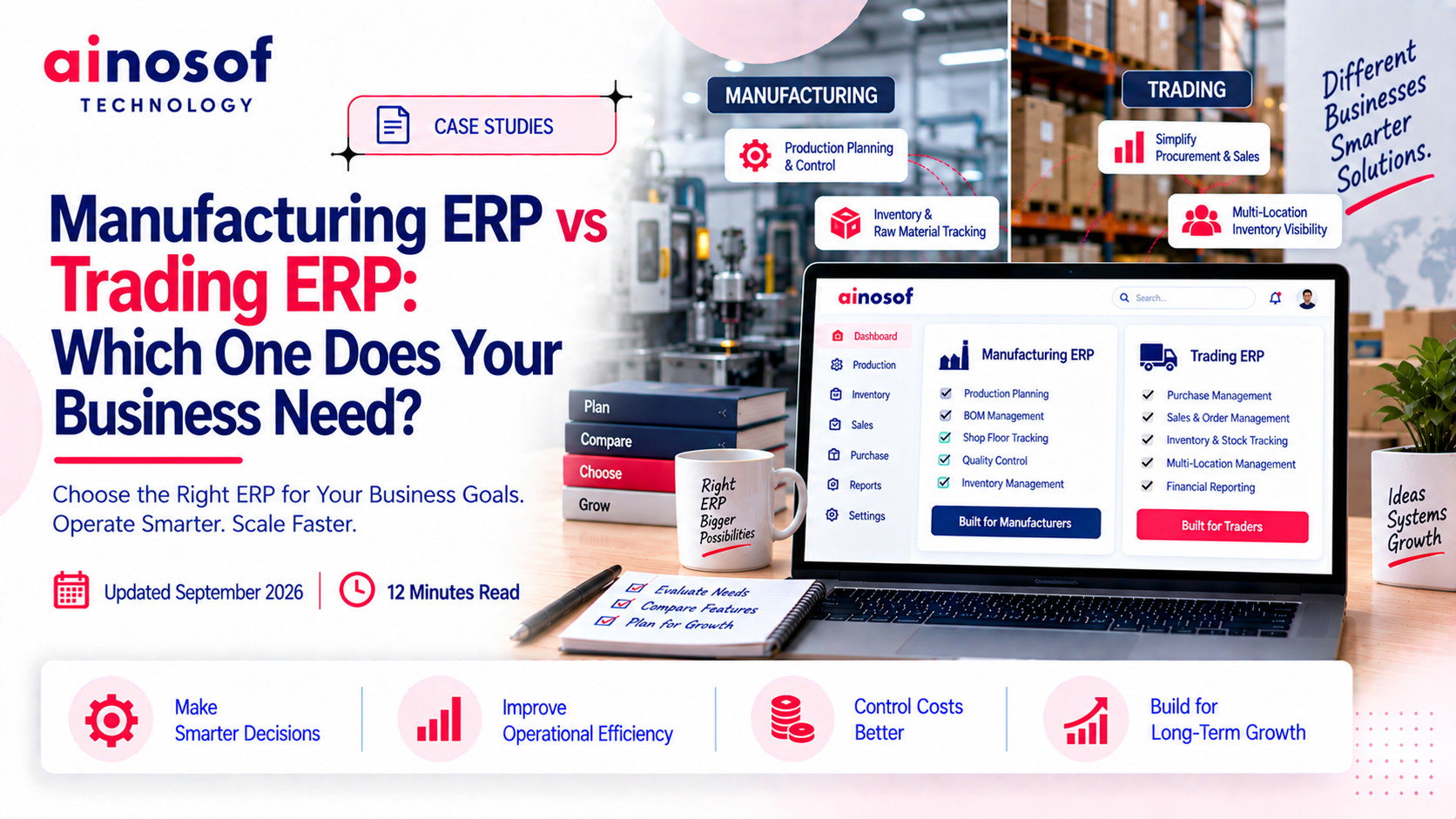 Manufacturing ERP vs Trading ERP: Which One Does Your Business Need?
25 Sep, 2026
Manufacturing ERP vs Trading ERP: Which One Does Your Business Need?
25 Sep, 2026
 What is LLM SEO and Why Is It Becoming Important for Business Visibility in 2026?
03 Aug, 2026
What is LLM SEO and Why Is It Becoming Important for Business Visibility in 2026?
03 Aug, 2026
 ERP Software Cost in India 2026: What Businesses Should Budget For
24 Sep, 2026
ERP Software Cost in India 2026: What Businesses Should Budget For
24 Sep, 2026
 Why Colleges and Universities Need ERP Software to Manage Admissions, Fees and Operations
23 Sep, 2026
Why Colleges and Universities Need ERP Software to Manage Admissions, Fees and Operations
23 Sep, 2026
 How ERP Software Solves Inventory and Production Chaos for Electronics Manufacturers
22 Sep, 2026
How ERP Software Solves Inventory and Production Chaos for Electronics Manufacturers
22 Sep, 2026
 Why Growing MSMEs in India Need ERP Software Before They Scale
21 Sep, 2026
Why Growing MSMEs in India Need ERP Software Before They Scale
21 Sep, 2026
Comment with an expert and get our answer.
Comment with an expert and get our answer.
Explore more insights related to this topic and discover useful perspectives, ideas and strategies from our latest articles.