
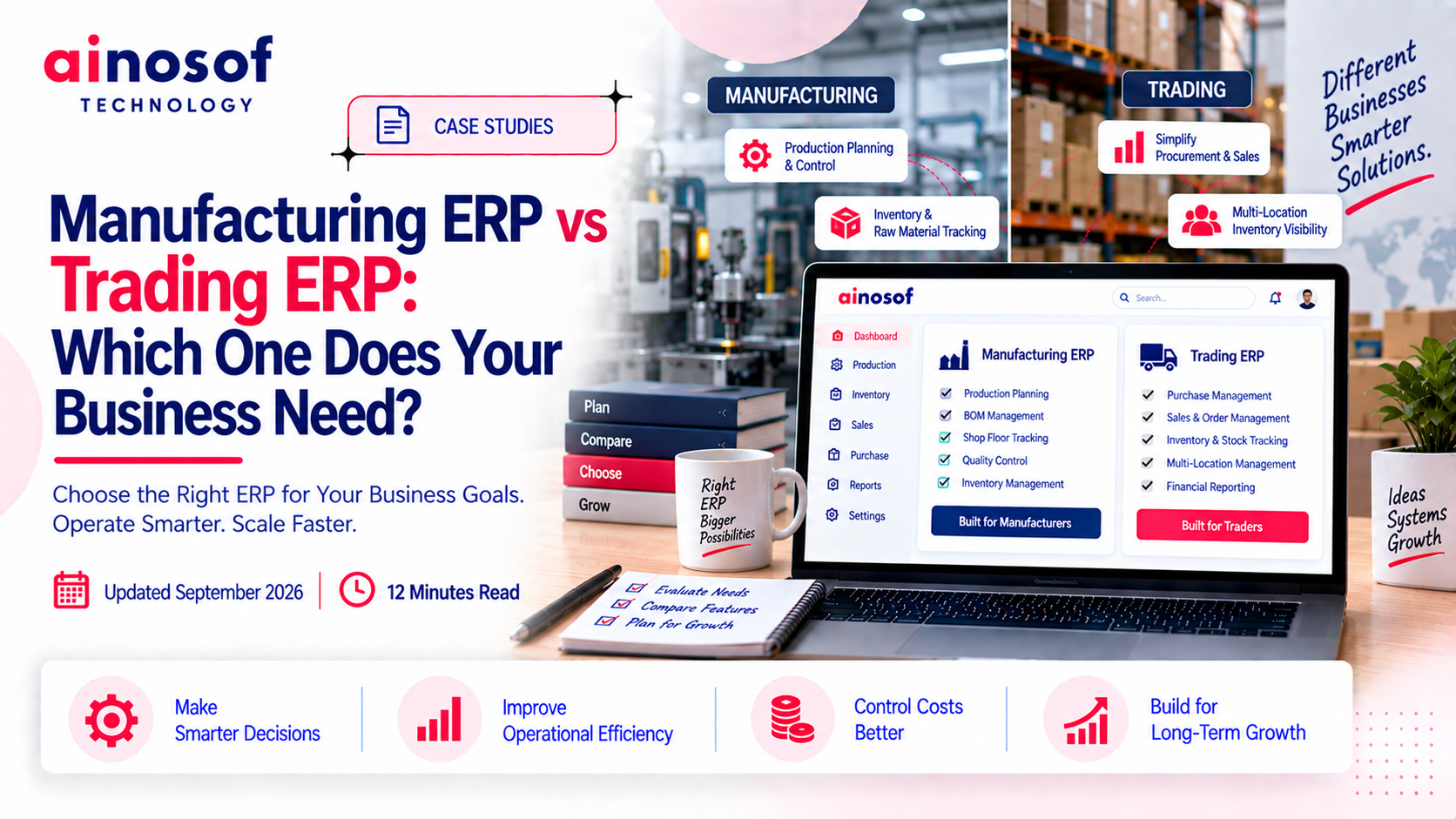
ERP Software Cost in India 2026: What Businesses Should Budget For
 Iram
Iram


A business can have strong sales, a large inventory, and a growing customer base, yet still struggle to control daily operations when its ERP does not match the way the business actually works.
A manufacturer has to think about raw materials, BOMs, production planning, WIP, material consumption, finished goods, and production costing. A trading or distribution business may have a very different priority: purchasing products, managing SKUs, controlling warehouses, processing orders, tracking stock movement, and managing customer receivables.
The problem becomes more complicated when a business does both. It may manufacture some products, purchase others for resale, and manage both operations through the same organization. Choosing an ERP based only on the industry name or a long feature list can then create unnecessary complexity—or leave important processes unsupported.
This is why the decision between manufacturing ERP vs trading ERP should begin with business processes, not software features. The right ERP should fit how products are purchased, produced, stored, sold, and financially managed.
In this article, we will compare manufacturing and trading ERP requirements across key business processes, examine when a manufacturing or trading-focused ERP makes sense, explore what businesses should consider when they operate both models, and explain how to approach choosing the right ERP for your business based on actual operational requirements.
A manufacturing business and a trading business may both purchase, store, and sell products, but the operational information they need to manage is different. Manufacturing introduces a production layer between purchasing and sales, which changes how inventory, costing, planning, and reporting need to work.
This difference is important when evaluating manufacturing ERP vs trading ERP. The right ERP should reflect what actually happens inside the business rather than simply matching its industry category.
In a trading business, a product is generally purchased and then sold. The ERP needs to track the purchase, stock receipt, warehouse movement, sales order, dispatch, invoice, and payment.
Manufacturing adds several activities between purchasing and selling.
Raw materials may need to be purchased, stored, issued to production, consumed during manufacturing, converted into finished goods, and then moved into finished-goods inventory. The business may also need to track BOMs, production orders, WIP, material consumption, production quantities, wastage, and production costs.
For example, a trading company purchasing 500 finished products mainly needs to know how many units were received, where they are stored, and how many have been sold.
A manufacturer producing those 500 units may need to know which raw materials are required, whether they are available, how much material has been consumed, how much production is complete, and what the actual production cost is.
That additional production layer changes the ERP requirement significantly.
An ERP platform can support both manufacturing and trading, but the workflows configured inside it may be very different.
A trading workflow may look like:
Purchase → Warehouse → Sales Order → Dispatch → Invoice → Payment
A manufacturing workflow may look more like:
Material Planning → Purchase → Raw Material Inventory → Production → WIP → Finished Goods → Sales → Dispatch
The same inventory module, for example, may therefore be used differently. A trader primarily needs to track purchased stock and its movement, while a manufacturer needs to track raw materials, WIP, production consumption, and finished goods.
Consider a business that purchases finished products for resale but also manufactures its own product line. Treating both operations as a simple trading workflow could make production information difficult to control.
The important point is that ERP selection should consider business workflows, not just whether a software platform technically contains a particular feature.
The difference becomes clearer when the two business models are compared across their everyday operations.
A useful ERP types comparison India should therefore focus on how information moves through the business—from purchasing and inventory to production or order fulfillment, sales, costing, and reporting.
Both manufacturing and trading businesses need purchasing, inventory, and sales management, but the purpose of those processes can be different.
A trading business generally purchases products that it intends to sell. Its ERP needs to provide visibility into supplier purchases, stock levels, warehouse movement, sales orders, dispatches, and customer transactions.
A manufacturer purchases raw materials or components that will eventually become finished products. Its purchasing decisions may therefore depend on production requirements, BOM quantities, current raw material stock, and planned production.
For example, a distributor may purchase 1,000 finished units based on expected customer demand. A manufacturer may need to purchase several different raw materials because it plans to produce 1,000 finished units.
Sales also create different requirements. A trader may primarily track product availability and order fulfillment, while a manufacturer may need to connect sales demand with production planning and finished-goods availability.
So although both businesses need purchasing, inventory, and sales modules, the information connecting those modules can be very different.
Production introduces some of the most important differences between manufacturing and trading ERP.
A manufacturer needs to know what needs to be produced, what materials are required, whether those materials are available, and how much material is actually consumed.
A Bill of Materials (BOM) can define the components or raw materials required to produce a particular finished product. Production planning can then use this information to determine material requirements and organize production activities.
For example, if producing one finished product requires five different components, the ERP should help the business understand the material requirement for the planned production quantity.
During production, the business may also need to compare planned consumption with actual consumption and identify wastage or variance.
A trading business generally does not need this production layer because it purchases finished products rather than converting raw materials into finished goods.
This is why manufacturing ERP needs to connect inventory with production information in a way that a typical trading workflow does not.
Warehouse management is important for both business models, but the nature of stock can be different.
A trading business may manage finished products across one or more warehouses and track receipts, transfers, sales, returns, and available stock.
A manufacturer may need to manage raw materials, semi-finished goods, WIP, finished goods, rejected materials, and production-related stock movements.
Costing also changes significantly.
A trading business may focus on purchase cost, selling price, margins, discounts, and customer profitability.
A manufacturer may need to understand material cost, production expenses, wastage, labor or process costs, and the cost of the finished product.
Reporting therefore needs to reflect these different operations.
For example, a trader may need a report showing stock value and sales margin by product. A manufacturer may need to see planned versus actual production, material consumption, production variance, and finished-goods cost.
The ERP should provide information that helps management understand how the business is actually operating, rather than producing reports simply because the software has a reporting module.
Choosing an ERP should begin with the business model and operational workflow.
Instead of asking which ERP is generally better, management should ask which system can support the processes that are critical to the business today and as it grows.
A business generally needs manufacturing-specific ERP capabilities when production is a central part of its operations.
Important requirements may include:
For example, a manufacturer producing hundreds of products with different components may find it difficult to manage production accurately through an ERP designed mainly around purchasing and sales.
The more complex the production process becomes, the more important it is for the ERP to connect materials, production, inventory, costing, and sales.
A trading-focused ERP can be appropriate when the business primarily purchases finished products and resells them without a significant manufacturing process.
In such a business, the main priorities may be:
For example, a wholesaler purchasing finished electrical products from several suppliers and distributing them to retailers may not need production planning or BOM management.
In that situation, paying for extensive manufacturing functionality may add unnecessary complexity.
The goal should be to select an ERP that supports the business's actual operational requirements, rather than purchasing functionality that the business does not use.
This is where ERP selection becomes more complex.
Some businesses manufacture their own products while also purchasing finished products from other suppliers for resale. They may therefore need to manage raw materials, production, finished goods, purchased goods, warehouses, sales, and finance within the same organization.
For example, an electrical products company may manufacture certain products but purchase and resell accessories from other suppliers.
Using completely separate systems can create problems with inventory visibility, customer orders, purchasing, and financial reporting.
A better approach may be to evaluate an ERP that can support both manufacturing and trading workflows through connected data.
Businesses should map both operations before choosing a system and determine whether standard functionality is sufficient or whether some customization is required.
Once the business model is clear, the next question is whether the shortlisted ERP can actually support the required workflows without creating unnecessary complexity.
A good ERP should solve operational problems while remaining practical for the people who will use it every day.
An ERP should fit the important processes of the business instead of forcing every department into a workflow that does not match how it operates.
For a manufacturer, that may mean connecting BOM, production, material consumption, WIP, inventory, and costing.
For a trading business, it may mean connecting purchasing, stock, warehouses, sales orders, dispatch, customers, and finance.
Businesses should identify their critical workflows before selecting an ERP and then check how the proposed system handles each one.
If a basic requirement needs several workarounds or manual steps, the ERP may not be the right operational fit even if its feature list looks impressive.
ERP selection should consider where the business is going, not only what it needs today.
A company may add users, products, warehouses, branches, production lines, departments, or customers over time.
For example, a trading company operating from one warehouse may later expand to several locations. A manufacturer may add new product lines, increase production volume, or introduce additional manufacturing processes.
The ERP should be able to accommodate this growth without requiring the business to replace the system again.
Businesses should therefore evaluate scalability, user management, product volume, multi-location operations, reporting, and future integrations before making a decision.
Customization can be useful when a business has a genuine process requirement that standard ERP functionality cannot reasonably support.
However, customization should have a clear business purpose.
For example, a manufacturer may need a specialized production approval workflow, while a trading company may require a particular distributor order process. Developing these capabilities can make the ERP more suitable for the business.
The risk comes when too many custom changes are made simply because the business has not first reviewed its processes or configured the standard system properly.
Before approving customization, management should ask:
This is where a requirement-focused approach from an ERP development partner such as Ainosof Technology can be useful. The objective should be to customize where the business genuinely needs it—not to make the ERP unnecessarily complicated.
The right ERP is ultimately the one that fits the way the business operates, supports its current processes, and can adapt as those processes grow.
Choosing the right ERP is one part of building a more connected business operation. Once the ERP requirement is clear, businesses can also evaluate related areas such as inventory management, production management, business process automation, CRM, and custom software development.
The next step should be to identify which business processes need better visibility and coordination, then determine how technology can support those processes.
A well-planned ERP can become the foundation for connecting these operations instead of leaving each department dependent on separate systems.
The difference between manufacturing ERP vs trading ERP is ultimately a difference in business processes.
A manufacturer needs to control what goes into production, how materials are consumed, how WIP moves through production, what finished goods are created, and how those activities affect product costs.
A trading or distribution business has a different operational focus, with greater emphasis on purchasing, inventory, warehousing, sales, order fulfillment, and customer and supplier management.
For businesses that do both, the decision becomes more about finding an ERP that can connect manufacturing and trading workflows within one operational system.
The right approach is to start with the business process, identify the information each department needs, and then evaluate whether the ERP can support those requirements without unnecessary complexity.
Ultimately, choosing the right ERP for your business means choosing a system that fits how the business operates today while providing enough flexibility to support where the business is going next.
The main difference is the type of business process each ERP needs to manage. Manufacturing ERP typically connects raw materials, BOMs, production planning, WIP, material consumption, finished goods, and production costing. Trading ERP generally focuses on purchasing, inventory, warehouses, sales, orders, customers, suppliers, and finance.
A manufacturer needs to track how products are made, while a trading business primarily needs to track how products are purchased, stored, and sold.
Not necessarily a completely different software platform, but the ERP capabilities and workflows can be different.
A manufacturing business usually needs production-related functionality that may not be necessary for a trading company. A trading business may instead need stronger capabilities for inventory, distribution, order processing, and warehouse operations.
The important consideration is whether the ERP can support the business's actual processes.
A manufacturing business should evaluate capabilities such as production planning, BOM management, raw material inventory, WIP tracking, material consumption, production costing, finished-goods management, purchasing, and production reporting.
The ERP should ideally connect these processes so that production information is not separated from inventory, purchasing, sales, and finance.
A trading or distribution business should look for purchase management, inventory management, warehouse management, sales orders, dispatch, customer and supplier management, receivables, stock reporting, and financial integration.
Businesses with multiple warehouses or large SKU volumes should also evaluate how effectively the ERP manages stock movement and availability across locations.
Yes, an ERP can support both operations when it has the required manufacturing and trading capabilities and can connect the workflows through shared data.
For example, a company may manufacture some products while purchasing other finished products for resale. Its ERP may need to manage raw materials and production alongside purchased inventory and distribution.
The key is to verify that both workflows can operate together without creating unnecessary complexity or disconnected records.
Start by mapping the business's actual operations.
If the core operation involves production, BOMs, raw materials, WIP, and manufacturing costs, manufacturing ERP capabilities become important.
If the business mainly purchases finished products and resells them, trading ERP capabilities may be more relevant.
If both models exist, the business should evaluate an ERP that can support both workflows.
The decision should be based on business processes rather than the lowest price or longest feature list.
Businesses should check whether the ERP can support their current workflows, users, products, locations, reporting requirements, integrations, and future growth.
They should also evaluate customization requirements, implementation scope, scalability, support, and total cost.
Before selecting an ERP, it is useful to map important processes and confirm how the proposed system will handle each one.
Yes. Ainosof Technology can develop customized ERP solutions based on specific manufacturing, trading, or hybrid business requirements.
The development approach can consider workflows such as production, BOM, inventory, purchasing, sales, warehouse operations, finance, reporting, and integrations.
Customization should be driven by genuine business requirements so that the ERP fits the organization's processes without creating unnecessary complexity.
 What is LLM SEO and Why Is It Becoming Important for Business Visibility in 2026?
03 Aug, 2026
What is LLM SEO and Why Is It Becoming Important for Business Visibility in 2026?
03 Aug, 2026
 ERP Software Cost in India 2026: What Businesses Should Budget For
24 Sep, 2026
ERP Software Cost in India 2026: What Businesses Should Budget For
24 Sep, 2026
 Why Colleges and Universities Need ERP Software to Manage Admissions, Fees and Operations
23 Sep, 2026
Why Colleges and Universities Need ERP Software to Manage Admissions, Fees and Operations
23 Sep, 2026
 How ERP Software Solves Inventory and Production Chaos for Electronics Manufacturers
22 Sep, 2026
How ERP Software Solves Inventory and Production Chaos for Electronics Manufacturers
22 Sep, 2026
 Why Growing MSMEs in India Need ERP Software Before They Scale
21 Sep, 2026
Why Growing MSMEs in India Need ERP Software Before They Scale
21 Sep, 2026
 Why NGOs and Charitable Trusts Need Fund & Donor Management Software (Not Just Spreadsheets)
19 Sep, 2026
Why NGOs and Charitable Trusts Need Fund & Donor Management Software (Not Just Spreadsheets)
19 Sep, 2026
Comment with an expert and get our answer.
Comment with an expert and get our answer.
Explore more insights related to this topic and discover useful perspectives, ideas and strategies from our latest articles.