How to Build an SEO Strategy for a B2B SaaS or Software Company
 Aakil Khan


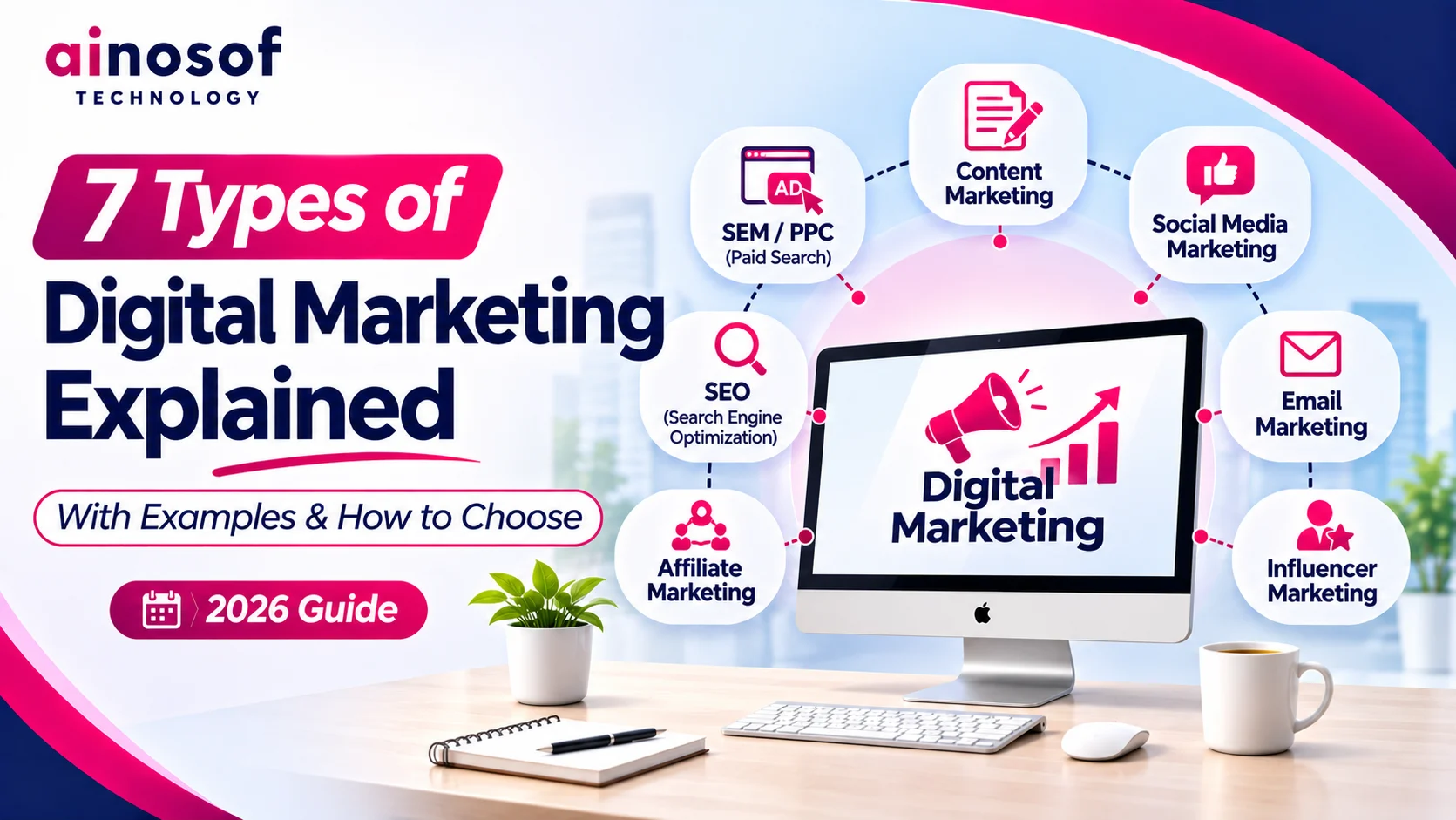
Digital marketing helps businesses reach potential customers through online channels such as search engines, social media, websites, email and digital advertising platforms. But not every channel serves the same purpose. Some help people discover a business, others build trust, while some encourage enquiries, purchases and repeat sales.
Understanding the 7 types of digital marketing makes it easier to choose the right channels instead of spending money across platforms without a clear strategy. For example, a business looking for long-term organic visibility may prioritise SEO, while a company that needs enquiries quickly may consider Google Ads or social media advertising.
In this guide, we explain the seven major types of digital marketing, how each works, practical examples, the platforms and services involved, and how to choose the right approach for your business in 2026.
Digital marketing is the process of promoting a business, product or service through internet-based channels and digital platforms. It includes activities such as search engine optimisation, paid advertising, social media campaigns, content creation, email communication and influencer collaborations.
Unlike traditional marketing methods, digital marketing allows businesses to reach specific audiences, monitor campaign activity and measure outcomes such as website visits, enquiries, purchases and customer engagement.
For example, a manufacturing company can use SEO to appear when buyers search for its products, LinkedIn to connect with business decision-makers, and Google Ads to reach people actively looking for suppliers. An ecommerce business may use Instagram campaigns, product-focused content, paid ads and email marketing to generate orders and encourage repeat purchases.
The right digital marketing strategy depends on the business model, target audience, buying journey, competition and available budget. Businesses do not necessarily need every marketing channel; they need the channels that help them reach their objectives.
Digital marketing gives businesses several ways to reach customers, build brand awareness and generate measurable business opportunities. Its main advantage is the ability to connect marketing activities with specific audiences and business goals.
Digital platforms allow businesses to target audiences based on factors such as location, interests, search behaviour, demographics and professional roles. This helps businesses focus their marketing efforts on people who are more likely to need their products or services.
Businesses can monitor website traffic, ad clicks, enquiries, conversions, engagement and sales through analytics and advertising tools. These insights help identify which campaigns are contributing to business objectives.
Digital campaigns can be planned according to business priorities and available budgets. Companies can start with selected channels, review performance and adjust spending as they learn more about their audience.
Useful content, consistent social media activity, search visibility and customer communication help businesses become more familiar to potential customers. A strong digital presence also gives people more opportunities to understand a brand before contacting it.
Search campaigns, paid advertising, landing pages and conversion-focused content can help businesses attract relevant visitors and turn them into enquiries or customers.
Email marketing, social media and other permission-based communication channels help businesses share updates, introduce new products, provide useful information and encourage repeat purchases.
Performance data helps businesses understand what is working and what needs improvement. Campaigns can be refined based on lead quality, conversion rates, customer behaviour and actual business outcomes rather than assumptions.
The seven major types of digital marketing use different platforms to connect businesses with their audiences. Some focus on organic visibility, others use paid promotion, and some help maintain relationships with existing customers.
The table below provides a quick comparison of the seven types, their common platforms, typical services and practical business applications.
|
Type of Digital Marketing |
Platforms |
Common Services and Activities |
Example |
|
Search Engine Optimisation (SEO) |
Google, Bing and other search engines |
Keyword research, technical SEO, on-page SEO, content optimisation and link building |
Improving a service page to attract relevant organic enquiries |
|
Paid Search Advertising (PPC) |
Google Ads and Microsoft Advertising |
Search ads, keyword targeting, bidding, landing pages and conversion tracking |
Running Google Ads for people searching for a particular service |
|
Content Marketing |
Websites, blogs, YouTube and other publishing platforms |
Blog writing, website content, case studies, guides, videos and infographics |
Publishing a guide that answers common customer questions |
|
Social Media Marketing |
Instagram, Facebook, LinkedIn and other social networks |
Social media management, content planning, community engagement and paid social campaigns |
Sharing product updates and running targeted social campaigns |
|
Email Marketing |
Email marketing platforms and CRM systems |
Newsletters, promotional campaigns, lead nurturing and automated emails |
Sending product updates to opted-in customers |
|
Influencer Marketing |
Instagram, YouTube and creator platforms |
Influencer collaborations, sponsored content, product reviews and creator campaigns |
Partnering with a relevant creator to introduce a product |
|
Affiliate Marketing |
Affiliate networks, websites and partner platforms |
Affiliate programmes, referral links, commission tracking and partner management |
Paying a publisher a commission for tracked sales |
Search Engine Optimisation (SEO) is the process of improving a website so that its pages can be discovered and understood by search engines and appear for relevant organic searches. It helps businesses attract people who are actively looking for information, products or services related to their offerings.
SEO generally involves three important areas:
Example: A website development company can optimise its service pages and publish useful articles around website design, ecommerce development and business website requirements. When these pages match relevant search intent, they can attract potential customers through organic search.
SEO is particularly useful for businesses that want to build long-term search visibility and attract relevant visitors without paying for every website click.
Paid search advertising allows businesses to display advertisements on search engine results pages for selected search queries. With pay-per-click (PPC) campaigns, advertisers generally pay when someone clicks on an ad, subject to the platform's advertising model and campaign settings.
Google Ads is one of the most commonly used platforms for paid search campaigns. Businesses can select relevant keywords, define audience and location settings, create advertisements, manage bids and direct visitors to suitable landing pages.
Important activities include:
Example: A business offering industrial equipment can run Google Search Ads for relevant product and supplier-related searches. Interested users can be directed to a product or enquiry page where they can request pricing or technical details.
Paid search is useful when a business wants to reach people with active search intent and generate traffic or enquiries within a planned advertising budget. However, results depend on competition, targeting, ad quality, landing pages and conversion performance.
Content marketing focuses on creating and distributing useful, relevant content to attract and educate a defined audience. Rather than relying only on direct promotional messages, it helps businesses answer questions, explain solutions and build trust throughout the customer journey.
Common content marketing formats include:
Example: An ERP development company can publish articles explaining inventory management challenges, production planning and ERP implementation. These resources can help business owners understand their problems and explore suitable solutions.
Content marketing supports SEO, brand authority, customer education and lead nurturing. Its effectiveness depends on content quality, relevance, distribution and how well the material supports the audience's needs.
Social Media Marketing involves using social networking platforms to communicate with audiences, build brand awareness, share content and develop customer relationships. Businesses can use organic posts, short-form videos, stories, community interactions and paid campaigns to reach relevant users.
Popular platforms include:
Example: A furniture manufacturer can use Instagram to showcase product designs and completed installations, while LinkedIn can help the company connect with architects, interior designers and commercial buyers.
Social media marketing works best when businesses select platforms based on their audience instead of trying to maintain an active presence everywhere. Consistent content, meaningful engagement and relevant campaigns are more valuable than posting frequently without a clear purpose.
Email marketing is a direct communication channel that allows businesses to send relevant messages to people who have subscribed or otherwise provided appropriate permission to receive them. It is commonly used for lead nurturing, customer updates, product announcements and repeat-purchase campaigns.
Email marketing activities may include:
Example: An ecommerce business can send order-related updates, product recommendations and promotional emails to customers who have agreed to receive marketing communication.
Email marketing is useful for maintaining customer relationships and communicating with an existing audience. Businesses should follow applicable privacy and consent requirements and make it easy for recipients to unsubscribe from promotional communication.
Influencer marketing involves collaborating with content creators or public personalities who have an established audience on social media or other digital platforms. Businesses work with relevant creators to introduce products, demonstrate services or share brand-related content.
Influencers can be grouped broadly according to their audience size and specialisation:
Common campaign formats include sponsored posts, product demonstrations, reviews, unboxing videos, event coverage and long-term brand partnerships.
Example: A skincare brand may collaborate with a beauty creator to demonstrate how its products are used and share an honest product experience with an audience interested in skincare.
Influencer marketing can help businesses reach relevant communities and build product awareness. Before selecting a creator, evaluate audience relevance, engagement quality, content suitability, campaign cost and the ability to measure enquiries or sales.
Affiliate marketing is a performance-based marketing model in which a business rewards external partners for generating tracked sales, leads or other agreed actions. Affiliates promote products or services through unique tracking links, referral codes or other attribution methods.
The process generally involves:
Example: An online software company can work with technology bloggers who review its product and share tracked referral links. When a visitor purchases through an eligible link, the affiliate receives the agreed commission.
Affiliate marketing can help businesses expand their reach through relevant partners without relying entirely on their own advertising channels. However, results depend on partner quality, commission structure, product suitability and accurate conversion tracking.
The most suitable digital marketing channels depend on what you sell, who your customers are and how they make purchasing decisions. A local service provider, an industrial manufacturer and an ecommerce brand will not necessarily benefit from the same marketing mix.
Consider these examples when planning your strategy:
Before investing in a channel, evaluate its relevance to your audience, expected costs, time required, internal resources and measurable business outcomes.
You can start with a small number of relevant channels, track their performance and expand the strategy as your business grows.
Digital marketing includes several channels, each serving a different purpose in attracting, engaging and converting customers. SEO helps businesses build organic search visibility, paid advertising reaches people through sponsored placements, content marketing educates audiences, and social media, email, influencer and affiliate marketing support discovery and customer relationships.
The goal is not to use all seven types at once. It is to identify where your potential customers spend time, understand how they make decisions and select the marketing channels that support your business objectives.
If you need help planning or managing your digital marketing strategy, Ainosof Technology offers services across SEO, paid advertising, social media marketing and content marketing. Discuss your requirements with the team to identify a practical approach for your business.
The seven types covered in this guide are Search Engine Optimisation (SEO), Paid Search Advertising (PPC), Content Marketing, Social Media Marketing, Email Marketing, Influencer Marketing and Affiliate Marketing. Each uses different online channels to attract, engage or convert customers. Businesses can combine these approaches according to their audience, goals and marketing budget.
SEO, content marketing and social media marketing are useful starting points for understanding how businesses attract and engage online audiences. However, the best starting channel depends on the business objective. Someone looking for immediate enquiries may consider paid advertising, while a business building long-term organic visibility may prioritise SEO and useful content.
SEO focuses on improving a website's visibility in organic search results without paying for each click. Paid search advertising uses advertising platforms such as Google Ads to display sponsored listings for selected searches. SEM is sometimes used as an umbrella term for search engine marketing activities, including SEO and paid search, although many businesses use it specifically to refer to paid search campaigns.
Common platforms include Google Search, Google Ads, Instagram, Facebook, LinkedIn, YouTube, email marketing platforms and affiliate networks. The right platform depends on where the target audience searches for information, discovers products and communicates with businesses.
Yes. Small businesses can use digital marketing to reach relevant audiences without relying only on large traditional advertising budgets. They can begin with selected channels such as local SEO, social media, content marketing or targeted paid campaigns and expand their activities based on performance.
Digital marketing costs depend on the services required, competition, campaign objectives, content volume, advertising budget and management effort. SEO, social media management, content marketing and PPC have different pricing structures. For paid advertising, the platform budget is generally separate from the agency's campaign management fee. Businesses should request a clear proposal that separates service charges, media spend and additional costs.
The timeline varies by channel and campaign. Paid advertising can start generating clicks soon after a campaign goes live, although profitable and consistent conversions may require testing and optimisation. SEO and content marketing generally require more time to build visibility and authority. Social media, email and influencer campaigns also depend on audience size, content quality and campaign execution.
Yes. Combining relevant channels can support different stages of the customer journey. For example, SEO and content marketing can attract visitors, Google Ads can reach people with immediate intent, and email marketing can help nurture interested prospects. The channels should work towards shared business goals rather than operate as disconnected campaigns.
Success should be measured using metrics linked to business objectives. These may include qualified enquiries, conversion rate, cost per lead, customer acquisition cost, sales revenue, return on ad spend, organic search traffic and repeat purchases. The most relevant metrics depend on the channel and the outcome the business wants to achieve.
The decision depends on your team's skills, available time, campaign complexity and business requirements. An in-house team provides direct control, while an agency can bring specialised expertise across SEO, paid advertising, content and social media. Before choosing, evaluate the scope of work, reporting process, communication, experience and expected deliverables.
 How to Integrate WhatsApp with Your CRM to Automate Customer Follow-Ups
04 Nov, 2026
 How AI Lead Scoring in CRM Helps Sales Teams Focus on Leads Most Likely to Convert
03 Nov, 2026
 What Is CRM Software Development and Why Do Growing Businesses Need a Custom CRM?
02 Nov, 2026
 Why Off-the-Shelf Software Is No Longer Enough for Scaling Businesses
31 Oct, 2026
 The Rise of AI-Native Business Software: What's Replacing Traditional SaaS Tools in 2026
30 Oct, 2026
 How Custom Software Helped a Business Automate Operations and Cut Costs: A Case Study
28 Oct, 2026
Comment with an expert and get our answer.
Comment with an expert and get our answer.
Continue exploring with related articles, practical guides and insights covering similar subjects. Discover more information, useful perspectives and ideas to help you learn about the topics that matter to your business.