What Is CRM Software Development and Why Do Growing Businesses Need a Custom CRM?
 Iram


Generating leads is only one part of the sales process. The bigger challenge for many growing businesses is identifying which enquiries deserve immediate attention. When sales teams receive leads from websites, advertisements, referrals, social media, and other channels, treating every enquiry with the same priority can waste valuable time.
Some prospects are actively comparing solutions and are ready to speak with a salesperson. Others may be researching options, gathering information, or simply exploring the market. Without a structured way to distinguish between them, sales representatives often depend on manual judgement, spreadsheets, or basic lead categories.
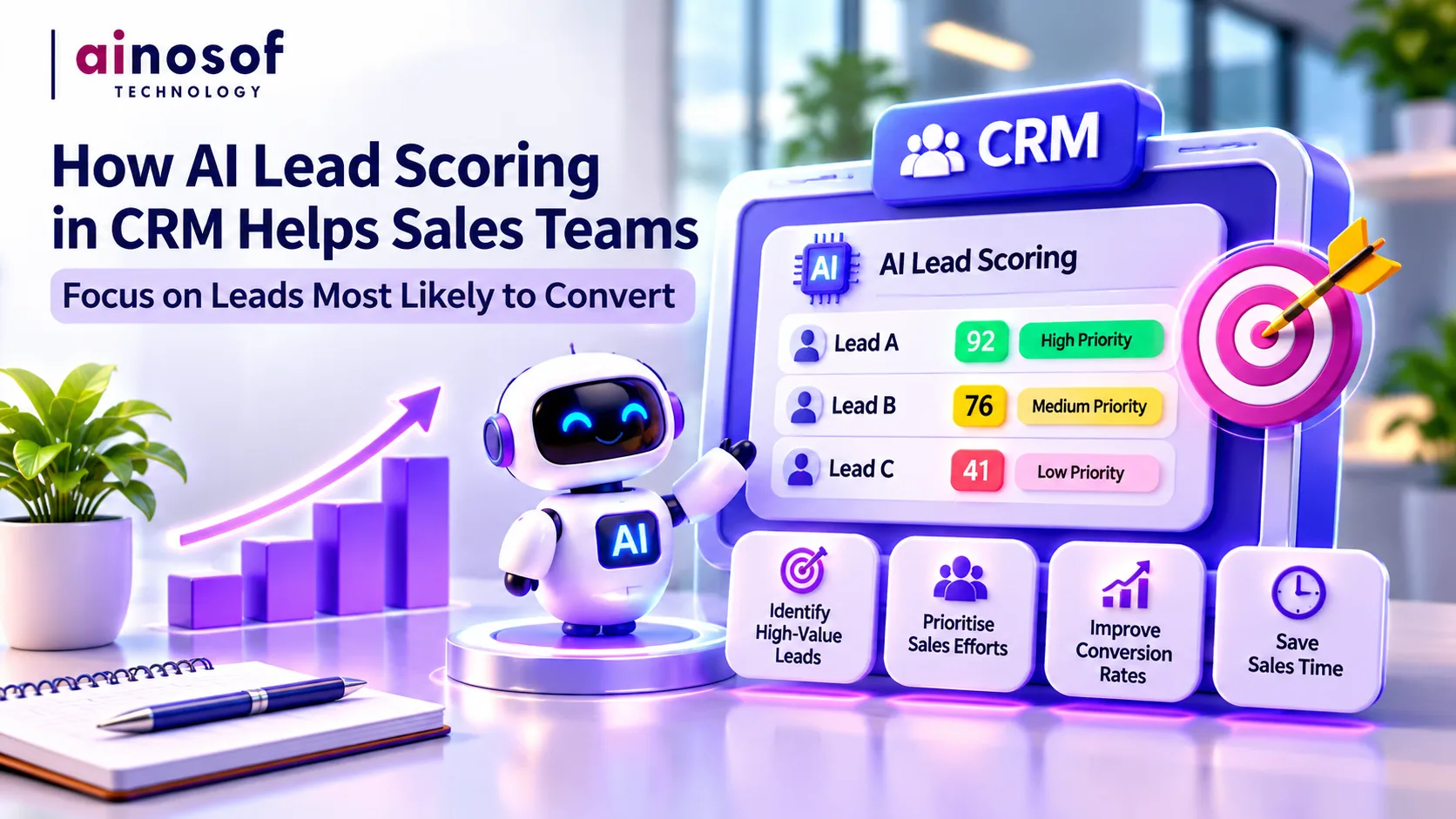
AI lead scoring in CRM helps businesses prioritize leads by analysing customer information, engagement patterns, and historical sales data to estimate which prospects are more likely to convert. Instead of asking sales representatives to review every enquiry in the same order, an AI-powered CRM can highlight promising opportunities and help teams decide where to focus their efforts.
This does not mean AI can guarantee which prospect will become a customer. It provides data-based guidance that helps sales teams make more informed decisions, respond at the right time, and manage their sales pipeline more effectively.
AI lead scoring is a process in which artificial intelligence and machine learning analyse lead information to estimate the likelihood of a prospect progressing towards a purchase.
A CRM system collects information about leads, including their contact details, company profile, enquiry history, communication records, website interactions, and sales activities. An AI lead scoring model evaluates relevant information to identify patterns associated with successful and unsuccessful sales outcomes.
Based on these patterns, the system assigns each lead a score or priority level. A lead showing strong buying signals may receive a higher score, while a prospect with limited engagement or a poor business fit may receive a lower score.
For example, consider a software development company receiving enquiries from 100 businesses. Some prospects may have a clearly defined project, an appropriate budget, and an immediate requirement. Others may only be exploring software options.
An AI-powered CRM can evaluate available information and help the sales team identify which enquiries appear more promising.
The purpose is not simply to rank leads. It is to help sales representatives understand where their time and attention are most likely to be useful.
AI lead scoring generally works by combining lead information, analysing patterns, assigning scores, and updating priorities as new information becomes available.
The process begins with collecting relevant information about each prospect. This information may come from website enquiry forms, CRM records, marketing campaigns, email interactions, customer conversations, and connected business applications.
For example, a CRM may record:
The more relevant information the CRM maintains, the better the system can understand a prospect's business fit and level of engagement.
AI models can examine previous sales records to identify patterns associated with successful and unsuccessful conversions.
For instance, a business may discover that customers who request a product demonstration, respond to a sales call, and match a particular industry profile are more likely to proceed.
The AI model can learn from these historical outcomes and use the patterns to evaluate new leads.
This is one of the important differences between predictive scoring and a manually configured scoring system. Rather than relying entirely on fixed points selected by a manager, predictive models can learn which combinations of signals have been associated with actual sales outcomes.
The system evaluates different activities and characteristics that may indicate a prospect's interest or readiness.
A prospect who repeatedly visits a pricing page, requests a quotation, or responds to a sales representative may show stronger buying intent than someone who has only viewed a general information page.
However, a single activity should not automatically determine a lead's priority. AI can consider multiple signals together to develop a more useful assessment.
After analysing the available information, the system assigns a score or priority category to each lead.
For example, a CRM may use categories such as:
Some systems also display a numerical score or estimated conversion probability. The scoring method and scale depend on how the CRM and its AI model are designed.
Lead quality is not fixed. A prospect who was previously inactive may return to the website, request a quotation, or respond to an earlier communication.
An AI-enabled CRM can use new information to reassess the lead's priority. This helps sales teams recognise changes in customer interest instead of relying only on the lead's original score.
AI lead scoring can evaluate several categories of information. The exact signals depend on the business model, available CRM data, and the scoring objectives.
|
Scoring factor |
Information evaluated |
Business relevance |
|
Customer profile |
Industry, company size, location, role, and business type |
Helps assess whether the prospect matches the target customer profile |
|
Website engagement |
Important page visits, enquiry forms, and repeated interactions |
Indicates interest in the business's products or services |
|
Communication history |
Email responses, calls, meetings, and follow-up interactions |
Helps understand the prospect's level of engagement |
|
Enquiry information |
Requirement, project scope, service interest, and expected budget where available |
Supports lead qualification |
|
Historical sales outcomes |
Patterns from previously won, lost, and disqualified leads |
Helps identify characteristics associated with sales outcomes |
|
Recent activity |
New enquiries, replies, website visits, or requests for information |
Helps identify changes in buying interest |
Customer fit helps determine whether a prospect belongs to the type of customer the business wants to serve.
For example, a company developing enterprise software may prioritise businesses with suitable operational requirements, decision-making authority, and project scope.
A high level of engagement alone does not necessarily make someone a suitable customer. The prospect must also match the business's service capabilities and target market.
Engagement signals help the system understand how actively a prospect is interacting with the business.
A request for a product demonstration, repeated visits to a service page, or a response to a quotation may indicate stronger interest than a single general website visit.
AI can evaluate these activities together rather than treating every interaction as equally important.
Historical sales information helps the model understand which types of leads have progressed through the sales process and which have not.
For example, if a business regularly converts enquiries from a particular industry with a specific requirement, those patterns may become relevant inputs for future lead scoring.
The model should be reviewed as the business's target customers, services, and sales processes change.
Traditional lead scoring and AI lead scoring both help businesses prioritise prospects. The main difference is how they evaluate lead information.
Traditional lead scoring generally uses predefined rules. A business decides which activities or customer characteristics should receive points. AI-based predictive scoring can learn patterns from historical sales outcomes and evaluate combinations of signals.
|
Comparison |
Traditional lead scoring |
AI lead scoring |
|
Scoring method |
Predefined rules and points |
Patterns learned from available data |
|
Score assignment |
Based on manually configured criteria |
Based on model evaluation |
|
Updates |
Rules are changed manually |
Scores can be reassessed as new data becomes available |
|
Data analysis |
Evaluates selected criteria |
Can identify relationships across multiple signals |
|
Business flexibility |
Depends on how rules are configured |
Depends on model design, data quality, and training |
|
Maintenance |
Requires reviewing and updating rules |
Requires model monitoring and periodic evaluation |
Traditional scoring can be a sensible starting point for businesses with limited historical sales data. It is relatively straightforward to configure and allows managers to define what qualifies as a high-priority lead.
AI lead scoring becomes more useful when a business has sufficient reliable historical information and wants to identify patterns that may be difficult to capture through fixed rules alone.
The right choice depends on the maturity of the sales process, the quality of available data, and the complexity of lead qualification.
The value of AI lead scoring becomes clearer when its output is connected to everyday sales activities.
Sales representatives often manage several prospects at different stages of the buying journey. Without clear priorities, they may spend too much time on low-intent enquiries while more promising opportunities wait for a response.
AI-based lead prioritisation helps representatives identify which prospects may deserve attention first.
Not every enquiry is a suitable business opportunity. Some prospects may have requirements outside the company's service scope, while others may not have the necessary budget or decision-making authority.
AI can help evaluate available qualification information and highlight leads that need further review.
The final qualification decision should still involve the sales team, particularly when important information is missing.
When a lead shows renewed interest, timely communication can be important. A CRM can connect scoring information with task reminders, notifications, and lead assignment workflows.
For example, if a prospect submits a quotation request after several website visits, the system may flag the enquiry for prompt attention.
Managers need to understand not only how many leads are entering the business but also how many represent meaningful opportunities.
AI lead scoring can provide another perspective on pipeline quality by showing how leads are distributed across different priority levels.
This helps managers review lead quality, identify potential gaps, and make more informed decisions about sales resources.
Different prospects may require different communication approaches.
A prospect who is comparing service providers may need detailed information, while someone who has already requested a quotation may need a direct discussion with the sales team.
Lead scores and engagement information can help representatives select more relevant next steps rather than following the same communication approach for every enquiry.
Consider a custom software development company that receives enquiries from multiple sources.
The sales team receives three enquiries:
|
Lead |
Requirement and activity |
Possible CRM priority |
|
Lead A |
Has a defined software requirement, requested a quotation, and matches the company's target customer profile |
High |
|
Lead B |
Visited several service pages and downloaded information but has not shared a specific requirement |
Medium |
|
Lead C |
Submitted a general enquiry but has not responded to subsequent communication |
Low |
A traditional scoring system may assign fixed points for each activity. An AI model, if supported by sufficient relevant historical data, may evaluate how similar combinations of characteristics and activities relate to previous sales outcomes.
The CRM can then display the priority assessment to the sales team.
A representative may contact Lead A first, place Lead B into a relevant follow-up process, and review Lead C again when new information becomes available.
This is how AI lead scoring can support a more organised sales process. It helps teams decide where to focus, while representatives remain responsible for understanding the prospect's actual requirement and building the customer relationship.
AI lead scoring should not be treated as a feature that automatically improves an unorganised sales process. The CRM must maintain relevant information, and the business needs a clear understanding of what it wants the model to predict.
Before implementation, consider the following requirements.
Lead records should contain consistent and useful information. Duplicate contacts, incomplete enquiry details, outdated records, and inconsistent sales statuses can affect the quality of analysis.
The business should establish what its sales stages mean. For example, the difference between a new enquiry, a qualified lead, a quotation shared, and a closed deal should be clearly maintained.
Predictive models need relevant examples of previous sales outcomes. If the business has very few completed sales records or inconsistent information about lost opportunities, an AI model may not have enough evidence to identify reliable patterns.
In such cases, rule-based scoring may be a more practical starting point.
Depending on the business requirements, the CRM may need to connect with website forms, email platforms, marketing tools, or other applications to collect useful engagement information.
The business should identify which data sources are necessary instead of connecting every available platform without a clear purpose.
A score only becomes useful when the sales team knows what action to take.
For example, the business may define a process for assigning high-priority leads to senior representatives, placing medium-priority leads into follow-up workflows, and reviewing low-priority leads periodically.
These rules should reflect the team's actual capacity and sales process.
A structured implementation helps ensure that the scoring model supports real business requirements rather than becoming an isolated technical feature.
The implementation should be improved over time as the business gathers more reliable information and understands how its sales process performs.
AI lead scoring can support better decisions, but businesses should understand its limitations before depending on it.
Businesses should evaluate lead scoring based on its usefulness in the sales process, not simply on whether the system can generate a numerical score.
AI lead scoring may be worth considering when your business receives a regular flow of enquiries, manages multiple sales representatives, and has difficulty identifying which prospects should receive attention first.
It can be particularly useful when:
However, a business receiving a small number of enquiries with limited sales history may not need predictive AI immediately. A well-configured CRM with clear lead stages, basic scoring rules, and consistent follow-up processes may be sufficient initially.
The objective should be to choose a scoring approach that fits the business's current sales maturity and can evolve as requirements grow.
As businesses generate enquiries through more channels, managing every lead with the same level of attention becomes increasingly difficult. Sales teams need a reliable way to understand which prospects are worth prioritising, what their interactions indicate, and when a follow-up may be appropriate.
AI lead scoring in CRM brings customer information, engagement patterns, and historical sales outcomes together to support these decisions. When implemented with reliable data and clear sales workflows, it can help representatives spend less time manually sorting enquiries and more time engaging with relevant prospects.
The right approach does not always require a complex AI model from the beginning. Businesses should first establish a structured CRM process, maintain accurate lead records, and identify the information that genuinely helps qualify prospects. Predictive scoring can then be introduced as the business develops the data and operational maturity to support it.
Ainosof Technology develops custom CRM and business software solutions designed around business requirements, lead management processes, and sales operations. If your business wants to move beyond manual lead tracking and explore intelligent CRM capabilities, the first step is to understand your existing sales workflow and identify where better lead prioritisation can make a difference.
AI lead scoring in CRM uses artificial intelligence and predictive analysis to evaluate lead information and estimate which prospects are more likely to progress towards a sale. It helps sales teams prioritise enquiries using customer profiles, engagement activities, and historical sales patterns.
Predictive lead scoring analyses historical sales outcomes to identify patterns associated with successful conversions. It uses those patterns to evaluate new leads and assign scores or priority levels based on the available information.
Traditional lead scoring uses predefined rules and manually assigned points, whereas AI lead scoring can learn patterns from historical sales data. Traditional scoring is often easier to start with, while predictive scoring can evaluate more complex combinations of signals when sufficient reliable data is available.
Yes, small businesses can use AI-assisted lead scoring, provided the approach matches their data availability and sales requirements. Businesses with limited historical information may benefit from starting with rule-based scoring and introducing predictive models as their CRM data becomes more reliable.
No. AI lead scoring does not guarantee conversions. It helps identify and prioritise promising leads, but actual sales outcomes depend on customer requirements, product or service suitability, pricing, communication, follow-up quality, and the overall sales process.
Yes. AI lead scoring can be incorporated into a custom CRM solution according to the business's lead qualification criteria, data sources, sales workflows, and reporting requirements. The implementation may use predefined rules, machine learning models, or external AI services depending on the project's scope.
 What Is CRM Software Development and Why Do Growing Businesses Need a Custom CRM?
02 Nov, 2026
 Why Off-the-Shelf Software Is No Longer Enough for Scaling Businesses
31 Oct, 2026
 The Rise of AI-Native Business Software: What's Replacing Traditional SaaS Tools in 2026
30 Oct, 2026
 How Custom Software Helped a Business Automate Operations and Cut Costs: A Case Study
28 Oct, 2026
 Custom Software vs SaaS: Which Gives Better Long-Term ROI?
27 Oct, 2026
 Custom Software Development Cost in India 2026: What Businesses Should Expect to Pay
26 Oct, 2026
Comment with an expert and get our answer.
Comment with an expert and get our answer.
Continue exploring with related articles, practical guides and insights covering similar subjects. Discover more information, useful perspectives and ideas to help you learn about the topics that matter to your business.