How a Professional Website Builds Credibility for Manufacturing and B2B Companies
 Shivam Kumar


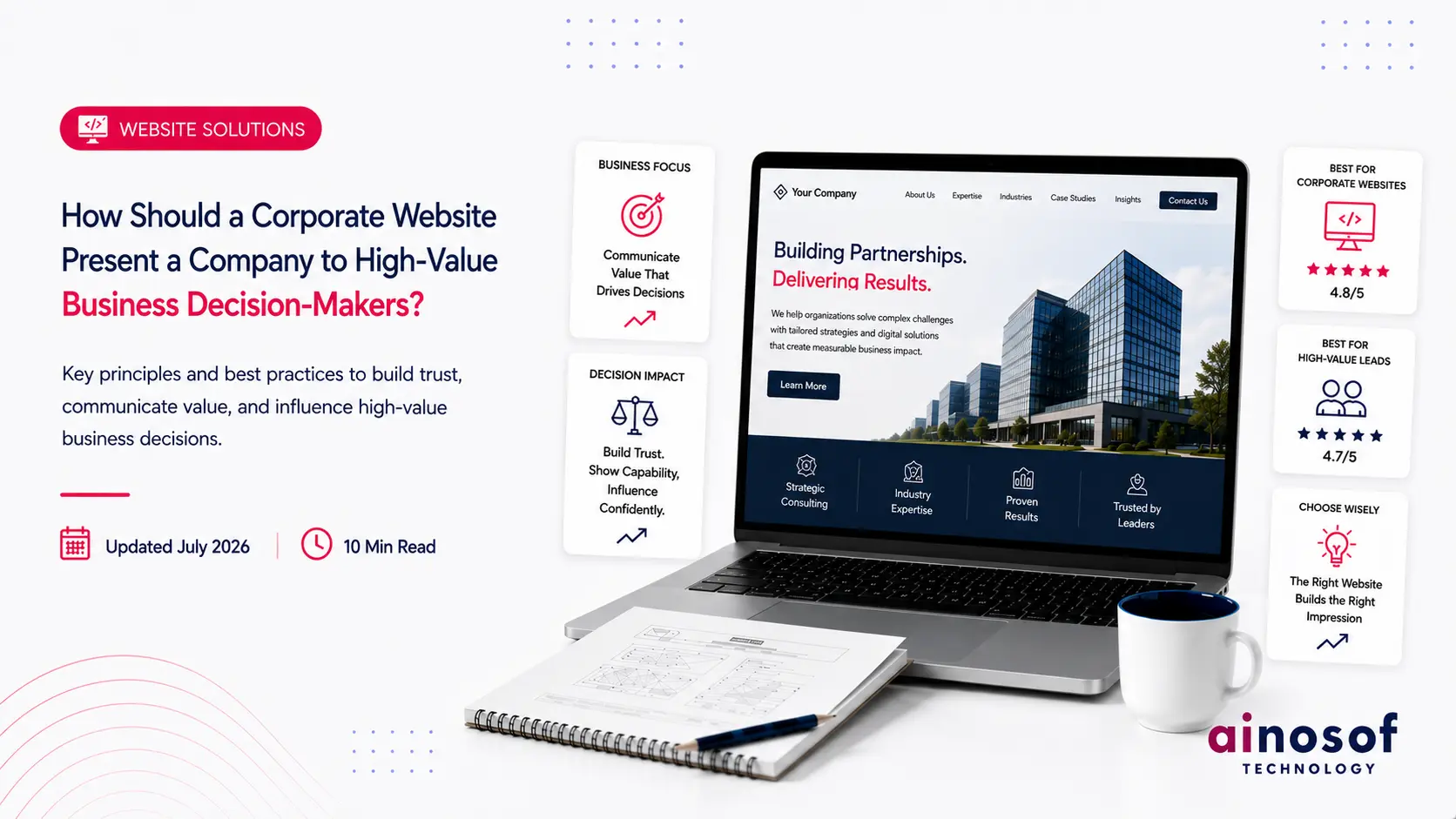
A high-value business decision rarely begins with a sales call. Long before a CEO, procurement leader, operations head, or other senior stakeholder agrees to speak with a company, they often form an initial judgment from what they can find online. The corporate website becomes one of the earliest places where they assess whether a company appears relevant, capable, credible, and worth considering.
That creates a problem for businesses that treat their website primarily as a digital company profile. A website can list services, display an impressive portfolio, mention years of experience, and still leave a serious prospect asking the questions that matter most: Can this company solve a problem like ours? Can we trust its capabilities? What makes it different from other options? Can it handle an engagement of this scale? And can I confidently recommend it to the other people involved in the decision?
The challenge becomes even greater in high-value B2B decisions, where the person researching a company may not be the only person influencing the final choice. Different stakeholders may need different evidence before they are comfortable moving forward. A website that communicates only what the company wants prospects to know may therefore create information gaps precisely when confidence matters most.
This is why corporate website presentation needs to be approached as a business decision problem rather than simply a design or content exercise. The website should help a potential buyer move from relevance to value, from value to proof, from proof to confidence, and from confidence to action—while giving them enough clarity to justify that consideration internally.
In this article, we will examine how a corporate website should present a company to high-value business decision-makers, including how to establish relevance, communicate business value, demonstrate proof and maturity, differentiate from competitors, reduce perceived risk, support multiple stakeholders, and turn buyer confidence into meaningful business conversations.
A corporate website is often the first serious point of evaluation for a potential client. Before a decision-maker agrees to a meeting, requests a proposal, or involves their internal team, they may already be judging whether the company appears relevant and capable enough to consider.
This is why a corporate website should not be treated only as a place to present the company's history, services, team, and achievements. For a high-value buyer, the more important question is whether the website provides enough business information and evidence to support an initial decision.
A senior decision-maker is usually trying to reduce uncertainty before investing time in a business conversation. They want to know whether the company understands their type of business, has relevant experience, can handle the requirement, and has a credible reason for being considered.
They may be asking themselves:
For example, a manufacturing company looking for a technology partner may find dozens of firms offering ERP or custom software development. A general statement such as “We provide innovative technology solutions” does little to help that buyer decide.
A stronger website could demonstrate experience with manufacturing operations, ERP systems, process automation, reporting, integrations, and similar business projects. The buyer can then begin judging whether the company is actually relevant.
The important point is that the buyer is not simply collecting information. They are evaluating suitability.
A corporate website should therefore help a serious prospect answer one early question: “Is this company worth evaluating further for our business?”
A website can contain a large amount of company information and still provide very little decision-making value.
A company may talk about its experience, expertise, quality, innovation, customer focus, and reliability. But these statements are mostly claims until the website gives the buyer something concrete to evaluate.
For example:
This distinction becomes more important as the value and complexity of a potential engagement increase. A buyer considering a small purchase may make a quick decision. A buyer evaluating a major technology, consulting, or business partnership needs much more confidence.
Imagine two software companies offering similar services. One website focuses heavily on company history and broad marketing statements. The other presents relevant case studies, explains the business problems solved, shows project outcomes, and demonstrates experience with similar organisations.
The second website gives the buyer more decision-making evidence.
This does not mean every corporate page needs to become a collection of statistics and case studies. It means important claims should be supported where evidence can genuinely reduce uncertainty.
A corporate website becomes more useful when it moves from “Here is what we say about ourselves” to “Here is what you can evaluate about our ability to help you.”
A serious prospect can leave a website without submitting a form or explaining why. They may simply conclude that the company does not appear relevant, credible, or different enough to justify further research.
That makes the website an important part of the early business evaluation journey.
A visitor may quickly look for signals such as:
Suppose an enterprise is looking for a long-term technology partner and visits three websites.
The first looks visually impressive but says little about the company's relevant experience. The second has detailed service pages but almost no proof of previous work. The third explains its target industries, relevant capabilities, case studies, outcomes, delivery approach, and next steps.
The third company has made the buyer's evaluation easier.
That does not guarantee a sale. But it can create enough confidence for the prospect to continue researching, share the website with other stakeholders, or start a conversation.
This is an important role of a corporate website: earning continued consideration.
For high-value prospects, the first meaningful conversion may therefore be the decision to keep evaluating the company rather than immediately filling out a contact form.
Before a decision-maker studies individual services, they need to understand whether the company is relevant to their situation. If that relevance is unclear, even strong capabilities may be overlooked.
The website should therefore establish the company's business position first, then make its services easier to understand within that position.
A senior decision-maker should not have to spend several minutes figuring out what a company actually does or who it serves.
Within the first few moments, the website should make the company's:
reasonably clear.
This does not mean putting every service and achievement on the homepage. It means creating a focused first impression.
For example, compare:
“Delivering innovative digital solutions for a better future.”
with:
“Custom software solutions for manufacturers looking to automate operations and improve business visibility.”
The second message provides more useful information to a manufacturing decision-maker. They can immediately judge whether the company may be relevant to their requirement.
This kind of clarity is particularly important for businesses pursuing high-value B2B opportunities. The goal is not simply to make the website attractive to everyone. It is to help the right prospects recognise the company as relevant.
The first impression should therefore make it easier for a decision-maker to answer:
“Is this company relevant enough for me to explore further?”
Many companies serve several industries, but that does not mean every audience should receive equal emphasis on the website.
A decision-maker wants to know whether the company has experience and capabilities that match their particular business environment.
The website can communicate its strongest business fit through:
For example, a technology company may offer ERP, CRM, software development, website development, and digital marketing. If it has strong experience with manufacturing businesses, that strength should be visible through manufacturing solutions, relevant case studies, industry-specific content, and examples of manufacturing challenges it has addressed.
The buyer should not have to discover this after exploring every service page.
This does not mean the company must reject customers from other industries. It means the website should make its strongest areas of relevance visible.
When the right prospects can quickly recognise their business situation on the website, the company becomes easier t o evaluate.
Many companies in the same industry use almost identical language. They describe themselves as experienced, innovative, reliable, professional, customer-focused, and quality-driven.
The result is a website that may look different visually but sound almost identical commercially.
Clear positioning helps solve this problem by connecting the company with a specific combination of:
For example, three software companies may all provide custom software development.
One may specialise in manufacturing systems. Another may focus on enterprise integrations. Another may primarily serve startups.
All three offer software development, but their positioning helps buyers understand which company may be the better fit for their particular situation.
This is why differentiation should not begin with clever marketing language. It should begin with relevance.
A buyer is often less interested in finding the company that claims to be the best overall and more interested in finding the company that appears to be the best fit for the problem they need to solve.
Clear positioning makes that fit easier to recognise.
Once the company has established who it serves and why it is relevant, the next challenge is explaining what its capabilities actually mean for the buyer's business.
This is where many corporate websites become too service-focused. They describe what the company can deliver without explaining why that capability matters commercially.
A service name is rarely the complete reason behind a business purchase.
A company may search for CRM development, but its actual concern could be poor customer visibility, disconnected sales information, weak follow-up processes, or inefficient reporting.
Similarly, a company may search for ERP development, while its real problem is fragmented operations, duplicate information, or limited management visibility.
Corporate messaging should therefore connect the service with the business problem behind it.
For example:
CRM development → improving customer information, sales processes, and follow-up.
ERP development → connecting operations, improving process control, and reducing fragmented information.
Custom software development → addressing business processes that standard software cannot handle effectively.
This gives the buyer a clearer understanding of why the service exists and when it becomes valuable.
A website should not force a business decision-maker to translate a technical offering into business value alone.
The strongest service messaging answers both:
“What can you provide?”
and
“Why does that matter to our business?”
A deliverable tells the buyer what they will receive. An outcome explains what the business is expected to gain from receiving it.
For high-value decisions, both matter.
A website development company may say:
“We build responsive corporate websites.”
That explains the deliverable.
But a more business-focused explanation could connect the website with stronger corporate credibility, clearer communication of complex services, better support for qualified enquiries, and an easier evaluation experience for potential clients.
Similarly, a software company should not stop at describing the application it builds. Where appropriate, it should explain the operational or commercial improvement the solution is intended to support.
Possible outcomes may include:
These should be presented realistically and supported with evidence wherever possible.
The goal is not to promise unrealistic results. It is to help the buyer understand the business purpose behind the deliverable.
When outcomes are clearly communicated, the website also becomes more useful to decision-makers who need to explain or justify the potential investment to others internally.
Strong technical capability does not automatically demonstrate business understanding.
A buyer may be looking for a partner who understands their processes, constraints, stakeholders, operational realities, and commercial priorities.
The website can demonstrate this understanding through:
For example, a technology company targeting manufacturers should understand that manufacturing businesses may deal with production workflows, inventory, procurement, reporting, multiple locations, machine data, integrations, and operational continuity.
A website that addresses these realities demonstrates more understanding than one that simply says:
“We build powerful software for every industry.”
This does not mean filling the website with complicated industry terminology. It means showing that the company understands the environment in which its solution will actually be used.
That understanding can reduce the amount of explanation a buyer expects to provide later and can make the company appear more prepared for a serious engagement.
A corporate website should therefore communicate not only what the company knows, but how that knowledge applies to the buyer's real business environment.
Once a company has established relevance and business value, another question naturally follows: why should the buyer consider this company instead of other credible alternatives?
This is where competitive differentiation becomes essential.
A high-value buyer may discover several companies that appear capable of providing the required service.
At this stage, saying “we can do it” is no longer enough.
The website needs to communicate why the company deserves a place on the buyer's shortlist.
That reason may come from:
For example, imagine four companies offering custom software development.
One has broad experience across many industries. Another specialises in manufacturing systems. A third has deep enterprise integration experience. The fourth mainly works with startups.
For a manufacturer looking for a complex operational platform, the second company's specialised manufacturing experience may be more relevant than a broad claim of being an “experienced software company.”
The question is therefore not:
“How can we prove we are better than everyone?”
It is:
“What relevant advantage gives this buyer a reason to consider us?”
A corporate website becomes more persuasive when it makes that answer clear.
Words such as “leading,” “innovative,” “trusted,” “best,” and “world-class” are common across corporate websites.
The problem is simple: if every company makes the same claim, the claim stops helping the buyer distinguish between them.
Instead of saying:
“We are a leading technology company.”
the website should demonstrate:
The same applies to claims such as “innovative.” The website should explain what is actually different, for whom, and why that difference matters.
For example, “We are a trusted global partner” is difficult to evaluate.
Relevant client work, industry experience, project outcomes, partnerships, delivery capabilities, and specific examples provide much stronger material for a buyer to assess.
This approach makes the website less dependent on marketing adjectives and more dependent on specificity and evidence.
The most convincing differentiation is rarely the claim that a company is better. It is the evidence that gives the buyer a reason to believe the company is better suited to their particular requirement.
Some companies have genuine competitive strengths but fail to communicate them clearly. Their websites reduce complex capabilities to generic service names, making valuable expertise almost invisible.
The website should instead make distinctive strengths easier to understand through context, examples, and evidence.
These strengths may include:
For example, a technology company may offer website development, software development, ERP, CRM, and digital marketing as separate services.
But if it can connect a company's website, CRM, ERP, internal software, and digital marketing systems into a broader digital ecosystem, that combined capability may be more strategically valuable than any single service.
The website should make that relationship visible.
A company's strongest competitive advantage may therefore not be one particular service. It may be the combination of expertise, experience, processes, and business understanding that allows it to solve a complex problem more effectively.
When specialised expertise is presented with clear context and evidence, the website gives high-value buyers something much more useful than another generic service claim: a specific reason to continue considering the company.
When a business is considering a high-value partnership, claims alone are rarely enough. A company may describe itself as experienced, reliable, innovative, or highly capable, but a serious decision-maker needs something more concrete before those statements can influence a buying decision.
The role of the corporate website is to make important claims easier to evaluate. The right evidence can show not only what the company says it can do, but also where it has done similar work, what it achieved, and why that experience is relevant to the buyer's situation.
Not every case study has the same value.
A long list of projects may show that a company has been busy, but it does not necessarily prove that it can handle the buyer's specific requirement. For a high-value decision-maker, the most useful case studies are those that demonstrate relevant capability in a comparable business context.
A strong case study should help answer questions such as:
For example, a manufacturer looking for a custom ERP solution will usually gain more confidence from a case study about ERP implementation for a manufacturing business than from ten unrelated website projects.
Similarly, an enterprise looking for a complex software integration may find a case study involving multiple systems, business processes, and stakeholders much more useful than a simple application-development example.
This does not mean every case study must match the buyer exactly. The goal is to demonstrate a meaningful level of similarity in industry, problem, complexity, technology, scale, or business objective.
The strongest case studies therefore work as evidence of capability rather than simply as a gallery of completed work.
A corporate website should prioritise relevant case studies over a large project count, because one highly comparable example can often create more confidence than dozens of unrelated ones.
A case study becomes much more useful when it explains the business situation behind the project.
Simply saying:
“We developed a custom software platform for a client.”
does not give a decision-maker much to evaluate.
The buyer needs context. What problem existed before the project? Why was the solution required? What did the company actually change? What was the resulting business impact?
For example, instead of only presenting a website redesign as a completed project, the company could explain that the previous website made it difficult for potential clients to understand its complex services, created poor navigation, and generated weak enquiry quality. The new website then addressed those specific problems through clearer positioning, improved information architecture, stronger proof, and more relevant conversion pathways.
That context allows a potential buyer to compare the situation with their own.
Client outcomes make the evidence stronger because they move the conversation beyond deliverables. Depending on the project, outcomes might include improved operational efficiency, reduced manual work, better lead quality, faster processes, stronger visibility, or improved customer experience.
The outcomes should be presented honestly and with enough context to avoid turning them into unsupported marketing claims.
The same principle applies to project details. Information about scope, complexity, business environment, challenges, and solution approach helps the buyer understand what the company actually handled.
A strong case study should therefore help the reader think:
“This company has dealt with a situation that is relevant to ours.”
When client outcomes are connected with clear project context, a corporate website turns past work into evidence that helps future buyers make a more informed decision.
Certifications, partnerships, awards, and recognised credentials can strengthen a corporate website, but they do not automatically create credibility.
Their value depends on relevance to the buyer's decision.
A certification may matter when it demonstrates a specific capability, standard, compliance requirement, or technical qualification that the buyer needs. A technology partnership may be valuable when the buyer requires expertise with that particular platform. An industry award may provide useful external validation when it is genuinely relevant to the company's work.
The problem occurs when credentials are displayed simply as decorative badges.
For example, a corporate website may show ten logos of technology partners, certifications, and awards without explaining what any of them mean for a potential client. The buyer sees recognition, but not necessarily business value.
A stronger approach is to connect the credential with the specific reason it matters.
If a company holds a relevant security certification, the website can explain how that supports its approach to handling sensitive business information. If it is a recognised partner of a major technology platform, the website can explain the expertise and implementation capability that relationship represents.
The same principle applies to awards. The important question is not only “Did the company win an award?” but “Does this recognition provide meaningful external evidence of a capability relevant to the buyer?”
Credentials should therefore support the broader evidence system rather than replace it.
A certificate or award can strengthen trust, but relevant experience, outcomes, and demonstrated capability should remain at the centre of the credibility argument.
For a high-value buyer, capability is not limited to whether a company can complete the technical work.
The buyer may also need confidence that the company has the people, processes, experience, resources, and organisational maturity required to manage the engagement responsibly.
This becomes especially important when the project is complex, long-term, expensive, or closely connected to important business operations.
A company does not need to publish every internal process on its website. However, a high-value buyer should be able to find enough information to understand whether the organisation appears capable of managing a serious engagement.
Useful signals may include:
The goal is not to make the company look large simply for the sake of appearing large.
A smaller specialist company may be an excellent partner if it has the right expertise, processes, and delivery capability. What matters is whether the website provides credible evidence that the company can handle the actual requirements of the engagement.
For example, a business considering a long-term ERP project may want to understand more than the company's technical skills. It may also want confidence around implementation, project coordination, support, maintenance, integration, and ongoing communication.
The website should make those capabilities visible where they are relevant.
A corporate website should communicate organisational maturity through evidence of how the company operates and delivers, not simply through claims about size or professionalism.
Statements such as “20 years of experience,” “500+ clients,” or “1,000 projects completed” can provide context, but numbers alone rarely explain whether the experience is relevant.
A buyer wants to understand the quality and relevance of that experience.
For example, “15 years in business” does not automatically prove that a company can manage a complex enterprise technology project.
More useful information could show:
Suppose a software company has completed 500 projects, but most were small websites. That number may not provide much confidence to an enterprise evaluating a large custom software platform.
Another company may have completed fewer projects but handled several complex, long-term implementations for organisations with similar requirements.
For that buyer, the second company's experience may be more relevant.
This is why experience should be demonstrated through context, not volume alone.
The strongest corporate websites use numbers as supporting information while giving buyers enough detail to understand what those numbers actually represent.
A high-value engagement often does not end when the initial project is delivered. The buyer may need ongoing support, maintenance, improvements, upgrades, consulting, or additional development.
That creates a different question:
“Will this company still be a reliable partner after the initial delivery?”
The website can help answer this through evidence such as:
For example, a company could show that a client initially engaged it for a website project and later expanded the relationship into software development, CRM integration, maintenance, or digital growth services.
That tells a prospective buyer something important: the relationship was valuable enough to continue.
Long-term capability can also be demonstrated through clear explanations of what happens after delivery. Buyers want to know who will support the solution, how future changes are handled, and whether the company can remain involved as the business evolves.
This information reduces uncertainty around the future of the relationship.
A corporate website should therefore demonstrate not only that the company can win and deliver a project, but that it can remain valuable throughout the life of the business relationship.
High-value buyers are not only asking what they might gain from choosing a company. They are also thinking about what could go wrong.
A poor technology decision, unreliable supplier, weak implementation, communication problems, or lack of ongoing support can create significant business costs.
The corporate website cannot remove every risk, but it can reduce avoidable uncertainty before the sales conversation even begins.
A prospect should not need a meeting simply to discover basic information that could have been presented clearly on the website.
Depending on the type of engagement, the website should help answer questions such as:
For example, if a company offers enterprise software development, a serious buyer may want to understand its approach to requirements, development, testing, deployment, integrations, support, and ongoing improvements.
The website does not need to reveal every operational detail. But it should remove enough basic uncertainty that the sales conversation can focus on the buyer's actual business requirements.
This makes the website more than a marketing asset. It becomes a tool for pre-qualifying expectations and preparing the buyer for a more productive conversation.
Reliability is difficult to communicate through a single sentence.
A company can say it is reliable, but the buyer needs to understand what supports that statement.
The website can demonstrate reliability through:
For instance, explaining that a company follows a structured process from discovery through implementation, testing, launch, and support gives the buyer more information than simply saying “we deliver quality solutions.”
Case studies can also demonstrate how the company handled challenges rather than showing only successful final results. This can make the business appear more transparent and realistic.
Accountability can be supported by clearly identifying how clients work with the company, what happens during different project stages, and where support is available.
These details matter because high-value buyers are evaluating delivery confidence, not just technical capability.
A corporate website builds stronger confidence when it gives buyers visible reasons to believe that the company can manage the engagement responsibly from beginning to ongoing support.
A person researching a potential vendor may not be the final decision-maker. They may need to share their findings with a CEO, procurement team, finance department, technical team, or other stakeholders.
That means the website needs to provide information that can survive internal scrutiny.
A decision-maker is more comfortable recommending a company when they can point to:
For example, instead of telling an internal team, “I found a company that looks good,” the stakeholder should be able to say:
“They have worked with businesses similar to ours, have experience with the same type of requirement, have demonstrated relevant outcomes, and have a clear delivery and support approach.”
That is a much stronger internal recommendation.
The website should therefore make important information easy to find, understand, share, and reference.
The safer a decision-maker feels about defending the company's credibility internally, the more likely the website is to support progression toward a serious business conversation.
High-value B2B decisions are rarely made by one person alone.
One person may discover the company, another may assess technical capability, procurement may evaluate the supplier, finance may consider commercial value, and senior leadership may approve the final engagement.
The corporate website should therefore support more than one perspective without losing a consistent business message.
The business sponsor is often the person who sees the potential value first. But recognising value personally is different from explaining that value to others.
They may need to communicate:
A website can support this by presenting information in a way that is easy to understand and share.
For example, a business leader considering a new CRM solution may understand that the company needs better customer visibility. But when presenting the potential partner internally, they may need evidence of similar implementations, expected business outcomes, technical capabilities, and ongoing support.
If the website provides those answers clearly, the decision-maker does not have to reconstruct the entire business case from scattered information.
The website therefore becomes part of the internal justification process.
A strong corporate website gives the business sponsor enough clear, relevant evidence to explain why the company deserves to be considered.
Different stakeholders evaluate the same company from different perspectives.
Procurement may want confidence around supplier credibility, experience, processes, and commercial suitability.
Finance may focus on business value, expected outcomes, commercial justification, and long-term implications.
Operations may want to know whether the company can deliver reliably and support the solution after implementation.
Technical stakeholders may need to verify technology expertise, integrations, architecture, security, scalability, or implementation capability.
The website does not need to create completely separate experiences for every stakeholder. Instead, it should provide enough well-organised evidence for different evaluators to find what matters to them.
For example, a case study can demonstrate business outcomes for leadership while also showing project complexity and technical scope for technical evaluators.
Similarly, a page describing the company's delivery process can provide confidence to procurement and operations while helping the business sponsor explain how the engagement would work.
The strongest corporate websites therefore recognise that a B2B buying journey contains multiple questions from multiple stakeholders.
When those questions can be answered through clear website evidence, the buyer does not have to depend entirely on the sales team to explain the company's credibility.
The biggest challenge in a complex buying process is often not generating interest. It is creating enough shared confidence for different stakeholders to move in the same direction.
A CEO may care about business value. A technical leader may care about implementation capability. Procurement may care about supplier reliability. Operations may care about ongoing support.
If the website only speaks to one of these concerns, another stakeholder may introduce objections later.
The website can support consensus by connecting these different concerns around one consistent business story:
What problem exists → Why it matters → What the company can provide → Why it is qualified → What evidence supports it → How the engagement can be managed → What happens next.
For example, a case study can connect a business problem with the solution, implementation approach, technical requirements, and final outcome. That gives different stakeholders something relevant to evaluate without forcing the company to use completely different messages for each audience.
The goal is not to make every stakeholder agree immediately. The goal is to give them enough credible information to have a more informed discussion.
This can also shorten the gap between initial research and a serious sales conversation because many basic objections have already been addressed.
A corporate website becomes a stronger business asset when it helps different stakeholders move from separate questions toward a shared level of confidence in the company.
A high-value B2B buyer rarely follows a simple path through a corporate website. One visitor may start with an industry page, move to a service, review a case study, check company credentials, and then return to another solution page before deciding whether to make contact.
If these pieces of information are difficult to find or poorly connected, the buyer has to do too much work. That can create doubt even when the company itself is highly capable.
A strong corporate website architecture should therefore support the way business decision-makers actually evaluate a company. Important information should be connected logically so that a visitor can move from relevance → capability → evidence → confidence → action without unnecessary friction.
A decision-maker should not have to search through multiple unrelated pages to answer basic questions about a company.
Depending on the business, important information may include:
For example, if a manufacturing company is evaluating an ERP development partner, it should be reasonably easy to move from the company's ERP service to relevant manufacturing experience, related case studies, technical capabilities, and information about ongoing support.
If the visitor has to return to the main menu after every step and manually search for the next piece of information, the website is creating unnecessary effort.
This does not mean every page should contain links to everything. It means the architecture should anticipate the questions a serious buyer is likely to ask next.
A useful test is simple: if a decision-maker has just answered one important question, can the website naturally help them find the next answer?
Good architecture reduces searching and allows the buyer to spend more time evaluating the company rather than navigating the website.
These sections should not operate as isolated parts of the website.
A service page should be connected to relevant industries. Industry pages should connect to appropriate solutions and services. Case studies should demonstrate those capabilities in real business situations. Company information should reinforce the experience and credibility behind the claims.
For example:
Manufacturing industry → ERP solutions → ERP development service → Manufacturing ERP case study → Relevant capabilities → Contact or consultation
This creates a logical evaluation path.
A visitor interested in a specific industry can move toward a solution. A visitor interested in a service can discover where that service has been applied. A visitor reviewing a case study can understand which capability made the result possible.
This structure also helps prevent a common corporate website problem: important evidence being separated from the claim it supports.
If a service page says the company has experience in a particular industry but provides no clear path to relevant examples, the buyer has to search for proof. Connecting those pages makes the evidence easier to verify.
The website should therefore behave less like a collection of individual pages and more like a connected business information system.
When services, industries, solutions, evidence, and company information reinforce each other, the buyer can build confidence step by step.
Not every visitor needs the same information at the same time.
Someone discovering the company for the first time may only need to understand who the company serves and what it does. A visitor already comparing suppliers may want case studies, credentials, delivery information, and technical capabilities.
The website should support these different stages without placing every possible detail in front of every visitor.
A simple pathway might look like:
Initial relevance → Service or solution → Relevant evidence → Company capability → Deeper validation → Business conversation
For example, a first-time visitor may begin on the homepage and move to an industry page. Once they recognise relevance, they can explore a specific solution. From there, they can access related case studies and supporting capabilities. If confidence increases, they can review company information and move toward a consultation.
This approach prevents the website from becoming overloaded with information simply because the company has a lot to say.
The goal is not to hide information. It is to make the right information available at the right stage.
A well-structured corporate website should allow buyers to go deeper when they need more evidence while keeping the initial experience clear and focused.
A complex B2B purchase often involves several people, and each person may evaluate the company differently.
A CEO may want to understand strategic value. A procurement leader may examine supplier credibility and commercial suitability. A technical evaluator may focus on implementation capability.
The website needs to support these different questions without becoming a collection of disconnected messages.
The underlying corporate position should remain consistent while the evidence and level of detail change according to the stakeholder's concerns.
A CEO or founder is unlikely to need every technical detail during the initial evaluation. Their attention is more likely to focus on business value, strategic fit, risk, and potential outcomes.
They should be able to understand:
For example, a founder evaluating a CRM development partner may care less about the programming framework used and more about whether the solution can improve customer visibility, support sales operations, integrate with existing systems, and scale with the business.
The website should make that business value visible without requiring the executive to interpret technical information.
This does not mean technical depth should be removed. It means the business reason for the technology should remain clear.
A corporate website should allow an executive to understand why the company matters to the business before asking them to understand how every part of the solution works.
Procurement and operations stakeholders often have different concerns from the original business sponsor.
They may want to understand whether the company has the delivery capability, organisational stability, relevant experience, processes, support structure, and commercial credibility required for the engagement.
Useful information may include:
For example, an operations leader considering a long-term software implementation may want to know what happens after deployment. Who provides support? How are improvements handled? Does the company have experience maintaining similar systems?
These questions are different from the initial business question, but they are still part of the same buying decision.
The website should therefore provide enough information for procurement and operations teams to verify whether the company is a credible and manageable business partner.
A technical evaluator may examine the company from a much deeper perspective.
They may want to understand:
The exact information will depend on the service and industry, but the principle remains the same: technical stakeholders need enough evidence to determine whether the company can handle the technical realities of the proposed engagement.
For example, an enterprise evaluating a software development partner may want to understand how the company handles integrations with existing systems, data flows, security, scalability, deployment, and ongoing maintenance.
A website does not need to turn every visitor into a technical expert. It should, however, provide a credible technical foundation that allows the appropriate evaluator to continue their assessment.
This is especially important when the person researching the company is expected to recommend it to others.
A strong corporate website allows technical stakeholders to find credible technical evidence without forcing the entire website to become technical.
Design has a major influence on how a corporate website is perceived, but visual quality cannot compensate for weak business communication.
A website may look premium and still leave a serious buyer unsure about what the company does, who it serves, or why it deserves consideration.
The purpose of corporate design should therefore be to strengthen the information and positioning already present, not distract from them.
A high-value buyer often forms an initial impression before reading every word on the page.
Visual signals can influence whether the company appears:
These signals can come from consistent branding, typography, spacing, imagery, interface quality, page structure, and professional presentation of business evidence.
For example, a corporate technology company targeting enterprise clients may need a design system that feels structured and dependable rather than overly playful or visually chaotic.
However, “premium” design does not necessarily mean using more animation, larger graphics, or complex visual effects.
A professional corporate website should make its important information feel intentional, organised, and easy to trust.
Design becomes valuable when it supports the company's actual business position.
A visitor should be able to understand what matters most without reading every word on a page.
Visual hierarchy helps establish that order.
Important information may include:
For example, a service page may first establish what the service helps businesses achieve. It can then present relevant capabilities, followed by case studies or evidence, and finally provide a suitable next step.
The visual structure should make that progression easy to follow.
Poor hierarchy can have the opposite effect. If every heading, image, statistic, animation, and button competes for attention, the visitor may struggle to identify what actually matters.
A high-value buyer should not have to visually search for the company's most important business evidence.
Good design therefore creates a clear path from message to evidence to action.
Design becomes a problem when it starts competing with the information the buyer needs.
Heavy animation, decorative graphics, excessive scrolling, unclear navigation, large empty sections, or visually complex layouts can make a website impressive to look at but difficult to evaluate.
For example, imagine a corporate website with an elaborate animated homepage but no clear explanation of its target industries, relevant services, or evidence of previous work.
The design may create an initial impression, but the buyer still has to search for the information that matters.
Excessive design can also weaken differentiation. If competitors are using similar visual trends, animation, gradients, and generic technology imagery, visual sophistication alone may not make the company memorable.
Trust can also suffer when the website feels designed primarily to impress rather than inform.
The best corporate design is not necessarily the most visually complicated. It is the design that makes the company's positioning, evidence, credibility, and next steps easier to understand.
The purpose of the evaluation journey is not simply to keep visitors on the website. At the right point, the website should help a qualified prospect move toward a useful business conversation.
That transition needs to feel natural. The visitor should have enough confidence to act, and the action should match the level of consideration they have already reached.
Once a visitor has reviewed the company's positioning, capabilities, evidence, and relevance, they should have a clear next step.
Depending on the business model, that could be:
The right action depends on what the company sells and how complex the buying process is.
For example, a business looking for a custom ERP system may not be ready to “buy now.” It may need to discuss its current processes, requirements, integrations, and expected outcomes first.
A “Discuss Your ERP Requirement” action may therefore be more appropriate than a generic purchase-oriented button.
The website should make the next step feel like a natural continuation of the evaluation rather than a sudden demand for commitment.
A qualified visitor should finish their evaluation knowing what they can do next and why that next step is useful.
“Contact Us” is familiar, but it provides very little context.
For a high-value B2B buyer, contacting a company may involve sharing business information, explaining a complex requirement, involving colleagues, or entering a sales process.
A generic button does not tell the visitor what will happen after they click it.
More specific calls to action can reduce this uncertainty.
For example:
These actions provide context around the conversation.
They also help the company understand what the visitor is interested in before the conversation begins.
Imagine a decision-maker who has just spent time reviewing an enterprise software company's case studies and delivery process. A button saying “Contact Us” creates a generic transition. A button saying “Discuss Your Software Requirements” feels more relevant to the journey they have just completed.
The difference may appear small, but it changes the meaning of the next step.
For high-value B2B websites, the call to action should reduce friction and uncertainty, not simply ask the visitor to make contact.
Not every visitor is ready for the same action.
Someone discovering the company for the first time may still be learning. Another visitor may already be comparing suppliers. A third may have a defined requirement and be ready for a detailed discussion.
Using the same call to action for all three can make the website feel disconnected from the buyer journey.
A useful progression could be:
Early evaluation → Learn more / Explore solutions
Active consideration → View relevant case studies / Discuss requirements
High buying readiness → Request consultation / Request proposal / Schedule a discussion
For example, an industry page may encourage the visitor to explore relevant solutions, while a detailed service page may invite them to discuss their requirements. After reviewing strong case studies and capabilities, a more direct consultation or proposal request may become appropriate.
This does not mean creating dozens of buttons. It means making the primary action reflect what the visitor is likely ready to do.
The strongest call to action is therefore not necessarily the most aggressive one. It is the one that feels like the natural next decision in the buyer's evaluation journey.
A corporate website should not be judged only by how many people visit it. For a company targeting high-value B2B opportunities, the more important question is whether the website is helping the right prospects understand the business, evaluate its credibility, and move toward a meaningful conversation.
This requires looking beyond surface-level metrics and examining whether the website is actually supporting the business decision-making process.
Website performance should be evaluated by looking at whether qualified visitors are engaging with the information that helps them make a decision.
Useful signals may include:
For example, if a corporate website receives strong traffic to its homepage but very few visitors explore its services, case studies, or business-specific pages, the problem may not be traffic. The website may simply be failing to move visitors into deeper evaluation.
On the other hand, if qualified visitors regularly move from an industry page to a relevant solution, then to a case study, and finally to an enquiry, that pathway provides a stronger indication that the website is supporting evaluation.
The exact numbers will vary by business, but the principle remains the same: measure whether qualified prospects are consuming decision-critical information, not just whether people are arriving.
A corporate website is performing its business role when its strongest visitors are finding the evidence they need to move from interest toward confidence.
Analytics can show what visitors did, but they usually cannot explain why they did it.
A sales team speaks directly with prospects and can therefore identify questions, objections, and information gaps that website data may not reveal.
Sales teams may repeatedly hear questions such as:
If prospects repeatedly ask questions that the website should already answer, that is a useful signal that the website has a content or architecture gap.
For example, analytics may show that visitors are reaching a software development service page and then leaving. The data shows the drop-off, but the sales team may reveal that prospects are leaving because they cannot find enough information about integration capabilities or post-launch support.
That insight is much more actionable.
Sales feedback can also reveal whether prospects are mentioning specific pages, case studies, or claims during conversations. If salespeople regularly hear that a particular case study helped establish confidence, that page is demonstrating real business value.
Website analytics and sales feedback should therefore work together.
Analytics shows behaviour. Sales conversations explain the reasons behind that behaviour.
When both are reviewed regularly, the company can improve the website based on real buyer questions rather than assumptions.
Traffic can be useful, but high traffic does not automatically mean a corporate website is creating business value.
A company targeting high-value B2B clients may receive fewer visitors than a consumer website and still generate significantly more commercial value from those visitors.
More meaningful outcomes can include:
For example, Website A may generate 20,000 monthly visitors but only a few relevant enquiries. Website B may attract 3,000 visitors but generate ten highly qualified opportunities from businesses that closely match its target market.
For a high-value B2B company, Website B may be performing much better.
The website can also influence opportunities that are not directly attributed to an online form. A prospect may discover the company through search, research the website, discuss it internally, and contact the sales team later through another channel.
This is why performance should be evaluated as part of the complete buyer journey, rather than through traffic numbers alone.
The most useful question is not “How many people visited the website?” but “Did the website help create better business opportunities?”
A corporate website has a much bigger responsibility when the company is targeting high-value business decision-makers.
The objective is not simply to present the company's history, list its services, or make the business look professional. The website needs to help a potential buyer answer a series of important questions:
Is this company relevant to us?
Can it solve our problem?
Has it handled similar work before?
What evidence supports its claims?
Can it manage an engagement of this importance?
What makes it different from other credible options?
Can I confidently recommend it to other stakeholders?
Answering these questions requires more than attractive design or persuasive copy. It requires a website built around business evaluation.
The strongest corporate websites connect positioning with relevant services, services with business problems, capabilities with evidence, evidence with credibility, and credibility with a clear next step.
They also recognise that a complex B2B decision is rarely made by one person. The website must give executives, procurement teams, operations leaders, technical evaluators, and other stakeholders enough relevant information to reach a shared level of confidence.
Most importantly, the website should reduce the amount of uncertainty a buyer carries into the sales conversation.
When a corporate website makes the right information easy to find, supports claims with meaningful evidence, communicates genuine differentiation, and guides qualified prospects toward an appropriate next step, it becomes more than a company presentation.
It becomes a business decision-support tool—one that can help the right prospects understand the company, trust its capability, and move forward with greater confidence.
A corporate website aimed at high-value decision-makers needs to address the questions that commonly arise during business evaluation. These questions can also help a company identify whether its website is providing enough information for prospects to make informed decisions.
It should clearly communicate who the company serves, what business problems it solves, what capabilities it has, what makes it relevant, and what evidence supports its claims. The goal is to help a serious prospect decide whether the company deserves further consideration.
Case studies provide real-world evidence of capability. Strong case studies explain the client's situation, the problem addressed, the solution delivered, and the resulting outcome. Relevant examples are more useful than simply showing a large number of projects.
Q3. How can a corporate website differentiate a company from competitors?
Differentiation should come from specific expertise, relevant experience, business understanding, delivery capability, and evidence, rather than generic claims such as “leading” or “innovative.”
It should communicate both, but services should be connected to the business problems and outcomes they are intended to address. Buyers need to understand not only what the company delivers but why that capability matters to their business.
It can build trust through relevant case studies, client outcomes, credentials, industry experience, clear delivery information, specialised expertise, and transparent company information. These elements reduce uncertainty before the buyer speaks with the sales team.
It should provide information relevant to different evaluation needs. Executives may look for business value, procurement may examine credibility and delivery capability, operations may assess ongoing support, and technical stakeholders may verify technical expertise.
No. Certifications, awards, and partnerships can support credibility when they are relevant to the buying decision, but they should work alongside case studies, outcomes, expertise, and other evidence.
The primary call to action should reflect the prospect's buying readiness. Depending on the business, this could be “Discuss Your Requirement,” “Request a Consultation,” “Schedule a Discovery Call,” or “Request a Proposal” rather than relying only on a generic “Contact Us.”
 Why ERP is Becoming a Growth Necessity, Not Just a Back-Office Tool, for Indian SMEs
29 Sep, 2026
Why ERP is Becoming a Growth Necessity, Not Just a Back-Office Tool, for Indian SMEs
29 Sep, 2026
 The Rise of Industry-Specific ERP Systems: Why One-Size-Fits-All ERP is Losing Relevance
28 Sep, 2026
The Rise of Industry-Specific ERP Systems: Why One-Size-Fits-All ERP is Losing Relevance
28 Sep, 2026
 How ERP Implementation Helped a Manufacturing Business Cut Inventory Errors by Half
26 Sep, 2026
How ERP Implementation Helped a Manufacturing Business Cut Inventory Errors by Half
26 Sep, 2026
 Manufacturing ERP vs Trading ERP: Which One Does Your Business Need?
25 Sep, 2026
Manufacturing ERP vs Trading ERP: Which One Does Your Business Need?
25 Sep, 2026
 What is LLM SEO and Why Is It Becoming Important for Business Visibility in 2026?
03 Aug, 2026
What is LLM SEO and Why Is It Becoming Important for Business Visibility in 2026?
03 Aug, 2026
 ERP Software Cost in India 2026: What Businesses Should Budget For
24 Sep, 2026
ERP Software Cost in India 2026: What Businesses Should Budget For
24 Sep, 2026
Comment with an expert and get our answer.
Comment with an expert and get our answer.
Explore more insights related to this topic and discover useful perspectives, ideas and strategies from our latest articles.