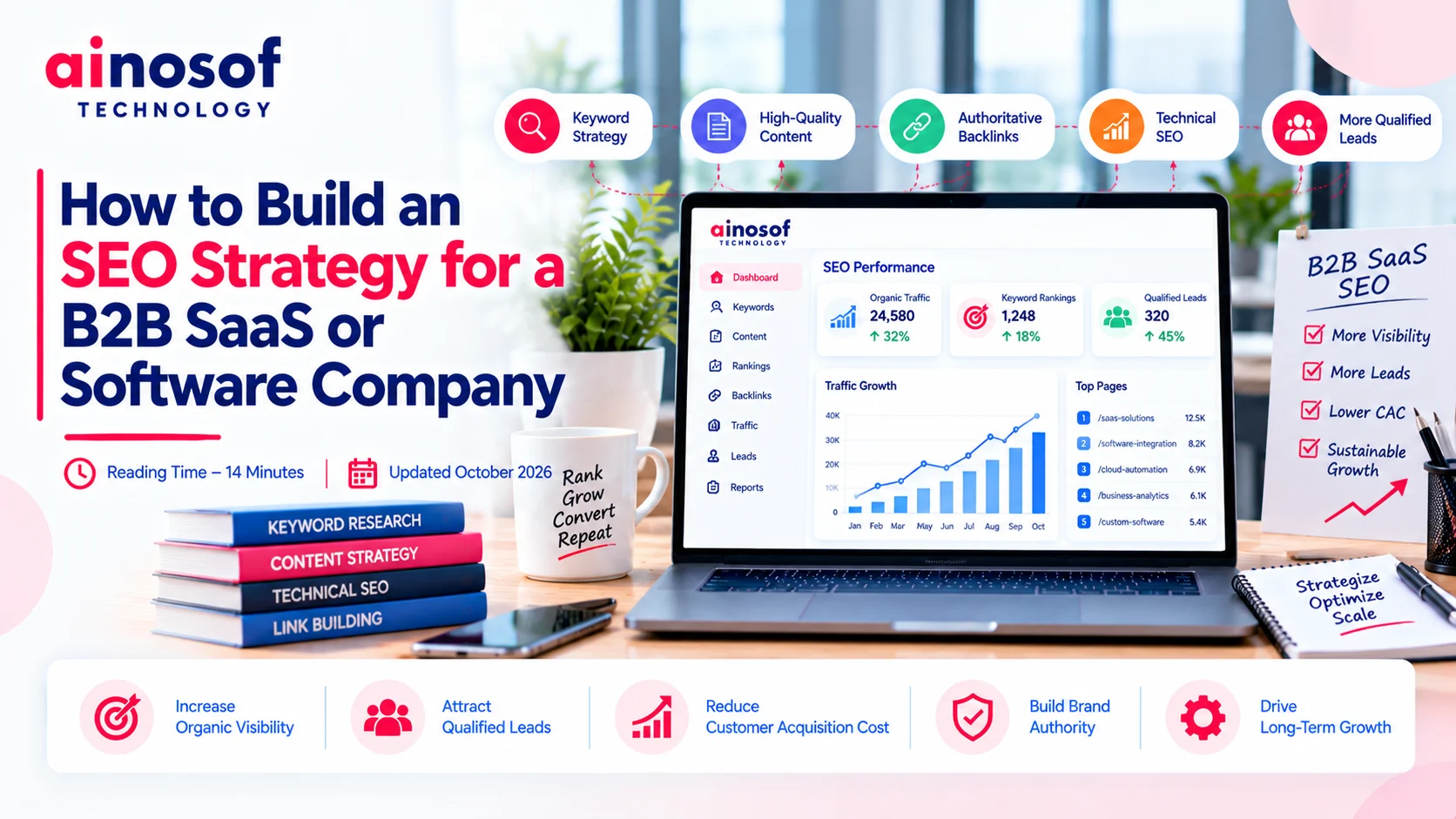
How to Build an SEO Strategy for a B2B SaaS or Software Company
 Aakil Khan


Hiring an SEO company is a significant decision for any business. You expect better search visibility, relevant website traffic and, ultimately, more enquiries or sales. But what actually happens after you hire an SEO team? What work do they perform every month, and how do you know whether their efforts are making a difference?
An SEO company does much more than add keywords to website pages or build backlinks. It analyses your website, understands your business and customers, identifies search opportunities, improves website performance, develops relevant content and measures the results.
The exact work depends on your website, industry, competition and business goals. This guide explains what an SEO company does, the services it provides, how the process works and what you should reasonably expect during the first year.
An SEO company is a team of specialists that helps businesses improve their visibility in organic search results. Its work involves making a website easier for search engines to crawl and understand while ensuring that its pages provide useful information to potential customers.
A professional SEO company typically brings together different skills, including:
An SEO company may work with your existing marketing and development teams or manage the SEO activities independently. The objective is to build sustainable search visibility that supports your business rather than chasing rankings without considering their commercial value.
SEO is an ongoing process. Once the initial research and website audit are complete, an SEO team works on improvements, monitors performance and adjusts the strategy as search behaviour and business requirements change.
Here is what that work generally involves.
Before making changes, an SEO company needs to understand what your business offers, who your customers are, which services or products matter most and what you want to achieve.
For example, a manufacturer may want enquiries from industrial buyers, while an ecommerce business may focus on product visibility and online sales.
The SEO team uses this information to establish priorities and select measurable goals, such as qualified organic enquiries, relevant traffic, product visibility or local leads.
The team reviews your website to identify technical, content and structural problems that may limit search visibility.
This can include checking:
The findings help determine which issues need immediate attention and which improvements can be planned over time.
An SEO company identifies the searches your potential customers use when looking for products, services or solutions.
However, keyword research is not simply about finding phrases with high search volume. The team also studies search intent, competition, relevance and the type of page needed to answer each query.
For example, someone searching for "what is CRM software" is likely looking for information, while someone searching for "CRM software development company" may be evaluating service providers.
Mapping keywords to the right website pages helps prevent overlapping content and creates a more organised SEO strategy.
The SEO team reviews existing pages and identifies opportunities to improve their relevance and usefulness.
This may involve updating page titles, meta descriptions, headings, content, images, internal links and calls to action.
New content may also be required when your website does not adequately cover important services, products or customer questions.
The focus should be on providing accurate, original and useful information rather than repeating keywords throughout a page.
SEO teams regularly review search performance to understand which pages are gaining visibility, which keywords are improving and where visitors may be dropping off.
They use this information to prioritise the next set of improvements.
Monthly activities can include:
The actual frequency of each task depends on the agreed scope. A good SEO company should explain what it is working on, why the work matters and what will happen next.
The services provided by an SEO company vary according to the website and business requirements. Most professional SEO strategies combine several areas rather than relying on one activity.
Technical SEO focuses on the website's underlying structure and performance so search engines can access, crawl, render and index its important pages.
Typical technical SEO services include:
Technical SEO creates a reliable foundation, but not every website needs the same fixes. Recommendations should be based on an actual audit.
On-page SEO improves individual website pages so their content and structure clearly communicate what they offer.
It includes:
The objective is to make each page relevant to its intended audience and search topic.
Content SEO involves planning, creating and improving website content around the information customers need.
Depending on the business, this can include service pages, industry pages, product descriptions, category pages, blog articles, guides and FAQs.
A content strategy should also consider topic coverage, related entities, subject expertise and the relationship between informational and commercial pages.
With AI-powered search experiences becoming more prominent, businesses should continue investing in original, helpful and well-structured content. However, no agency can guarantee that a page will be cited or displayed in a particular AI-generated answer.
Off-page SEO focuses on improving a website's credibility and authority through relevant external signals.
Activities may include:
The emphasis should be on relevance and genuine value, not purchasing large numbers of low-quality links.
Local SEO helps businesses improve visibility when customers search for services in a particular city, area or nearby location.
It is particularly important for service providers, retailers, clinics, manufacturers and businesses serving specific geographic markets.
Local SEO services may include:
Local SEO should connect the business's website, Google Business Profile and other relevant online information consistently.
Reporting helps businesses understand what the SEO team has completed and whether the strategy is moving towards its objectives.
An SEO company may use Google Analytics 4, Google Search Console and other relevant tools to monitor:
A useful report should explain what changed, what the data indicates and what actions are planned next. Rankings and traffic alone do not tell the complete story.
SEO results do not appear on a fixed schedule. The timeline depends on your website's existing condition, competition, industry, content quality, implementation speed and the resources available.
The following is a practical example of how an SEO engagement may progress.
The initial phase usually focuses on understanding the business, identifying opportunities and resolving important website issues.
Typical activities:
What you may notice:
Important website issues may be resolved, pages may become better organised, and search impressions or indexing may begin to improve. Significant traffic or lead growth is not guaranteed at this stage.
Once the foundation is in place, the team can focus more consistently on content, page optimisation and authority-building activities.
Typical activities:
What you may notice:
Some targeted keywords may improve, more pages may receive impressions and relevant organic traffic may begin increasing. Early enquiries may also appear, depending on the market and website's conversion performance.
At this stage, the SEO team has more performance data to understand what is working and where additional investment is needed.
Typical activities:
What you may notice:
A well-implemented SEO strategy may begin producing more consistent organic visibility, relevant traffic and business enquiries. Highly competitive keywords may still require additional time and effort.
These stages are planning benchmarks, not guaranteed milestones. Google also makes clear that no SEO professional can guarantee a particular ranking position.
The value of SEO should be measured by how it supports your business, not simply by how many keywords appear in ranking reports.
A well-planned SEO strategy can help businesses in several ways.
SEO helps your website become visible when potential customers search for relevant products, services or solutions. This gives your business an opportunity to connect with people who already have an interest or requirement.
By targeting commercial search intent and improving service pages, SEO can attract visitors who are more likely to contact your business, request a quotation or make a purchase.
Unlike paid advertising, organic search visibility does not depend on paying for every click. SEO requires ongoing investment, but useful content and website improvements can continue supporting visibility over time.
SEO work often identifies problems with navigation, page structure, mobile usability, content and website performance. Resolving these issues can make the website easier for customers to use.
Consistent visibility across relevant searches, useful website content, genuine customer reviews and credible external references can help build trust in your business.
Businesses can use location-specific SEO and relevant service content to reach customers in new areas, provided they can genuinely serve those markets.
Choosing an SEO company should involve more than comparing monthly packages or promises of first-page rankings. You need a team that understands your business, explains its strategy and can demonstrate the work it performs.
Before hiring an SEO company, consider asking these questions:
A reliable SEO partner should be comfortable explaining its approach, limitations, deliverables and reporting process before you commit.
SEO works best when the strategy is built around your business model, customers and growth objectives. At Ainosof Technology, we approach SEO by understanding how your customers search, evaluating your website and identifying improvements that can support better organic visibility and qualified enquiries.
Our SEO services cover keyword research, technical SEO, on-page optimisation, content strategy, local SEO, link building and performance tracking. We focus on building a clear strategy around your website rather than applying the same checklist to every business.
Whether you want to improve an existing website or build organic visibility for a growing business, our team can help you understand the opportunities and plan the next steps.
Explore our SEO services or discuss your website's SEO requirements with Ainosof Technology.
An SEO company improves a website's organic search visibility through technical optimisation, keyword research, content development, on-page SEO, link building, local SEO and performance analysis. Its work aims to attract relevant visitors and support business goals such as enquiries and sales.
SEO companies commonly provide technical SEO, on-page SEO, keyword research, content optimisation, link building, local SEO, competitor analysis and performance reporting. The exact services depend on the website and business requirements.
An SEO agency may review website performance, fix technical issues, optimise existing pages, publish content, improve internal linking, monitor backlinks and analyse search data. It should also share completed work and upcoming priorities through regular reporting.
SEO timelines vary. Some improvements may become visible within a few weeks, while meaningful growth in organic traffic and enquiries often takes several months. Competition, website condition, implementation and content quality all influence the timeline.
It can be worthwhile when potential customers search online for the products or services the business offers. An SEO company can help improve local visibility, optimise important service pages and attract relevant organic traffic. The investment should be evaluated against business goals and expected returns.
An SEO company primarily focuses on organic search visibility, including technical SEO, content, keyword strategy and link building. A digital marketing agency may offer a wider range of services, such as SEO, paid advertising, social media marketing, email marketing and brand promotion.
No reliable SEO company can guarantee a specific Google ranking. Search results are influenced by competition, relevance, website quality and search engine systems. A professional agency can explain its strategy, implement improvements and report measurable progress, but it cannot control Google's ranking decisions.
A useful report should cover completed activities, organic clicks and impressions, keyword and page performance, technical improvements, traffic trends and relevant conversions. It should also explain key findings and the next month's priorities.
Many SEO companies provide local SEO services that include Google Business Profile optimisation. This may involve improving business information, categories, services, photos, posts, reviews and local search visibility.
Modern SEO strategies can support visibility across AI-assisted search experiences by improving content quality, website accessibility, structured information and brand credibility. However, appearing in AI-generated answers is not guaranteed and should not be treated as a separate guaranteed deliverable.
 Why Off-the-Shelf Software Is No Longer Enough for Scaling Businesses
31 Oct, 2026
 The Rise of AI-Native Business Software: What's Replacing Traditional SaaS Tools in 2026
30 Oct, 2026
 How Custom Software Helped a Business Automate Operations and Cut Costs: A Case Study
28 Oct, 2026
 Custom Software vs SaaS: Which Gives Better Long-Term ROI?
27 Oct, 2026
 Custom Software Development Cost in India 2026: What Businesses Should Expect to Pay
26 Oct, 2026
 How Custom Construction Management Software Helps Builders Track Projects in Real Time
24 Oct, 2026
Comment with an expert and get our answer.
Comment with an expert and get our answer.
Continue exploring with related articles, practical guides and insights covering similar subjects. Discover more information, useful perspectives and ideas to help you learn about the topics that matter to your business.