How a Professional Website Builds Credibility for Manufacturing and B2B Companies
 Shivam Kumar


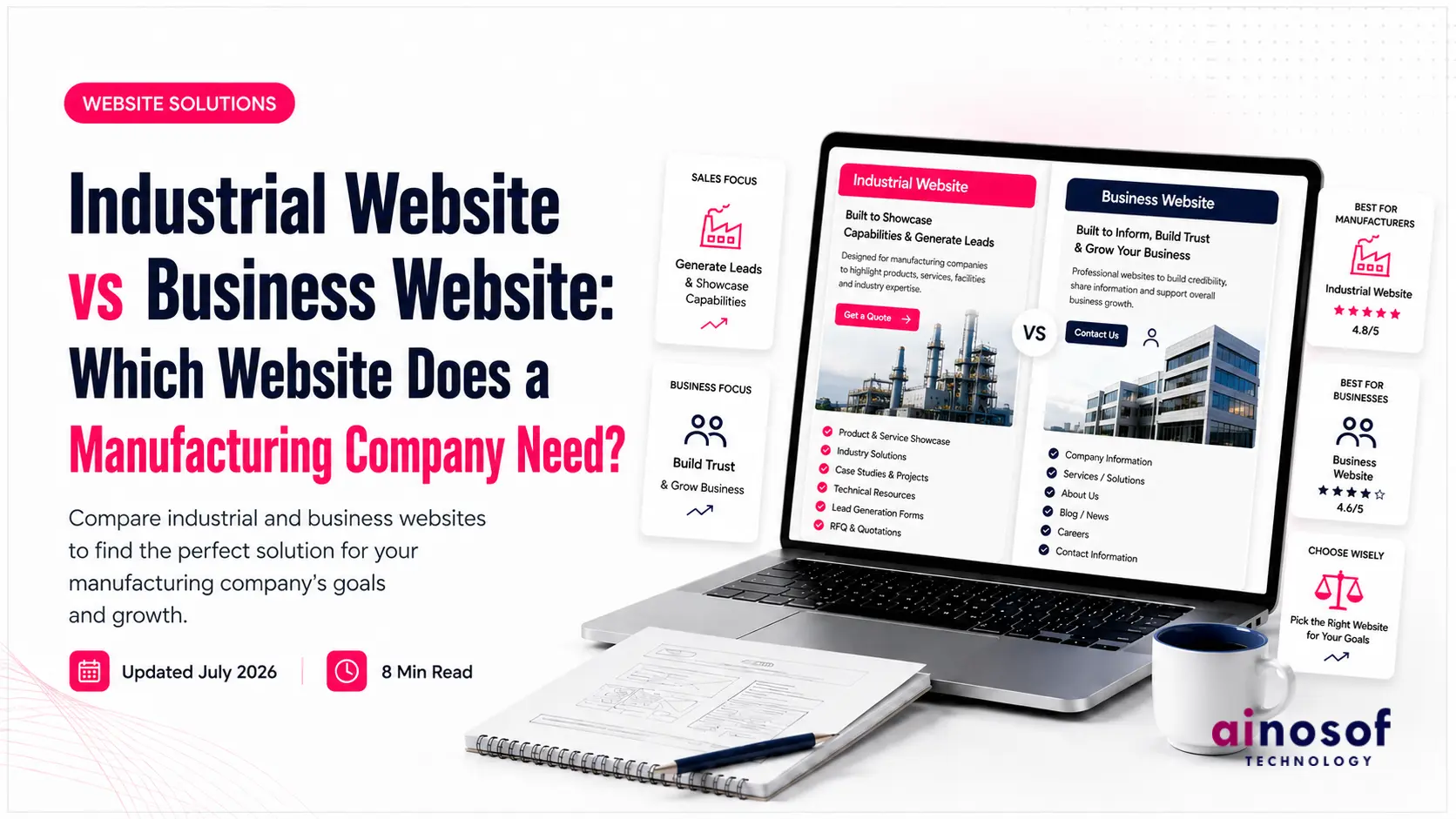
For many Manufacturing Companies, building a website isn't the difficult part.
The real challenge is building a website that supports the way the business sells, communicates, and grows.
As manufacturers expand into new markets, introduce more products, or compete for larger projects, their website gradually becomes more than a digital company profile. It becomes a place where Industrial Buyers, procurement teams, distributors, and potential business partners evaluate the company long before the first phone call, email, or RFQ is sent.
At this stage, many business owners find themselves asking an important question.
Should their business invest in an Industrial Website that's designed around manufacturing operations and technical buyers, or would a Business Website better support their commercial and marketing goals?
It's a common question—and one that often leads to confusion.
Both website types can look equally professional. Both can showcase products and services. Both can help businesses establish an online presence. From the outside, the differences aren't always obvious, making it easy for manufacturers to assume that choosing one over the other is simply a matter of design or functionality.
In reality, the decision runs much deeper.
The website you choose influences how potential customers discover your business, how they evaluate your capabilities, the confidence they develop in your brand, and ultimately, whether they decide to contact you or continue searching for another supplier.
That's why the right choice isn't determined by trends or by what competitors are doing.
It should be based on your Manufacturing Business, your target audience, your sales process, and the role you expect your website to play in achieving your long-term business objectives.
Throughout this guide, we'll explore the business considerations that separate an Industrial Website from a Business Website, helping you understand which approach is better aligned with your company's current requirements and future growth plans.
Whether you're planning your first Website Development project or rethinking an existing Manufacturing Website, the goal remains the same—to invest in a website that supports your business today while creating opportunities for tomorrow.
For many Manufacturing Companies, the confusion doesn't begin when they're building a website.
It begins much earlier—when they're trying to decide what kind of website their business actually needs.
A quick online search introduces terms like Industrial Website, Business Website, Corporate Website, Manufacturing Website, and B2B Website. Each promises to improve your digital presence, generate more enquiries, and strengthen your brand.
At first glance, they all appear to serve the same purpose.
As a result, many business owners assume that choosing the right website is simply a matter of selecting a modern design or adding the right features.
In reality, the decision has very little to do with appearance.
The confusion exists because the distinction between these websites isn't always visible. It's reflected in how the website supports your business, the type of buyers it speaks to, and the journey it creates for potential customers.
A website that's built for a manufacturing business selling complex Industrial Products has very different priorities from one designed to support broader business development and digital marketing initiatives.
Understanding that difference is what helps manufacturers make a better investment—not just in Website Development, but in the future of their business.
One of the biggest reasons manufacturers struggle to differentiate between an Industrial Website and a Business Website is that both can look equally professional.
Both may feature modern layouts, product pages, company information, contact forms, and polished branding. To someone evaluating websites based only on visual design, the differences can seem almost impossible to identify.
This often leads to a common misconception—that if two websites look similar, they must perform the same role.
However, professional design is only one part of a successful website.
What matters far more is how the website is structured to support your business objectives, communicate with your target audience, and guide potential customers towards making an enquiry.
For a Manufacturing Company, those business requirements are often very different from businesses operating in other industries.
When manufacturers compare different types of websites, design often becomes the deciding factor.
But website strategy has a far greater impact on business performance than visual appearance.
Before choosing between an Industrial Website and a Business Website, it's important to consider questions that go beyond colours, layouts, and features.
The answers to these questions shape the website your business actually needs.
A website should support the way your company sells, communicates, and builds trust—not simply reflect current design trends.
A website that doesn't align with your business objectives rarely creates immediate problems.
Instead, the limitations become visible as your business grows.
You may find it difficult to showcase expanding product lines, explain your Manufacturing Capabilities, organise technical information, support Industrial SEO, or provide buyers with the information they need before making an enquiry.
Over time, your website begins responding to business growth instead of supporting it.
This often results in frequent redesigns, inconsistent user experiences, and missed opportunities to generate qualified leads.
Choosing the right website from the beginning creates a stronger digital foundation that can grow alongside your manufacturing business.
Many manufacturers believe the decision is simply between a basic website and a more advanced one.
It isn't.
The real decision is about choosing a website that's aligned with your business model.
A company manufacturing customised industrial equipment may require a completely different website strategy from a manufacturer supplying standardised products through dealers or distributors—even if both operate within the same industry.
Business requirements, buyer expectations, and sales processes influence the right website far more than company size or the number of webpages.
That's why there's no single website that's suitable for every Manufacturing Business.
Before comparing website types, take a step back and evaluate your business.
Consider how customers discover your company, what information they look for during the buying process, and what encourages them to contact you instead of another manufacturer.
The clearer these answers become, the easier it is to identify whether an Industrial Website or a Business Website will better support your current objectives and future growth.
Because the best website isn't the one with the longest list of features.
It's the one that's built around the way your manufacturing business creates value for its customers.
Before deciding between an Industrial Website and a Business Website, it's worth asking a more important question.
What does your business actually expect the website to achieve?
Many Manufacturing Companies begin the Website Development process by discussing design preferences, page layouts, or the latest website features. While these elements certainly matter, they don't determine whether a website will contribute to business growth.
The real value of a website lies in how effectively it supports your customers throughout their buying journey.
For some manufacturers, the website's primary role is to establish credibility and help buyers evaluate technical capabilities. For others, it's about generating enquiries, strengthening their digital presence, and supporting ongoing marketing efforts.
Understanding these priorities before planning your website leads to better business decisions, a clearer website strategy, and a digital presence that continues to support your company as it grows.
The following questions can help you evaluate what your business genuinely needs from its website.
Every Manufacturing Business has different growth priorities.
Some businesses focus on generating a consistent flow of qualified RFQs from industrial buyers who already know what they're looking for. Others want to strengthen their reputation within the industry, improve brand recognition, or expand into new domestic and international markets.
These objectives may seem similar, but they influence how your website should be planned.
If your growth strategy relies heavily on technical enquiries, supplier evaluations, and quotation requests, your website should make it easier for buyers to understand your products, capabilities, and production expertise.
If your primary goal is building visibility and attracting new business opportunities across multiple industries, your website should place greater emphasis on brand communication, trust-building, and discoverability.
Understanding your primary objective creates a stronger foundation for every decision that follows.
Not every website is built for the same audience.
Before investing in Website Development, identify the people who are most likely to visit your website and the information they're expecting to find.
For many Manufacturing Companies, visitors may include:
Each audience evaluates suppliers differently.
Some need detailed product information and technical specifications before initiating contact. Others want to understand your manufacturing experience, industries served, certifications, or production capabilities before considering your business.
The better you understand your audience, the easier it becomes to build a website that answers their questions before they even ask them.
Not all manufacturing businesses sell in the same way.
Some compete through an extensive range of Industrial Products.
Others differentiate themselves through specialised Manufacturing Capabilities, customised production, engineering expertise, or industry-specific solutions.
This distinction has a significant impact on how your website should present your business.
A company offering standard products may need to focus on organised product information, enquiry pathways, and search visibility.
A manufacturer specialising in custom fabrication, precision engineering, or contract manufacturing may benefit from highlighting production processes, quality standards, technical expertise, and completed projects that reinforce buyer confidence.
Your website should reflect what truly influences your customers' purchasing decisions.
A website shouldn't only support your business today.
It should also be prepared for where your business is heading.
Many Manufacturing Companies begin with a limited product range before gradually expanding into new industries, increasing production capacity, introducing additional services, or entering export markets.
As these changes happen, your website should be capable of growing without requiring frequent redevelopment.
Planning with scalability in mind helps your website adapt to future business requirements while maintaining a consistent experience for both existing and prospective customers.
Growth often brings new audiences.
As manufacturing businesses expand, their website may need to communicate with distributors, overseas buyers, procurement teams, consultants, and technical decision-makers simultaneously.
Each group expects different information before taking the next step.
Export buyers may look for certifications, production capacity, and international experience.
Distributors may want product documentation and partnership opportunities.
Technical buyers often evaluate specifications, manufacturing processes, and quality assurance before requesting an RFQ.
Understanding these expectations ensures your website is built around the needs of your evolving customer base—not just your current one.
One of the most common mistakes businesses make is developing a website solely around their current requirements.
While this may solve immediate challenges, it often creates limitations as the company expands.
Your website should be able to accommodate new products, additional industries, updated certifications, expanding service offerings, and changing customer expectations without losing its structure or effectiveness.
Thinking beyond today's requirements helps protect your investment and reduces the need for major redesigns in the future.
Every successful website begins with a clear business objective.
Not with a template.
Not with a colour scheme.
And not with a list of features.
When your Website Strategy is aligned with your business goals, every part of the website—from its content and structure to its navigation and enquiry process—works together to support meaningful outcomes.
Whether your objective is generating qualified Leads, attracting larger industrial projects, strengthening your Digital Presence, or building long-term credibility, your website should be planned around those priorities from the very beginning.
Because the most effective website isn't necessarily the one with the most pages or the latest technology.
It's the one that helps your Manufacturing Business achieve its next stage of growth.
For many Manufacturing Companies, the decision to invest in an Industrial Website isn't driven by design preferences or industry trends.
It's driven by the way their business operates.
Unlike businesses that rely on impulse purchases or short buying cycles, manufacturers often deal with customers who spend time evaluating suppliers, comparing capabilities, reviewing technical information, and assessing credibility before making contact.
In these situations, a website becomes far more than a marketing asset.
It becomes an extension of your sales process.
An Industrial Website is often chosen because it supports these business requirements more effectively, helping manufacturers communicate their expertise, strengthen buyer confidence, and simplify the journey from initial research to enquiry.
The following business scenarios explain why this approach makes sense for many manufacturers.
Growth in the manufacturing sector rarely happens overnight.
It comes from building stronger relationships, winning larger projects, entering new industries, and earning the trust of customers who often make carefully considered purchasing decisions.
An Industrial Website supports this journey by presenting your business in a way that reflects its technical capabilities, operational strengths, and manufacturing expertise.
Instead of acting as a simple online brochure, it becomes a platform where potential buyers can understand what your company manufactures, how it operates, the industries it serves, and why it's a reliable business partner.
As your Manufacturing Business expands, your website grows into an important business asset that supports visibility, credibility, and long-term growth.
Not every manufacturer needs the same type of website.
However, businesses that manufacture specialised products, offer customised solutions, work with industrial clients, or serve multiple sectors often require more than a standard business website can provide.
These companies usually need to communicate detailed information that helps buyers move closer to a purchasing decision.
Whether it's explaining production capabilities, showcasing specialised machinery, presenting certifications, or demonstrating experience across different industries, an Industrial Website provides the flexibility to support these business objectives without overwhelming the visitor.
The value doesn't come from having more pages.
It comes from providing the right information at the right stage of the buyer journey.
Industrial buyers rarely choose a supplier based on a homepage alone.
They want to understand whether a manufacturer has the experience, infrastructure, and technical expertise required for their project.
This is where an Industrial Website becomes particularly valuable.
It allows businesses to showcase Manufacturing Capabilities, production processes, quality standards, certifications, machinery, and completed projects in a structured and accessible way.
Instead of requiring multiple conversations to establish credibility, your website begins answering important questions before the first enquiry is submitted.
That creates a more informed buyer and a more productive sales conversation.
Many manufacturing purchases involve multiple stakeholders.
Procurement teams, engineers, technical consultants, and business decision-makers often participate in evaluating potential suppliers before a final decision is made.
An Industrial Website supports this process by making relevant information easily available throughout the buying journey.
Detailed product pages, application-based solutions, technical documentation, industry experience, and company credentials help different decision-makers find the information they need without unnecessary delays.
When buyers can evaluate your business more efficiently, your sales team spends less time answering basic questions and more time discussing project requirements.
Trust is one of the most valuable assets in manufacturing.
Long before buyers visit your production facility or schedule a meeting, they're already forming opinions about your business through your website.
An Industrial Website gives manufacturers the opportunity to reinforce that trust by highlighting the factors buyers genuinely care about.
This may include your manufacturing experience, quality certifications, industries served, production standards, infrastructure, customer success stories, or commitment to quality.
When these elements are presented clearly and professionally, buyers gain greater confidence in your business before the first conversation even begins.
Procurement professionals are often comparing multiple suppliers within a limited timeframe.
The easier it is to understand your business, products, and manufacturing capabilities, the easier it becomes for your company to remain under consideration.
An effective Industrial Website organises information in a way that reduces unnecessary effort for buyers.
Instead of searching through generic company information, procurement teams can quickly access product details, technical specifications, certifications, industries served, manufacturing expertise, and contact channels relevant to their requirements.
A better buying experience doesn't simply improve usability.
It also reflects positively on your company's professionalism and operational maturity.
An Industrial Website isn't the right choice because it's more comprehensive.
It's the right choice when your business requires a website that supports complex buying decisions, communicates technical expertise, and grows alongside your manufacturing operations.
If your customers evaluate suppliers carefully before making contact, request detailed information before submitting an RFQ, or expect greater transparency into your manufacturing capabilities, investing in an Industrial Website can provide long-term business value.
Ultimately, the decision isn't about building a larger website.
It's about building one that supports the way your Manufacturing Company earns trust, wins opportunities, and continues growing in an increasingly competitive market.
Not every Manufacturing Company requires an Industrial Website from the very beginning.
While manufacturers often benefit from presenting technical expertise and production capabilities, there are many situations where a Business Website aligns more naturally with the company's objectives, target audience, and stage of growth.
The decision shouldn't be influenced by what other manufacturers are doing.
Instead, it should reflect how your business generates enquiries, communicates with customers, and plans to expand over the coming years.
For businesses focused on building visibility, strengthening their brand, and creating consistent opportunities through digital channels, a Business Website can provide exactly what's needed—without adding unnecessary complexity.
The following scenarios illustrate when this approach becomes the more practical investment.
Some manufacturing businesses don't rely on lengthy technical discussions before securing a customer.
Instead, their growth comes from consistent Lead Generation, brand awareness, digital marketing campaigns, and building relationships with businesses that already understand the products they need.
In these situations, the website's role is to make the company easy to discover, communicate its value clearly, and encourage potential customers to take the next step.
A well-planned Business Website supports this objective by creating a straightforward user journey that moves visitors from interest to enquiry without overwhelming them with unnecessary technical information.
When marketing drives growth, simplicity often becomes a competitive advantage.
Not every manufacturer needs to present detailed production processes, machinery specifications, or extensive technical documentation online.
Businesses supplying standardised products, operating within well-established dealer networks, or serving customers who already understand the product offering may not require the depth typically associated with an Industrial Website.
For these companies, providing clear information about products, services, industries served, and contact channels may be sufficient to support customer enquiries and business development.
The objective isn't to include more information.
It's to provide the information your customers actually need before reaching out.
Many businesses operating within the manufacturing sector offer services alongside production.
These may include installation, maintenance, repair, engineering consultation, fabrication support, design assistance, or project management.
When these services become a significant part of the business, customers often evaluate the company based on experience, reliability, responsiveness, and problem-solving capabilities rather than manufacturing infrastructure alone.
A Business Website allows these organisations to communicate both their expertise and service offering in a way that's accessible to a broader commercial audience while still maintaining credibility within the manufacturing industry.
Some Manufacturing Businesses don't serve a single industry.
Their products or services are supplied across sectors such as automotive, construction, agriculture, food processing, pharmaceuticals, energy, and infrastructure.
In these cases, the website often needs to communicate a broader business identity rather than focusing exclusively on manufacturing operations.
A Business Website provides the flexibility to present diverse capabilities, industries served, business solutions, and customer success stories without making the experience feel overly technical.
This approach can strengthen brand recognition while making the business more approachable for different customer segments.
Adding more pages, technical content, or complex navigation doesn't automatically improve a website.
In fact, it can sometimes create unnecessary friction for visitors who simply want to understand what your business offers and how to get in touch.
If your customers can make purchasing decisions without reviewing extensive technical information, a clear and focused Business Website often delivers a better user experience.
Well-structured content, intuitive navigation, and prominent enquiry opportunities can be far more valuable than a large website containing information that most visitors never need.
Sometimes, the simplest solution is also the most effective one.
Every Manufacturing Company reaches digital maturity at its own pace.
For businesses in the early stages of expansion, investing in a comprehensive Industrial Website may not always be necessary.
A Business Website is often the right choice if your current priorities include:
As your products, customer base, and business requirements evolve, your website can evolve alongside them.
Choosing a Business Website today doesn't limit tomorrow's opportunities—it simply ensures your digital strategy reflects where your business stands today while leaving room for future growth.
When manufacturers compare an Industrial Website with a Business Website, the conversation often revolves around design, features, or the number of pages each website includes.
In reality, these factors rarely determine whether a website contributes to business growth.
The real difference lies in how well the website supports your business objectives, addresses your customers' expectations, and fits into your overall sales process.
A website isn't successful because it contains more information.
It's successful because it presents the right information to the right audience at the right stage of the buying journey.
Before deciding which approach is better for your Manufacturing Company, it's worth evaluating the business factors that have the greatest influence on long-term performance.
Every successful Website Development project begins with a business objective—not a website layout.
Some Manufacturing Businesses want to generate a steady flow of qualified enquiries. Others aim to strengthen credibility, support export expansion, establish themselves in new industries, or improve relationships with existing customers.
Your website should be planned around these priorities from the very beginning.
When the website reflects your business objectives, every decision—from content structure to navigation and conversion strategy—works towards achieving measurable business outcomes rather than simply creating an attractive online presence.
Different buyers expect different experiences.
A procurement manager evaluating multiple suppliers isn't looking for the same information as a distributor searching for a reliable manufacturing partner.
Similarly, an OEM assessing production capabilities approaches your website differently from a customer making a straightforward product enquiry.
Understanding who your ideal buyers are helps determine what your website should prioritise.
The better your website aligns with buyer expectations, the easier it becomes for visitors to move from research to enquiry with confidence.
The way customers buy should influence the way your website is built.
Some purchasing decisions happen quickly, requiring only enough information to establish credibility before an enquiry is submitted.
Others involve technical reviews, internal discussions, supplier comparisons, quality assessments, and multiple approval stages before an RFQ is generated.
Your website should support this journey instead of creating unnecessary obstacles.
When buyers can easily find the information they need at each stage of their decision-making process, your website becomes an active contributor to business development rather than a passive source of company information.
Every Manufacturing Company presents its products differently.
Businesses offering standardised products often benefit from clear product categorisation, concise descriptions, and an enquiry-focused experience.
Manufacturers providing customised solutions, engineered products, or project-based services may need a more consultative presentation that highlights applications, technical capabilities, production expertise, and industry-specific experience.
The goal isn't to display every product your company manufactures.
It's to organise information in a way that helps buyers quickly identify the solutions most relevant to their requirements.
Website content should do more than fill pages.
It should answer the questions your buyers naturally ask during the purchasing process.
For many Manufacturing Companies, this includes information about Manufacturing Capabilities, industries served, production standards, certifications, product applications, quality processes, and company experience.
When this content is organised effectively, your website begins supporting the sales team by educating buyers before the first conversation takes place.
Well-planned content reduces uncertainty, builds credibility, and helps visitors make informed decisions with greater confidence.
Every website should make it easy for potential customers to take the next step.
However, the nature of that next step differs from one Manufacturing Business to another.
Some companies want visitors to submit a general enquiry.
Others encourage customers to request detailed quotations, discuss customised manufacturing requirements, or speak directly with technical sales representatives.
Designing your website around these conversion goals creates a smoother experience for visitors while improving the quality of incoming Leads and RFQs.
A successful website doesn't simply attract traffic.
It encourages meaningful business conversations.
A strong website isn't only valuable to people who already know your business.
It should also help new customers discover you.
An effective SEO Strategy allows your Manufacturing Website to appear when businesses search for products, manufacturing services, industrial solutions, or suppliers related to your industry.
This goes beyond adding keywords to webpages.
It involves creating relevant content, organising information logically, improving user experience, and demonstrating topical expertise that search engines can understand and trust.
When SEO is considered during Website Development, your website becomes a long-term asset for business growth rather than simply an online brochure.
As manufacturing businesses expand, websites naturally become more complex.
New product categories, additional services, multiple industries, certifications, resources, and case studies all need to be organised in a way that's easy to navigate.
A well-planned Website Architecture ensures visitors can quickly find relevant information without feeling overwhelmed.
It also provides a scalable structure that supports future growth without requiring major redesigns every time the business evolves.
Good architecture benefits both your customers and your business.
Growth brings change.
New products are introduced.
Markets expand.
Industries diversify.
Customer expectations evolve.
Your website should be prepared for these changes from the beginning.
A scalable website allows your business to add new product categories, manufacturing capabilities, industries served, and supporting content without compromising the overall user experience.
Planning for scalability today often saves significant time, cost, and redevelopment effort in the future.
The best website isn't necessarily the one that delivers the fastest results.
It's the one that continues creating value as your business grows.
Whether your objective is improving Lead Generation, increasing visibility in search results, supporting industrial buyers, or strengthening customer confidence, your website should remain relevant as your company evolves.
Viewed this way, Website Development becomes more than a marketing investment.
It becomes an investment in the future of your Manufacturing Business.
|
Business Consideration |
Industrial Website |
Business Website |
|
Primary Business Focus |
Showcasing Manufacturing Capabilities, technical expertise, and supporting industrial buying decisions |
Strengthening brand visibility, generating enquiries, and supporting marketing activities |
|
Target Audience |
Industrial Buyers, Procurement Teams, OEMs, Distributors, Export Partners |
Business Owners, Commercial Buyers, Service Enquiries, General B2B Audience |
|
Buying Journey |
Supports longer evaluation cycles with technical information and RFQs |
Supports shorter enquiry journeys with marketing-focused content |
|
Content Strategy |
Manufacturing processes, certifications, production facilities, product applications, technical documentation |
Company profile, products or services, business solutions, customer trust, brand communication |
|
Lead Generation |
Focused on qualified RFQs and technical sales enquiries |
Focused on enquiries, consultations, and business opportunities |
|
SEO Focus |
Product-specific, industry-specific, and manufacturing-related search visibility |
Brand awareness, commercial keywords, and broader business searches |
|
Scalability |
Designed to expand with products, industries, and manufacturing growth |
Suitable for businesses with straightforward expansion requirements |
|
Best Suited For |
Manufacturers serving industrial, engineering, OEM, or export markets |
Businesses prioritising marketing, visibility, and general business development |
This comparison isn't about identifying a better website.
It's about identifying the website that aligns more closely with the way your Manufacturing Company operates, serves customers, and plans for future growth.
After exploring the strengths of both an Industrial Website and a Business Website, one thing becomes clear.
There isn't a universal answer that applies to every Manufacturing Company.
The right choice depends on how your business operates, how your customers make purchasing decisions, and what role you expect your website to play in supporting future growth.
Rather than asking which website is better, a more practical question is:
Which website aligns better with the way your business creates value?
The following considerations can help simplify that decision.
An Industrial Website is often the better choice when your website needs to do more than generate enquiries.
It should support buyers who require detailed information before making purchasing decisions and reinforce your company's technical expertise throughout the buying process.
You should consider an Industrial Website if your business:
In these situations, your website becomes a valuable business resource that supports credibility, technical communication, and long-term customer acquisition.
A Business Website may be the more suitable option when your primary objective is improving visibility, attracting enquiries, and supporting business development through digital channels.
It works particularly well for manufacturers whose customers don't require extensive technical evaluation before making contact.
A Business Website is often appropriate if your business:
For many businesses, this approach delivers the right balance between simplicity, usability, and long-term flexibility.
Not every business fits neatly into one category.
Many Manufacturing Companies manufacture industrial products while also offering installation, maintenance, engineering support, consulting, or customised solutions.
Others may be transitioning into new industries, expanding internationally, or gradually building their digital presence.
In these situations, the decision doesn't have to be limited to one website type.
Instead, your website strategy should reflect the unique combination of products, services, customers, and business goals that define your company.
The objective is to build a website around your business—not force your business into a predefined website model.
Absolutely.
A website shouldn't be viewed as a one-time project.
It should evolve alongside your business.
Many Manufacturing Businesses begin with a focused Business Website that supports their immediate goals and later expand it as their operations become more complex.
Additional product categories, technical resources, certifications, manufacturing processes, case studies, and industry-specific content can all be introduced as the business grows.
Planning your Website Development with future expansion in mind makes this transition far more efficient than rebuilding your website from scratch.
Your website should reflect not only where your business stands today, but also where you expect it to be in the future.
Think about the direction your company is heading.
Will you introduce new Industrial Products?
Expand into export markets?
Increase manufacturing capacity?
Target larger industrial clients?
Add new business divisions?
Each of these decisions influences what your website will need to support over time.
Planning with a long-term perspective ensures your digital presence continues adding value as your business evolves instead of becoming a limitation that requires constant redevelopment.
Before choosing between an Industrial Website and a Business Website, take a moment to evaluate your business honestly.
Ask yourself:
The answers to these questions often provide greater clarity than comparing features, layouts, or website trends.
Because choosing the right website isn't about selecting the more comprehensive option.
It's about investing in a digital platform that supports the way your Manufacturing Business grows, competes, and builds lasting customer relationships.
A website shouldn't remain the same while the business behind it continues to grow.
As Manufacturing Companies expand their operations, enter new markets, diversify their product portfolio, or strengthen their position within the industry, their website naturally needs to evolve as well.
This evolution isn't about keeping up with design trends.
It's about ensuring your website continues to support changing business priorities, customer expectations, and long-term growth.
The businesses that gain the most value from their website are rarely the ones that rebuild it every few years.
They're the ones that plan a website strategy capable of growing alongside the business.
No two Manufacturing Businesses follow the same growth journey.
Some begin by serving a single industry with a limited range of products.
Others launch with multiple product categories, serve international markets, or specialise in customised manufacturing solutions from day one.
As a result, the website requirements of one manufacturer may be completely different from another.
Rather than following a fixed formula, your website should reflect your current business model while remaining flexible enough to support future expansion.
A website that fits your business today creates a stronger foundation for the opportunities that come tomorrow.
Customer expectations rarely stay the same.
As your business gains experience, larger customers often expect greater transparency before choosing you as a supplier.
They may want to review your Manufacturing Capabilities, understand your quality processes, explore previous projects, verify certifications, or assess your ability to handle larger production volumes.
At the same time, your website begins attracting a wider audience—including procurement professionals, export buyers, consultants, and decision-makers from new industries.
As expectations evolve, your website should continue providing the information that helps these buyers make confident decisions.
Growth often brings an expanding product portfolio.
New Industrial Products, additional manufacturing services, industry-specific solutions, and customised offerings gradually become part of the business.
Without careful planning, this growth can make a website difficult to navigate.
Product pages become harder to organise.
Information becomes scattered.
Visitors struggle to find what they're looking for.
Planning a scalable website structure from the beginning makes it easier to accommodate new products while maintaining a clear and consistent experience for every visitor.
When businesses expand, the natural response is often to add more pages.
While additional content can improve search visibility and provide more information, growth shouldn't come at the cost of usability.
A website with hundreds of poorly organised pages creates confusion rather than clarity.
Instead of simply increasing the number of pages, focus on improving the way information is organised.
Clear product categories, logical navigation, well-structured content, and meaningful internal linking make it easier for both users and search engines to understand your Manufacturing Website.
A better structure almost always delivers greater value than simply adding more content.
Many businesses don't realise their website has outgrown its original structure until common problems begin to appear.
You may notice:
These aren't just website issues.
They're indicators that your business has evolved beyond the website's original strategy.
Recognising these signs early allows you to improve your website before they begin affecting customer experience and business growth.
One of the most valuable decisions a Manufacturing Company can make is planning for growth from the very beginning.
A scalable website architecture, organised content strategy, and flexible navigation make it easier to introduce new products, industries, certifications, and business capabilities without rebuilding the website every few years.
This approach not only reduces future Website Development costs but also preserves your search visibility, strengthens user experience, and allows your website to continue supporting business growth without unnecessary disruption.
Because the most effective websites aren't built only for today's business.
They're designed for the business your company is working towards becoming.
Choosing between an Industrial Website and a Business Website isn't where most mistakes happen.
The bigger challenge lies in the assumptions businesses make before the Website Development process even begins.
Many Manufacturing Companies invest significant time and resources into building a new website, only to realise later that it doesn't support their sales process, communicate their capabilities effectively, or keep pace with business growth.
In most cases, these issues aren't caused by poor design.
They're the result of planning the website around the wrong priorities.
Recognising these common mistakes early can help you make better decisions, protect your investment, and create a website that continues delivering value as your business evolves.
One of the most common mistakes manufacturers make is assuming that a competitor's website will also work for their business.
While competitor research can provide useful ideas, it shouldn't become the blueprint for your own website.
Every Manufacturing Company has different products, target industries, sales processes, customer expectations, and long-term business objectives.
A website that's highly effective for one manufacturer may create unnecessary complexity—or fail to communicate the strengths of another.
Instead of asking, "What does our competitor have?", a more valuable question is, "What does our business need to achieve?"
The answer almost always leads to a stronger website strategy.
A larger website doesn't automatically create better business results.
Many companies assume that adding more pages, more product descriptions, or more technical information will improve search visibility and generate more enquiries.
In reality, visitors don't measure the value of a website by its size.
They measure it by how easily they can find relevant information.
A well-organised Manufacturing Website with clear navigation and purposeful content will almost always outperform a larger website that's difficult to explore.
Quality of information consistently delivers more value than quantity alone.
Industrial purchasing decisions rarely happen instantly.
Buyers often compare suppliers, evaluate Manufacturing Capabilities, review certifications, assess production capacity, and discuss technical requirements internally before requesting an RFQ.
When a website overlooks this process, buyers are left searching for answers elsewhere—or worse, moving on to another supplier.
Understanding how your customers evaluate manufacturers helps ensure your website provides the right information at every stage of the buying journey.
A website should support your sales process, not create additional work for your sales team.
Many manufacturers approach their website as a place to upload product information.
While products are an important part of any Manufacturing Website, they're only one part of the story.
Customers also want to understand the company behind those products.
They look for manufacturing expertise, production standards, industries served, certifications, quality processes, business experience, and evidence that your organisation can deliver consistently.
A website that focuses only on products often misses the opportunity to build trust before the first conversation.
Your website should present your business—not just your catalogue.
A website built exclusively around today's product range can quickly become outdated.
As businesses grow, new Industrial Products, services, customer segments, and market opportunities naturally emerge.
If the website wasn't planned with expansion in mind, adding these elements often becomes complicated, expensive, and disruptive.
Planning for future growth from the beginning creates a more flexible digital foundation that supports your business as it evolves.
Scalability should be part of the strategy—not an afterthought.
Visual design certainly influences first impressions.
But it isn't what determines whether a website contributes to business growth.
A modern-looking website that fails to generate enquiries, communicate expertise, or guide visitors towards meaningful action provides limited business value.
Successful Website Development focuses on the complete experience.
Clear messaging.
Logical navigation.
Relevant content.
Strong user experience.
Simple enquiry pathways.
These elements have a much greater impact on long-term performance than design alone.
Many Manufacturing Companies continue using websites that no longer reflect their business.
The company expands.
The product portfolio grows.
New certifications are achieved.
Additional industries are served.
But the website continues presenting the business as it existed years ago.
Over time, this gap affects credibility, customer confidence, and even search visibility.
Your website should evolve alongside your business.
Reviewing your website periodically ensures it continues supporting your current capabilities, your customers' expectations, and your long-term business objectives.
Because a website should grow with the business—not fall behind it.
After evaluating the business factors discussed throughout this guide, you should have a clearer understanding of which website aligns with your company's objectives.
If you're still weighing both options, this quick checklist can help simplify the decision.
Rather than focusing on design or features, think about how your business operates, how your customers buy, and what you expect your website to achieve over the next few years.
An Industrial Website is likely the right investment if most of these statements describe your business.
If you found yourself agreeing with most of these points, an Industrial Website is likely to support your business more effectively.
A Business Website may be the better fit if these statements reflect your current priorities.
If these objectives align more closely with your business, a Business Website may provide the right foundation for your current stage of growth.
If the answer still isn't obvious, step away from the website itself and think about your business.
Ask yourself:
The answers often make the decision much clearer.
Because choosing between an Industrial Website and a Business Website isn't about selecting the more comprehensive solution.
It's about investing in a website that supports your Manufacturing Business, your customers, and your long-term growth strategy.
Choosing between an Industrial Website and a Business Website isn't about deciding which one is more professional or more feature-rich.
It's about choosing the website that best supports your Manufacturing Business goals.
If your priority is showcasing Manufacturing Capabilities, building credibility with Industrial Buyers, generating qualified RFQs, and supporting longer sales cycles, a professionally planned Industrial Website provides the right foundation.
If your focus is generating enquiries, increasing online visibility, strengthening your brand, and supporting digital marketing initiatives, a Business Website may be the better fit for your current business objectives.
The most successful Manufacturing Companies don't build websites based only on where their business stands today.
They build websites that can grow alongside their product range, adapt to changing market demands, and continue supporting business growth for years to come.
Whether you're planning your first Manufacturing Website or investing in your next Website Development project, choosing the right strategy today will help create a stronger digital presence, a better buying experience, and a website that continues supporting your business as it evolves.
An Industrial Website is typically planned around the needs of Manufacturing Companies, Industrial Buyers, procurement teams, and businesses that require technical information before making purchasing decisions. A Business Website, on the other hand, focuses more on brand visibility, Lead Generation, and supporting broader business growth through digital channels. The right choice depends on your business objectives rather than the website itself.
Neither website is universally better.
If your customers evaluate suppliers based on Manufacturing Capabilities, technical expertise, certifications, and product specifications, an Industrial Website is often the better choice. If your primary goal is generating enquiries, strengthening your online presence, and supporting digital marketing, a Business Website may be more suitable.
A Manufacturing Company often requires an Industrial Website to communicate technical expertise, showcase production capabilities, build trust with industrial buyers, and support the longer buying cycles commonly found in B2B Manufacturing. It also helps present products, certifications, and company experience in a way that supports supplier evaluation.
An effective Industrial Website should include detailed product information, Manufacturing Capabilities, industries served, certifications, production facilities, quality standards, enquiry forms, RFQ options, company profile, and content that helps buyers understand your expertise before making contact.
Yes.
A well-planned Industrial Website improves buyer confidence by providing the information industrial customers often need before contacting a supplier. This creates a smoother buying journey, resulting in more qualified Leads, RFQs, and meaningful business enquiries.
Absolutely.
Many businesses begin their search for manufacturers, suppliers, and industrial solutions online. A website supported by a strong Industrial SEO strategy can improve visibility for relevant searches, helping your Manufacturing Company attract qualified visitors who are actively looking for your products or services.
Yes.
Many businesses begin with a Business Website and expand it as their operations, products, and customer requirements evolve. If your website is built on a scalable structure, adding technical content, product categories, certifications, and manufacturing-focused pages becomes much easier without rebuilding the entire website.
The cost of Industrial Website Development depends on factors such as the number of products, website structure, required functionality, content requirements, integrations, and long-term business objectives. Rather than focusing only on the initial investment, manufacturers should consider the long-term value a professionally planned website brings through stronger credibility, improved enquiries, and better support for business growth.
The best website is the one that aligns with how your B2B Manufacturing Company sells its products and builds customer relationships.
Businesses serving OEMs, procurement teams, distributors, and industrial buyers often benefit from an Industrial Website, while manufacturers focused on broader marketing, visibility, and commercial enquiries may find a Business Website more appropriate.
 Why ERP is Becoming a Growth Necessity, Not Just a Back-Office Tool, for Indian SMEs
29 Sep, 2026
Why ERP is Becoming a Growth Necessity, Not Just a Back-Office Tool, for Indian SMEs
29 Sep, 2026
 The Rise of Industry-Specific ERP Systems: Why One-Size-Fits-All ERP is Losing Relevance
28 Sep, 2026
The Rise of Industry-Specific ERP Systems: Why One-Size-Fits-All ERP is Losing Relevance
28 Sep, 2026
 How ERP Implementation Helped a Manufacturing Business Cut Inventory Errors by Half
26 Sep, 2026
How ERP Implementation Helped a Manufacturing Business Cut Inventory Errors by Half
26 Sep, 2026
 Manufacturing ERP vs Trading ERP: Which One Does Your Business Need?
25 Sep, 2026
Manufacturing ERP vs Trading ERP: Which One Does Your Business Need?
25 Sep, 2026
 What is LLM SEO and Why Is It Becoming Important for Business Visibility in 2026?
03 Aug, 2026
What is LLM SEO and Why Is It Becoming Important for Business Visibility in 2026?
03 Aug, 2026
 ERP Software Cost in India 2026: What Businesses Should Budget For
24 Sep, 2026
ERP Software Cost in India 2026: What Businesses Should Budget For
24 Sep, 2026
Comment with an expert and get our answer.
Comment with an expert and get our answer.
Explore more insights related to this topic and discover useful perspectives, ideas and strategies from our latest articles.